(Dong-A Ilbo) [Exclusive] Budget Raised 2.7-Fold to “Cut It to 120 Days,” Yet Still 221 Days — Industrial Accident Claims Processing Fails to Pick Up Speed (September 21, 2026)
Budget up from 4.7 billion to 12.7 billion won, staff expanded, yet
61 days longer than this year’s 160-day target
“Sort cases by severity from the filing stage
and fix the practice of ‘workers proving their own case’”
Although the government nearly tripled the related budget this year, pledging to cut the time it takes to have an occupational disease recognized as an industrial accident to 160 days, the average processing time in the first half of the year (January–June) turned out to exceed 220 days.
This is because applications for disease-related industrial accident claims have surged, while the process of establishing a causal link between work and illness remains difficult.
Experts pointed out that the procedure should be made more efficient by sorting cases by severity from the filing stage, and that practices such as requiring workers to prove the work-relatedness of their illness themselves should be improved.
● Budget and staff increased, yet disease claims still take 220 days
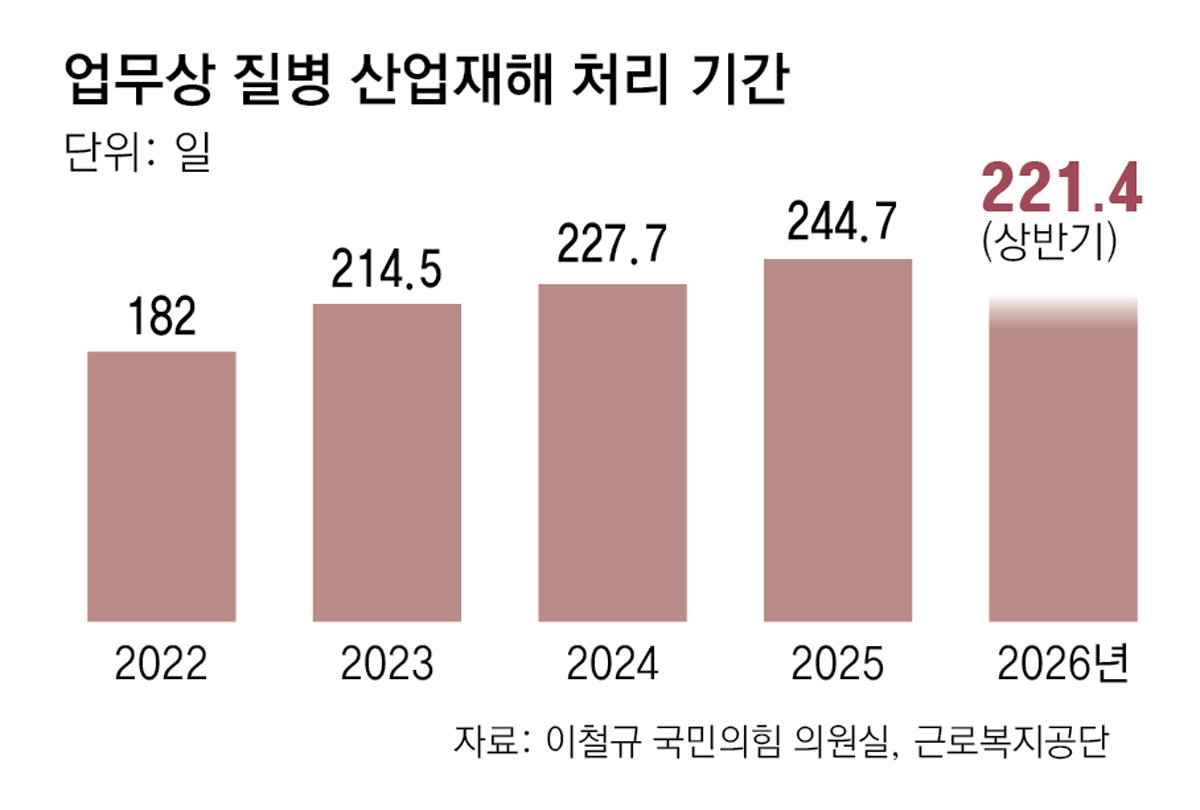
According to data that Representative Lee Cheol-gyu of the People Power Party, a member of the National Assembly’s Climate, Energy, Environment, and Labor Committee, obtained from the Korea Workers’ Compensation and Welfare Service on the 20th, the average processing time for disease-related industrial accident claims in the first half of this year came to 221.4 days. That was 23.3 days shorter than last year’s 244.7 days but 61.4 days longer than the government’s target of 160 days for this year.
In September last year, the Ministry of Employment and Labor announced that it would cut the processing time for disease-related claims, which usually took about six to seven months, to 160 days this year and then to 120 days next year. This followed the proposal by the presidential State Affairs Planning Committee to make “shortening disease-related claim processing” a fast-track task.
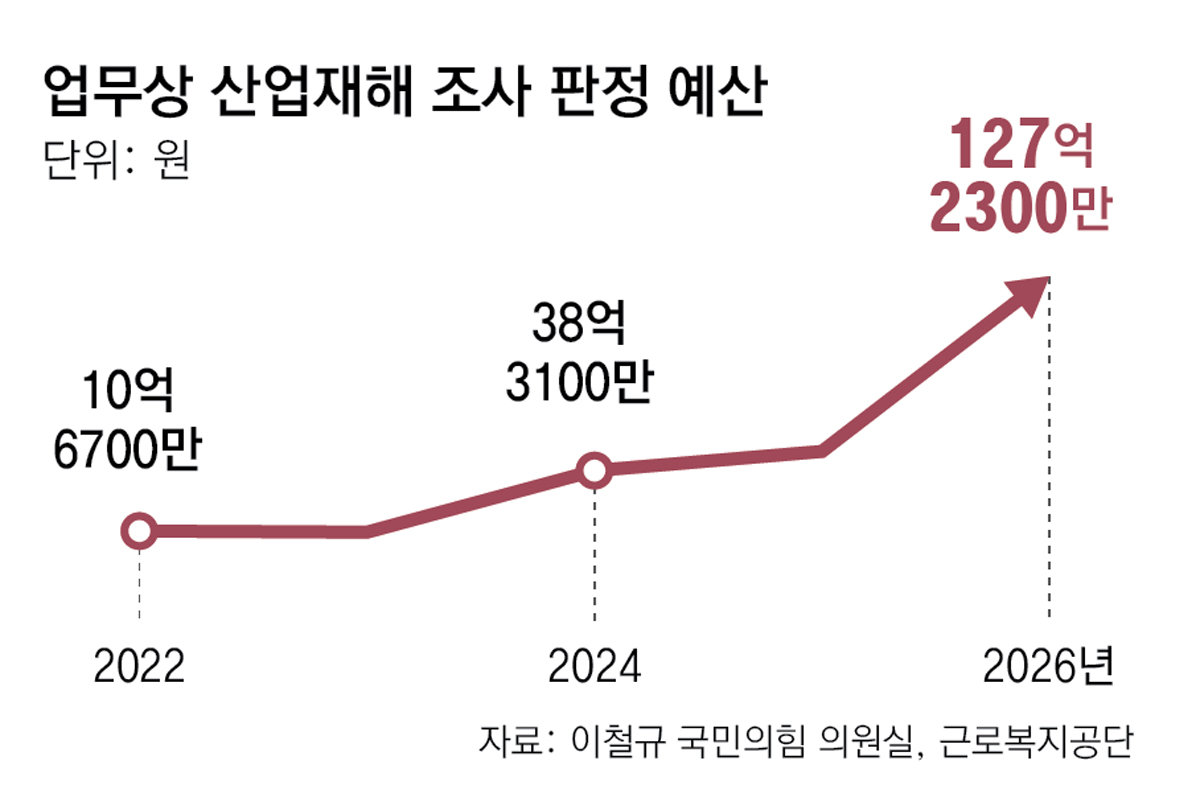
The budget for “occupational accident investigation and adjudication” was also raised from 4.709 billion won last year to 12.723 billion won this year, and the related staff was expanded from 968 to 1,079 over the same period. Yet the processing time for disease claims still falls far short of the government’s target.
Cases of long delays also continue. A worker who filed an industrial accident claim in November 2022, saying they had developed occupational cancer from exposure to metal dust, asbestos powder, aromatic hydrocarbons, and other substances, was recognized as having an occupational disease only this June, some three years and seven months later. The longer processing takes, the more workers are unable to receive industrial accident insurance’s medical care and temporary disability benefits in time, leaving them no choice but to shoulder the burden of treatment costs and living expenses.
● “Classify cases by type and set processing standards”
The difficulty of shortening disease-claim processing owes much to the surge in applications itself. The number of occupational disease claims processed by the Korea Workers’ Compensation and Welfare Service roughly tripled in five years, from 18,634 in 2020 to 50,946 last year. Yet the Service’s guidelines set no processing deadlines for each stage of investigation.
On top of this, disease claims take a long time because they require investigating the work environment and the history of exposure to hazardous substances and, where necessary, going through special examinations by medical institutions and epidemiological investigations by research institutes. In the first half of this year, the processing time for accident-related claims was just 18.4 days.
Seon Jeong-yeon, head of the Legal Support Headquarters of the Federation of Korean Trade Unions (and a certified labor attorney), said,
“Even when we request materials on the work environment, employers often delay,”
and that “the deadline for employers to submit materials should be shortened, and cases requiring epidemiological investigation should be classified from the filing stage to make the investigation procedure more efficient.”
Yun Suk-myung, Research Fellow Emeritus at the Korea Institute for Health and Social Affairs, said, “If the procedure requiring injured workers to prove work-relatedness and submit materials themselves is left as it is, it will be difficult to drastically reduce processing times.”
However, the business community also points out that across-the-board reductions in processing times could increase the burden on employers.
Representative Lee said, “Effective institutional improvements are needed, such as establishing processing standards for each type of case and strengthening the management of cases under prolonged review.”
https://faq.donga.com/NEWS/Society/article/all/20260921/134706439/2