
(KBS TV News) Views on the National Pension Income Replacement Rate “Sharply Divided” (May 6, 2015)
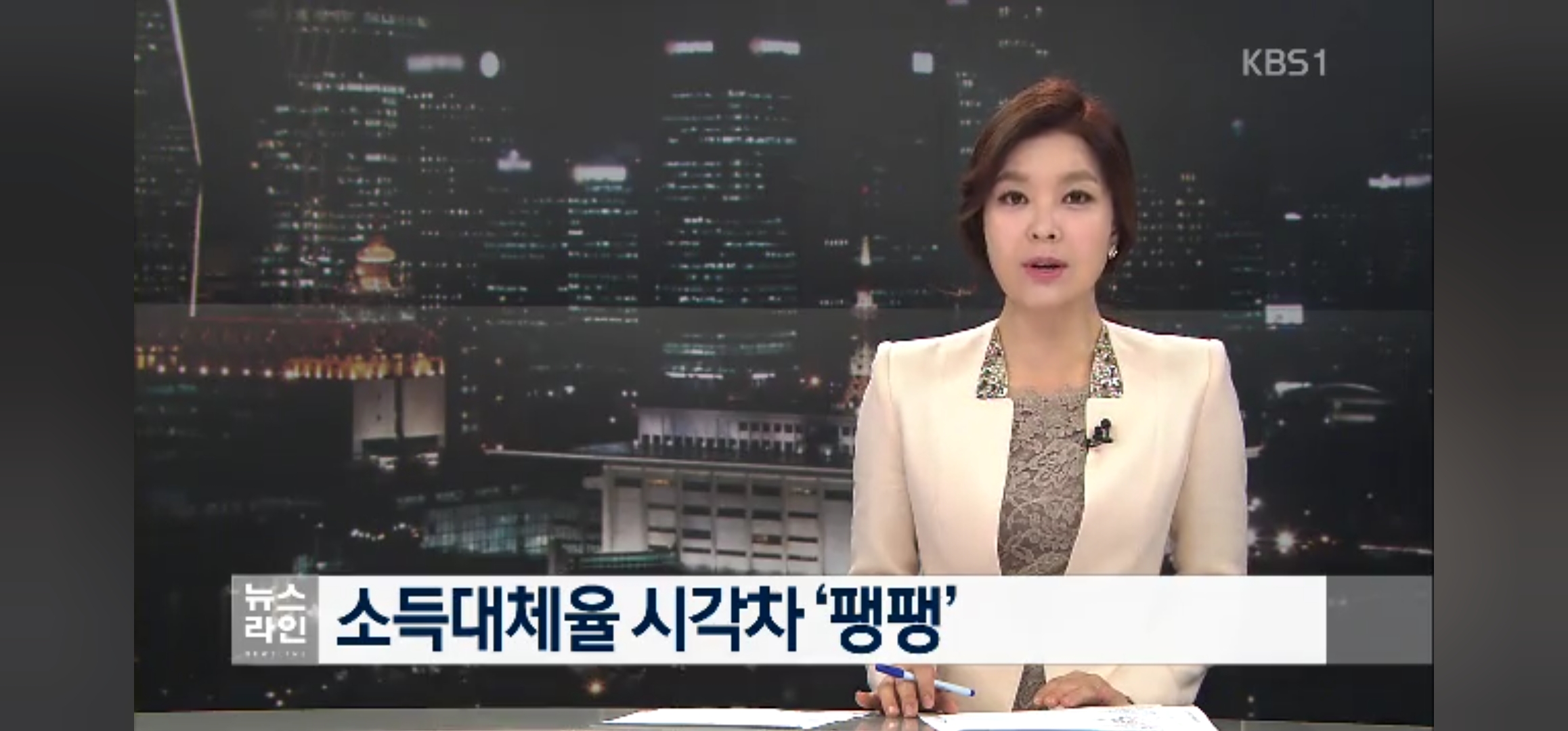
Anchor
A heated dispute is under way over raising the income replacement rate again to lift the level of old-age security that the National Pension provides.
Above all, the question is how much more in contributions would have to be paid if the income replacement rate were raised to 50%...
Here, the government and the opposition do their sums differently.
Reporter Kim Se-jeong explains why this difference has arisen.
The government and the opposition both base their explanations of the added contribution burden on the 2013 long-term financial projection of the National Pension.
The difference lies in when they take the pension fund to be depleted.
The opposition, which says contributions need rise only 1 percentage point more if the income replacement rate is raised to 50%, set the depletion point at 2060, 45 years from now.
The government, by contrast, which says they must nearly double, emphasizes the sustainability of the pension and pushed the horizon back to 2100.
The government stresses that the entry into a super-aged society and the burden on the children’s generation must be given priority.
Its judgment is that even if the income replacement rate is left at 40%, keeping the pension going until 2100 would require the contribution rate to rise to 15%.
<Interview> Yun Suk-myung (Research Fellow, Korea Institute for Health and Social Affairs):
“The contribution rate has been held at 9%, but the contributions that should be raised as soon as possible are not being raised. To that extent, the sources of the National Pension’s fiscal instability are getting worse.”
The opposition, however, argues that resolving severe elderly poverty requires focusing on old-age income security rather than on future fiscal stability.
<Interview> Kim Yeon-myeong (Professor, School of Social Welfare, Chung-Ang University):
“A social body should debate whether to leave the 2060 fund depletion point as it is or to make a softer landing, and disclose this to the public so that they can choose...”
There is also analysis that raising the National Pension income replacement rate would add to the burden on the self-employed and others who pay the whole contribution themselves, unlike employees, who split it half and half with their companies.
Since the sensitive issue of raising contributions is deepening distrust of the pension, the first step must be to reach agreement, through a social body, on a National Pension model that future generations can accept.
This has been Kim Se-jeong, KBS News.
Attachments
- Screenshot_20261115_011035_Samsung Browser.jpg(475.1 KB)ViewDownload
- Screenshot_20261115_011128_Samsung Browser.jpg(719.2 KB)ViewDownload
- Screenshot_20261115_011752_Samsung Browser.jpg(817.6 KB)ViewDownload
- Screenshot_20261115_011150_Samsung Browser.jpg(760.2 KB)ViewDownload
- Screenshot_20261115_011157_Samsung Browser.jpg(606.7 KB)ViewDownload
- Screenshot_20261115_011203_Samsung Browser.jpg(703.9 KB)ViewDownload
- Screenshot_20261115_011209_Samsung Browser.jpg(631.3 KB)ViewDownload
- Screenshot_20261115_011221_Samsung Browser.jpg(784.3 KB)ViewDownload


