
(Chosun Ilbo) Recipients of 2 Million Won or More Triple in a Single Month as the National Pension Undergoes Upheaval — More High-Pension Recipients, Fewer Voluntary Contributors [King Ant Lab] (October 6, 2024)
“They say the National Pension lost 80 trillion won last year through poor fund management. And yet it is spending nearly 2 trillion won more from the fund to raise pensions by 5%? That is truly absurd. Shouldn’t the way pensions are paid be fixed?” (Office worker A, in their 30s)
“By the time we people in our 30s get our pensions, the fund will already be depleted, or they will tell us to start receiving them at 80 because this is the age of living to 100. I am a lost cause anyway, so I hope my parents live long, to 100, and collect my share as well.” (Office worker B, in their 30s)
Signs of upheaval are appearing in the National Pension, already a scheme beset by severe intergenerational conflict. The number of older people drawing pensions is rising rapidly, while the number of people newly joining the scheme has begun to fall. The latest pension statistics reflect this shift exactly.
Experts warn that if Korea, at a critical inflection point like the present one, persists with stopgap measures instead of reform, a tsunami of pension bombs is a foregone conclusion.
Yun Suk-myung, Research Fellow at the Korea Institute for Health and Social Affairs, said,
“Korea’s situation is far worse than that of France, which recently carried out pension reform, and yet Korea is gripped by an extreme optimism that ‘it will all work out somehow,’”
adding, “Discussion of pension reform to stop the deterioration of pension finances driven by low fertility and population aging has at least begun, but it is going off course because everyone is watching how others will react.”
What is happening in the National Pension right now?
1️⃣ Recipients of high pensions in the 2 million won range triple in one month
The National Pension Service analyzes and publishes the status of pension beneficiaries every month. The most recent release, the National Pension statistics for January 2023, is drawing more attention than ever.
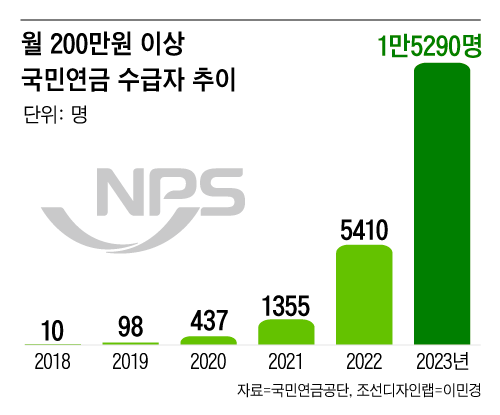
That is because the number of high-pension recipients surged within a single month. As of January, 15,290 people were receiving 2 million won or more a month from the National Pension, triple the figure for the month just before, December 2022 (5,410 people).
The first cause is that the retirement of the baby boom generation is now in full swing. Kim Dong-yeop, Managing Director of the Mirae Asset Investment and Retirement Center, said, “The baby boomers, whose retirement has recently gotten into full swing, were already economically active in 1988, when the National Pension was introduced, so the periods over which they paid contributions are quite long,” adding, “Many of them have paid contributions since the early years, when the income replacement rate was as high as 70%, so they can receive relatively large pensions.”
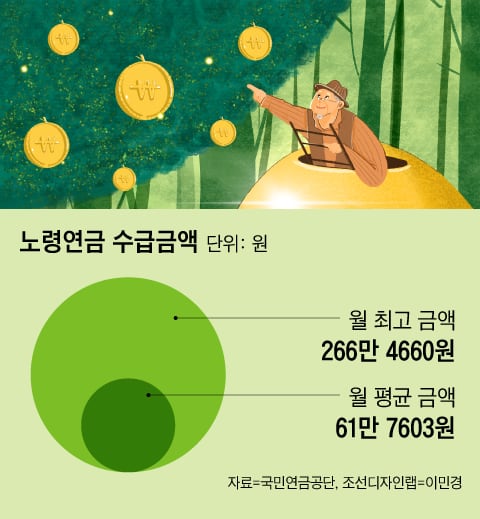
The average National Pension benefit of long-term contributors with 20 years or more of coverage reached 1.03 million won a month, exceeding 1 million won for the first time ever. Under the National Pension, the longer the contribution period, the larger the benefit.
The highest monthly National Pension benefit also exceeded 2.66 million won, setting a new all-time record. Since this year’s minimum wage for 209 hours of work a month is about 2.01 million won, 2.66 million won is a considerable sum.
The second cause is prices.
Managing Director Kim Dong-yeop said,
“Korea’s National Pension adjusts benefit amounts to reflect the inflation rate, and because prices rose sharply last year, benefits rose across the board by 5.1% this year,”
adding, “The beneficiary receiving 2.66 million won a month appears to have deferred the start of their pension by five years, increasing the amount received by a total of 36% (an increase of 7.2% a year).”
Price indexation is the greatest strength of the National Pension, but in a country like Korea, where population aging and low fertility are severe, it can also become a poison (毒). Neighboring Japan, too, at first paid pensions fully indexed to price increases, as we do. But in 2004, the Koizumi government carried out pension reform to reduce the burden on future generations. The system introduced at that time is the “macroeconomic slide.” Its core is that pension amounts are cut in line with falling incomes of the working generation and rising life expectancy. Japan will raise public pension benefits by 1.9% starting next month, but that falls well short of the inflation rate (2.5%).
2️⃣ “Paying health insurance contributions only to lose the Basic Pension”: voluntary enrollment declines
Even if the number of people receiving high pensions surges, it would not be a major problem if more people were paying contributions. The reality, however, is that contribution revenue is shrinking.
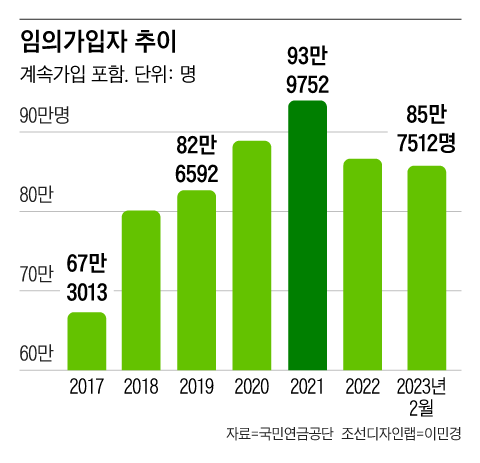
A prime example is the decline in so-called voluntary contributors (including voluntary continued contributors), who join of their own accord. Unlike employees and the self-employed, voluntary contributors are people who join even though the law does not compel them to (homemakers, students, and so on). As word spread that “the National Pension is the best way to prepare for old age,” the number of voluntary contributors rose steadily through 2021.
Since last fall, however, the number of new enrollees has dropped sharply, and it has struggled to recover this year. The number of voluntary contributors, which exceeded 930,000 as recently as 2021, fell to around 860,000 at the end of last year, and in January this year it fell by another 8,800 from the previous month to 857,512.
Experts cite health insurance contributions as the biggest reason voluntary enrollment has turned downward. The health insurance contribution system changed last September: anyone receiving 20 million won or more a year from the National Pension loses dependent status. Those who lose dependent status are switched to regional subscribers, in which case property such as housing is combined with all kinds of income, and they may have to pay health insurance contributions of several hundred thousand won. From the standpoint of someone who joined voluntarily despite hard circumstances to help with old age, it is understandable to complain, “Did I join the pension just to have the health insurance system suck me dry?”
The possibility of being disadvantaged in the Basic Pension is another obstacle to voluntary National Pension enrollment. Ms. Lee, a homemaker in her 40s, said, “Everyone around me is reluctant (to enroll voluntarily) because they heard the Basic Pension can be cut if you receive the National Pension,” adding, “I can get up to 400,000 won from the Basic Pension, and it will probably go up by 100,000 won at every election from now on, so I do not think I need to pay my own money to join the National Pension.”
The Basic Pension goes to older people aged 65 or over in the bottom 70% of the income distribution, and more than 6.1 million older people currently receive it. This year’s benefit is 323,180 won a month, but it is scheduled to rise to 400,000 won. A couple receiving it together gets 640,000 won a month (with a 20% reduction for couples).
However, even someone eligible for the Basic Pension may not receive the full amount if they receive the National Pension. That is because if the National Pension benefit exceeds 150% of the Basic Pension, the Basic Pension benefit is cut by up to 50%. This year’s threshold is 482,925 won a month for a single-person household; anyone receiving more than this from the National Pension sees their Basic Pension reduced.
3️⃣ “Better to collect early than pay health insurance contributions”: early claimants surge
The core of France’s pension reform this year was to raise the retirement age and, at the same time, push the pension eligibility age back from 62 to 64.
For a government worried about deteriorating pension finances, the later it pays out money (pensions), the better.
Japan’s extension last April of the eligibility age from the previous 70 to as late as 75 follows the same logic.
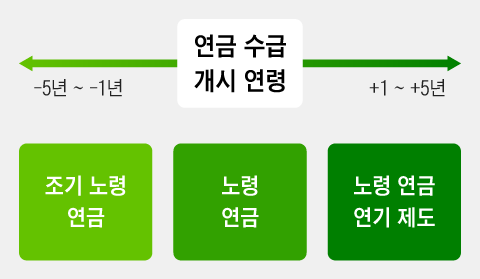
In Korea, however, the trend among older people is not to defer receiving their pensions but, on the contrary, to bring them forward. The National Pension can be claimed up to five years before the normal starting point (the early pension), but in exchange the benefit is cut by up to 30%. Although the loss is large compared with claiming at the normal time, an ironic situation is unfolding in which it is all the more popular precisely because the benefit is cut.
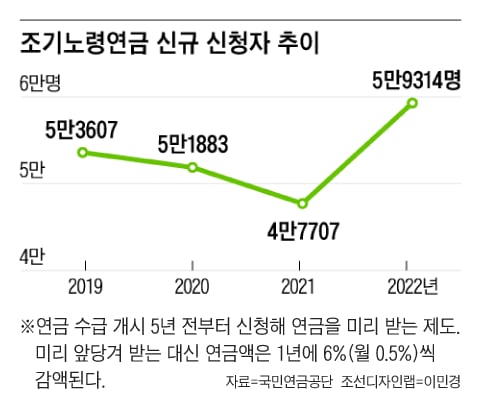
According to the National Pension Service on the 8th, new applicants for the early pension, which had declined every year through 2021, instead surged to 59,314 in 2022. That is an increase of 11,607 over a year earlier.
A National Pension official said, “Some people say they will apply for the early pension even though they know it is a loss, in order to keep their dependent status for health insurance (receiving 1.66 million won or less a month),” adding, “But because National Pension benefits rise every year by the inflation rate, even if they keep their dependent status now, they may lose it a few years later, so the effect may not be large.”
Yun Suk-myung, Research Fellow at the Korea Institute for Health and Social Affairs, said,
“As the saying goes, where there is income there is tax: pension beneficiaries in advanced countries pay not only income tax on their pensions but also health insurance contributions and long-term care insurance contributions, all of them,”
adding, “Applying for the early pension to save on health insurance contributions is a wrong decision, and people are likely to regret it later.”
https://www.chosun.com/economy/economy_general/2023/05/08/CITJNAEZ7ZG4NFX4UPUX3ICMEI/


