(Nocut News) “600,000 Won a Month” in Hand — Why “Extension” Matters More Than “Pensions” (November 9, 2023)
[Retirement Age Extension Report ④]
Postponed over fears of an “income gap”…
but raising the pension eligibility age is unavoidable
Agreement on “matching the pension age and the retirement age,” but…
labor and the government are far apart on solutions
Labor: “Pensions alone cannot sustain old age…
guarantee adequate income by raising the retirement age to 65”
Korea became an aged society this year, and in 2026, just eight years from now, it is set to become a super-aged society in which 20% of the population is 65 or older.
Yet the pension eligibility age is being raised in stages and will be pushed back to 65 by 2033, raising concerns about an abrupt loss of income for older people.
Legal and institutional support is therefore needed so that employment can be extended in preparation for a super-aged society.”
The challenge posed by the National Assembly Research Service’s 2018 report, “Legislative Impact Analysis of Mandating a Retirement Age of 60 or Older,” remains valid five years on.
In the meantime, the entry into a super-aged society, in which “one in five” people is 65 or older, has moved a year closer (now expected in 2025), and the “era of 10 million older people” next year is just around the corner.
Getting by on “600,000 won a month”? — Older people who work of their own accord
According to Statistics Korea, as of 2021, 7,768,000 older people received at least one pension, public or private, amounting to 90.1% of the population aged 65 or older. That the take-up rate has risen every year is encouraging, but the money they actually take home averages only about 600,000 won a month.
Unless one belongs to the few high earners for whom a pension can be dismissed as “pocket money,” no one would be satisfied with an amount that falls short of even half the minimum living cost in old age (1,243,000 won, according to the National Pension Research Institute).
In fact, 50% of older people now receiving a pension (about 3.9 million) were found to be working.
This is not unrelated to the reality of Korea, which ranks an overwhelming first in Organisation for Economic Co-operation and Development (OECD) statistics with an elderly relative poverty rate (the share of people below 50% of median income) of 40.4%. More than two in three older pensioners (61.6%, about 4.79 million) want a job, and earning a living (31.9%, about 2.48 million) is their main reason.
Joo Myeong-ryong, President of the Korea Association of Retired Persons,
asked at a Pension Future Forum seminar on the 7th, “In this aging society, the way for us to survive now is ‘learn and earn’: we have to live by learning and earning,” and “How are we going to feed the 800 to 900 retirees pouring out every day?”
He added, “Admirably, Korea’s older people say (of their own accord) that they ‘will work.’ (Then) all you have to do is create jobs for them,” and said, “How long will the government go on acting as the biggest employer of older people?”
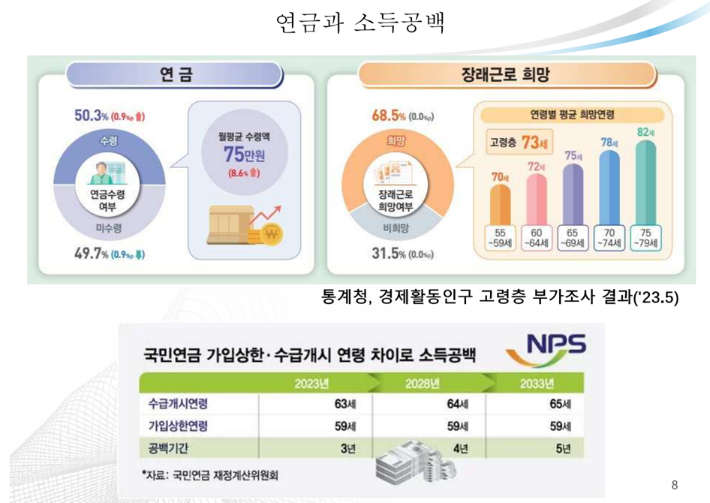
Part of the presentation material by Standing Commissioner Kim Deok-ho of the Economic, Social and Labor Council. Courtesy of the Pension Future Forum
Pointing to the public-interest activity jobs offered to Basic Pension recipients aged 65 and older, Joo asked, “Do they really still have to do work that pays 270,000 won (a month)?” and “It truly brings me to tears to see our older people lining up for it,” he lamented.
In an era when “life begins at 60” is a common saying, people in their 60s are clearly different from those of the past. As the generation with longer life expectancy, better health and more financial means than the one before it — the “baby boomer generation” (born 1955–1963) — enters old age in earnest in the 2020s, demand for work is bound to surge even further.
The retirement age: the age at which workers must leave their jobs, regardless of the wishes of labor or management. This is the background against which, seven years after the “retirement age of 60” took effect, the debate over extending the retirement age has reignited. The trigger is pension reform, which President Yoon Suk-yeol has called one of his “three major reforms.”
Postponed over fears of an “income gap”…
but raising the pension eligibility age is unavoidable
Ultra-low fertility, with a “total fertility rate of 0.78,” and rapid aging threaten the sustainability of pensions. With the working-age population that pays contributions shrinking while only the population drawing benefits grows, a heavier support burden on the younger generation is a foregone conclusion.
Having confirmed in the 5th financial projection early this year that the pension finances will turn to deficit sooner (2042 → 2041 expected) and that the fund will be depleted sooner (2057 → 2055 expected), the government pulled out “raising the eligibility age” as a reform card.
With the age already scheduled to rise from 63 this year to 65 by 2033, it judged that further adjustment was needed. The report of the Financial Estimation Committee, which served as the blueprint for the draft Comprehensive National Pension Operation Plan released at the end of last month, had proposed options pushing the eligibility age back to 66, 67 and 68, respectively.
The proposal is to delay it by a further year every five years after it reaches 65 on the current timeline, so that pensions start at 68 in 2048. It rests on the calculation that raising contributions and improving fund investment returns alone cannot achieve fiscal stabilization.
However, these scenarios were not included in the government plan. That is because, with the retirement age left at 60, raising only the eligibility age would raise concerns about an “income crevasse (cliff)” that are too great.
The government deferred a decision, saying, “A further adjustment of the eligibility age will be discussed after conditions for the continued employment of older people have matured, in view of the widening income gap after retirement.” The reasoning is that because adjusting the eligibility age would cut everyone’s benefits across the board, securing older people’s income by expanding continued employment must come first.
Continued employment refers to keeping workers who have reached the retirement age employed, or concluding employment contracts with them on new terms, through reemployment, extending the retirement age, abolishing the retirement age and similar means.
According to a Statistics Korea survey, people aged 55–64 left the job they had held longest at an average age of 49.4 (average tenure of 15 years and 8 months), whereas the cutoff that older people wishing to keep working set for themselves averaged 73. The average age of complete exit from the labor market has also been the highest in the OECD for the past ten years.
The government points out that the employment rate of people aged 65 and older, at 34.1% (as of 2020), is high compared with the OECD average (14.7%), but in reality most of them drift between temporary and daily jobs (36.4%).
In the end, the point is that older people’s economic activity must be raised in every respect, in both quantity and quality.
Labor and government agree on “matching the pension age and the retirement age,” but are far apart on solutions
The government and organized labor agree only on the premise that the age at which people actually leave the workplace and the pension eligibility age should coincide. The former believes continued employment should be achieved through reemployment and other means, while the latter insists on extending the retirement age to 65.
The government had originally planned to present a roadmap for legislating continued employment within the year. Only at the end of July did it set up the “Research Group on Continued Employment in a Super-Aged Society” under the presidential Economic, Social and Labor Council (ESLC), but with organized labor declaring a boycott on the grounds of the administration’s “suppression of unions,” the discussions are being led mainly by experts.
The Continued Employment Research Group stresses that workplaces to which the concept of a retirement age applies are only a minority, such as large companies.
Its basis: as of June last year, 94.3% of businesses with 300 or more employees (2,820 of 2,991) had adopted a retirement-age system, but only 21.9% of those with fewer than 300 (about 340,000 of some 1.56 million) had one. Whether a union exists is also one of the dividing lines.

Standing Commissioner Kim Deok-ho of the ESLC, who chairs the “Research Group on Continued Employment in a Super-Aged Society,” presents on “Current Issues and Points of Contention in Continued Employment” at a Pension Future Forum seminar on the 7th. Reporter Lee Eun-ji
Standing Commissioner Kim Deok-ho of the ESLC, who chairs the Continued Employment Research Group,
said, “Large companies with regular jobs and unions account for about 7.2%. (These) differ enormously from the rest in working conditions, social insurance coverage rates and the like,” and “if the retirement age is extended in this situation, only around 10% of people will end up cheering.”
The point is that the dual structure of the labor market, in which non-regular workers at small and medium-sized firms are the overwhelming majority, must be taken into account.
Since workplaces with a retirement age are mostly the ones people in their 20s and 30s want to work at, it also worries that lengthening working lives could spill over into reduced youth hiring. The Korea Enterprises Federation (KEF) also recently released a report to similar effect.
Research Fellow Yun Suk-myung of the Korea Institute for Health and Social Affairs said,
“Because Korea’s labor-market dualism is the most severe in the OECD, on one side wages are rising and welfare benefits are improving, while on the other people remain stuck at the minimum wage,” and “(right now) raising the retirement age could work not toward social integration but toward social conflict.”
The seniority-based wage system, in which pay rises in proportion to years of service, is also cited as a barrier. Standing Commissioner Kim noted, “In Korea, people earn the most around the time of retirement (regardless of productivity),” and said that, to young people stuck in an “employment ice age,” such a structure looks neither fair nor rational at all.
The country the government is using as its closest model is Japan. The Japanese government, which implemented a retirement age of 60 as early as 1994, made employment to age 65 and beyond mandatory in 2013. It offered employers three options: △abolishing the retirement age, △extending the retirement age to 65, and △introducing a continued-employment system. From April 2021, it also imposed a duty to make efforts to secure employment for those aged 65–70.
“Employment-based measures” in force include extending the retirement age to 70, abolishing the retirement age, and continued employment up to 70. Other measures, such as support for starting a business through outsourcing contracts, are also in place.
Commissioner Kim said, “When people hear ‘continued employment,’ they assume it means extending the retirement age, but in Japan more than 80% use reemployment.”
Research Fellow Yun also recommended “post-retirement reemployment,” in which wages are cut as workers near the upper age limit but about 70% of the monthly salary is guaranteed through government subsidies and the like.

Part of the presentation material by Standing Commissioner Kim Deok-ho of the Economic, Social and Labor Council. Courtesy of the Pension Future Forum
Labor, with its legislative petition past 50,000: “Guarantee adequate income by raising the retirement age to 65”
Organized labor, by contrast, says that with pensions unable to secure old age, the only answer is extending the retirement age.
Launching a national consent petition in August for the “amendment of the Act on Employment of Older Persons and other laws to extend the retirement age in line with the National Pension eligibility age,” the Federation of Korean Trade Unions (FKTU) said, “To ease old-age insecurity caused by the income gap, the statutory retirement age should be raised in stages to 65 by 2033 at the latest .”
It also argued that the practice of moving into low-quality jobs after leaving one’s main job is spreading non-regular work among people in their 60s, and that “delaying retirement by extending the retirement age so that adequate income can be maintained is the best measure to prepare for demographic change.”
The petition has gathered the 50,000 signatures required for referral to a National Assembly standing committee and has gone to the Environment and Labor Committee.
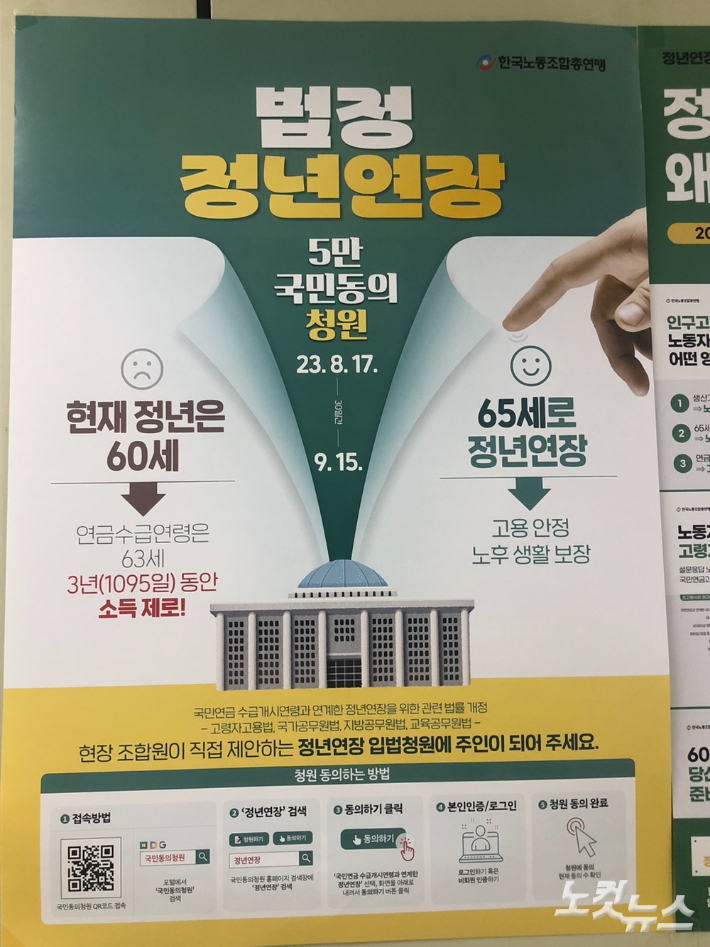
A poster for the “National Consent Petition of 50,000 to Extend the Statutory Retirement Age” hanging in the FKTU office in Yeongdeungpo-gu, Seoul. Reporter Lee Eun-ji
Hwang Seon-ja, Vice President of the FKTU Central Research Institute, who surveyed every FKTU member-union workplace to gather material for a future public debate on extending the retirement age, said, “There are differences by industry, with places short of workers (such as freight and transport) continuing to extend (employment),” but pointed out that “this kind of reemployment is carried out on very poor terms, with wages slashed even though working hours and responsibilities stay the same.”
Hwang went on, “Even now, when you look at people who keep working past 60, there is a ‘stigma effect’: (their work) is said to be encouraged, but it is treated as an exception. They are not seen as regular workers,” and predicted that extending the retirement age to 65 would bring better perceptions of this kind as well as wider reemployment of older people around 60.
FKTU spokesperson Lee Ji-hyun also said, “Because reemployment has no legal safeguards, wages and other working conditions are very likely to drop drastically. Our view is that going the route of extending the retirement age would be better wherever possible.”
There are no plans yet to join the ESLC, the FKTU said. “People say an agreement among labor, management and government is more favorable for legislation, and of course if it were decided through social dialogue, (legislating) would be easier,” Lee said, “but the plan now being discussed at the ESLC is set on reemployment. I see no need to go in (at this point) and lower our demands.”
The FKTU, which recently released a survey showing that about 63% of the public support extending the retirement age, plans to press the National Assembly as hard as it can, aiming for legislation before next year’s general election.

Courtesy of CBS Nocut News and R&Search
In a survey of 1,012 men and women aged 18 and older conducted by R&Search for CBS Nocut News from the 25th to the 27th of last month, 26.4% of respondents said that “a scientific analysis of the expected effects and side effects of extending the retirement age” should be at the core of the debate.
“Agreement within social dialogue bodies such as the ESLC” (18.5%) and “protection measures for occupations without a retirement age, such as workers in special employment and freelancers” (18.2%) were also cited as important points.
In a poll of 1,028 people conducted the same month, 64.6% said they supported extending the retirement age.