
(Yonhap News) Government Employees Pension Taxpayer-Funded Subsidies Estimated to Exceed 10 Trillion Won — Controversy over the Burden on Future Generations (April 28, 2026)
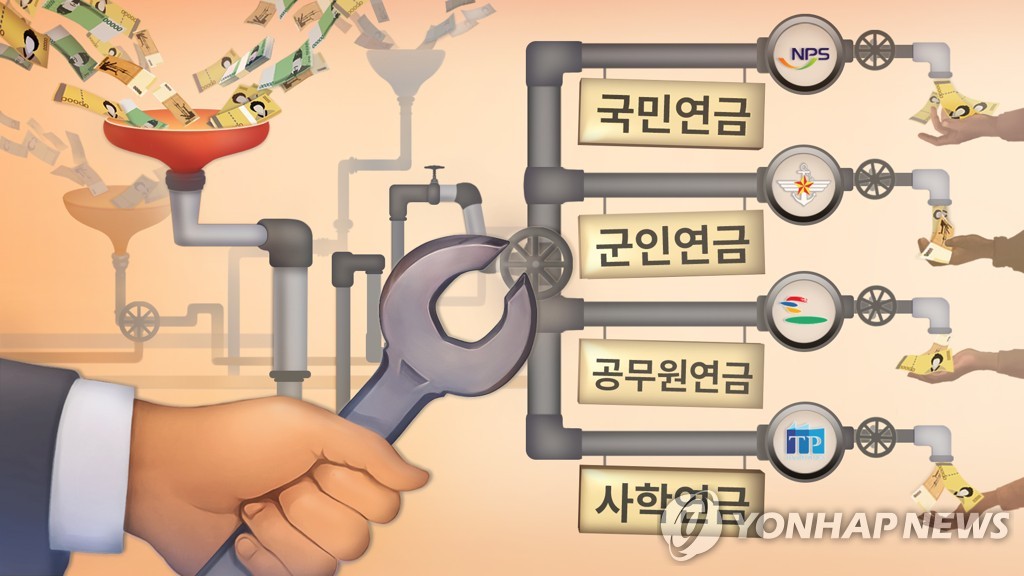
Pension debt surges amid a low-growth quagmire…
Experts:
“Excluding special occupational pension reform is a stopgap measure”
Enlarge image
(Seoul = Yonhap News) Reporter Seo Han-gi =
Public funds injected to cover the Government Employees Pension deficit are estimated to have surpassed 10 trillion won.
With the pensions owed to retired civil servants rising while the money collected falls far short, taxpayer money poured in to cover the difference has surged, and the burden on state finances is growing rapidly.
◇ The era of 10 trillion won deficit subsidies… taxpayer injections surge as the revenue-expenditure gap widens
According to the Pension Future Forum, an assembly of specialists in the pension field, and the relevant government ministries on the 28th, projections based on the 2025 budget figures submitted by the Government Employees Pension Service to the government indicate that the deficit subsidy amount for 2025 is expected to exceed 10 trillion won.
In this context, given the pace at which mandatory expenditures are projected to expand, there are serious concerns that the scale of the Government Employees Pension deficit subsidy will grow in an increasingly uncontrollable manner.
The subsidy amount requested by the Government Employees Pension Service for 2025 stands at 10.0475 trillion won, an increase of 1.4435 trillion won over the 2024 figure of 8.604 trillion won — a rise occurring within a single year.
According to Government Employees Pension Service data, projected revenues for the Government Employees Pension fund in 2025 amounted to 14.8621 trillion won, while projected expenditures approached 24.2432 trillion won, implying a fiscal deficit of approximately 10 trillion won.
In effect, the national and local governments have filled this deficit with the public’s taxes.
The problem is that the outlook is even more serious. Mandatory expenditures, rigid budget items whose size is set by law and which the government cannot cut at will, are increasing rapidly.
According to the National Fiscal Management Plan for 2025 to 2029, mandatory expenditures account for 415.1 trillion won, or 54.3%, of next year’s total expenditures of 764.4 trillion won.
With mandatory expenditures growing faster (6.3% a year on average) than total expenditures (5.5%), their share is projected to expand to 55.0% in 2028 and 55.8% in 2029.
More than half of these mandatory expenditures are statutory welfare spending.
This includes National Basic Livelihood Security benefits, health insurance, the four public pensions, and the Basic Pension. With entry into a super-aged society increasing both the number of beneficiaries and benefit amounts, it is estimated to exceed 200 trillion won next year and reach 237 trillion won in 2029.
◇ Deficit share relative to the size of the economy to more than double… coinciding with falling potential growth
The more acute concern is the burden that must be borne by the national economy.
Experts project that even under the government’s highly optimistic estimates, the ratio of the Government Employees Pension deficit subsidy to gross domestic product (GDP) will more than double between 2025 and 2065.
This implies that the costs of covering the Government Employees Pension deficit are growing twice as fast as the income the whole country earns, placing on future generations a burden that far exceeds what the national economy can absorb.
In this regard, Yun Suk-myung, Research Fellow Emeritus at the Korea Institute for Health and Social Affairs, who leads the Pension Future Forum, expressed strong concern.
Research Fellow Yun
stated bluntly: “Even under the government’s optimistic projections, the deficit ratio is expected to double, yet no one mentions the need to reform the Government Employees Pension and the other special occupational pension schemes. The Republic of Korea today can hardly be regarded as a normal society.”
He characterized the current situation, in which society as a whole maintains silence while offloading a devastating fiscal burden onto future generations, as abnormal.
Budget experts are also raising their voices in concern.
They point out that, with mandatory expenditures that must by law be spent already accounting for more than half of the total budget, the sustainability of state finances is slim without structural reform of the special occupational pension schemes (the Government Employees, Military Personnel and Private School Teachers pension schemes) such as the Government Employees Pension.
The International Monetary Fund (IMF) expects Korea’s pension spending to grow the fastest among the advanced G20 economies over the five years from 2025 to 2030, and the Organisation for Economic Co-operation and Development (OECD) projects that Korea’s potential growth rate will hit a record low of 1.57% in 2027.
It is a dilemma in which the engine of economic growth is cooling while the hole to be filled with taxes grows exponentially.
◇ “Reform that excludes special occupational pensions is a stopgap”… calls for transparent disclosure of information
Despite the gravity of the situation, criticism has emerged that the response from the government and the National Assembly remains complacent.
The Pension Future Forum has criticized the government for failing to properly disclose the reality of a pension scheme that absorbs 10 trillion won in taxpayer money each year.
In the current deliberations of the 22nd National Assembly Special Committee on Pension Reform, reform of the special occupational pension schemes, including the Government Employees Pension, the Private School Teachers Pension, and the Military Pension, has been entirely excluded.
The Pension Future Forum has raised its voice in particular over the Special Committee’s refusal to disclose relevant data, despite the estimated unfunded liability of the Private School Teachers Pension approaching 200 trillion won, characterizing this refusal as a violation of the public’s right to know.
Accordingly, the Pension Future Forum is demanding full and unedited disclosure of the fiscal status of the Government Employees Pension, the Private School Teachers Pension, and the Military Pension through 2096, the 70-year horizon used for the National Pension’s financial assessment.
The Forum’s position is that addressing only the National Pension or the Basic Pension while excluding special occupational pension reform, the primary driver of the surge in mandatory expenditures, amounts to nothing more than a stopgap measure.
In short, citizens who pay their hard-earned taxes have a right to know exactly where and how the 10 trillion won in taxpayer money that drains away every month is spent, and how heavy a burden it will become for future generations.
Experts said that dealing only with the National Pension in the National Assembly’s Special Committee on Pension Reform while ignoring Government Employees Pension reform, the key cause of the explosion in mandatory expenditures, is a sin against future generations,
stressing that discussions on comprehensive reform must begin now, together with transparent disclosure of information.

![(KBS TV. 이슈&뉴스] 공무원 연금, '세금 먹는 하마'?...'사회적 합의' 절실 (2013년 10월 23일)](/_next/image?url=%2Fuploads%2Feditor%2F2026%2F11%2Fcfe4824d207e450c8cad3a7c73e2fb04-Screenshot_20261122_221550_Samsung-Browser.jpg&w=128&q=75)