
(News1) Pension Reform Pledged ‘Within the 21st National Assembly’ Nears Its Deadline — “It Must Be Finished” vs. “It Should Be Postponed” (May 26, 2024)
“Accepting the ruling party’s plan”
Lee Jae-myung reignites the debate…
Government and ruling party favor handling it in the 22nd
Fiscal-stability camp: “It should be discussed in the 22nd”…
Income-security camp, while insisting on the original plan: “It must be finished in the 21st”

On the 24th, a staff member moves through the civil complaints office of the National Pension Service’s Seoul Northern Regional Headquarters in Seodaemun-gu, Seoul. 2024.4.24/News1 ⓒ News1 Reporter Ahn Eun-na
(Sejong = News1) Reporter Jeon Min =
With the 21st National Assembly closing in three days, on the 29th, pension reform, which the ruling and opposition parties had pledged to pass within the 21st National Assembly, is also at a crossroads.
After Democratic Party of Korea leader Lee Jae-myung rekindled the pension reform debate, which had seemed a lost cause, a heated debate is under way in civil society and academia as well.
While the fiscal-stability camp, which focuses on raising the contribution rate, argues that in-depth discussion is needed in the 22nd National Assembly, the income-security camp, which focuses on raising the income replacement rate, is urging that the matter be wrapped up in the 21st National Assembly.
According to political circles and others on the 26th, the ruling and opposition parties are again sparring over pension reform at the very end of the 21st National Assembly.
Earlier, in the public deliberation survey conducted by the Public Deliberation Committee under the National Assembly’s Special Committee on Pension Reform, the 500-member citizen representative group chose the option that raises the National Pension contribution rate (what you pay) from the current 9% to 13% and the income replacement rate (what you receive) from 40% to 50%, an option that puts income security ahead of fiscal stabilization.
However, the Special Committee on Pension Reform, which took up the ball, failed to reach an agreement between the ruling and opposition parties. The parties reached common ground on raising the contribution rate (what you pay) from the current 9% to 13%. But on the contested income replacement rate (what you receive), the Democratic Party of Korea proposed raising it from the current 42.5% to 45%, while the People Power Party held to 43–44%.
After the Special Committee on Pension Reform then officially declared the negotiations broken off, pension reform within the 21st National Assembly seemed to have run aground, but Lee Jae-myung brought it back up for discussion.
On his YouTube broadcast on the 23rd, Lee said, “I will officially announce our position that we will accept your (the government and ruling party’s) plan, so let us pass pension reform in the 21st National Assembly. I hope the ruling party will cooperate.”
The previous day (the 25th), Lee also held a press conference,
saying, “We cannot let the pension reform pursued so far collapse over 1%,” and “We will fully accept the 44% income replacement rate proposed by the ruling party.”
Nevertheless, the prevailing outlook is still that passage before the 21st National Assembly closes will be difficult.
The People Power Party rejected Lee’s acceptance of the ruling party’s plan, calling it “a media stunt” and “a distortion of the facts and of the essence.”
The People Power Party says that it does not fit the purpose of pension reform, which is fiscal stabilization; it balks at raising the income replacement rate at all and insists that reform be made a core task of the 22nd National Assembly.
The presidential office, too, after Lee’s press conference, put the weight on handling it in the 22nd National Assembly, saying, “The point is that rather than the ruling and opposition parties deciding hastily as if pressed for time, the decision should fully reflect the views of the public as a whole, and especially of the younger generation.”
Minister of Health and Welfare Cho Kyu-hong also said at a recent press briefing, “It would be desirable to discuss it in the 22nd National Assembly after sufficient discussion and a social consensus.”

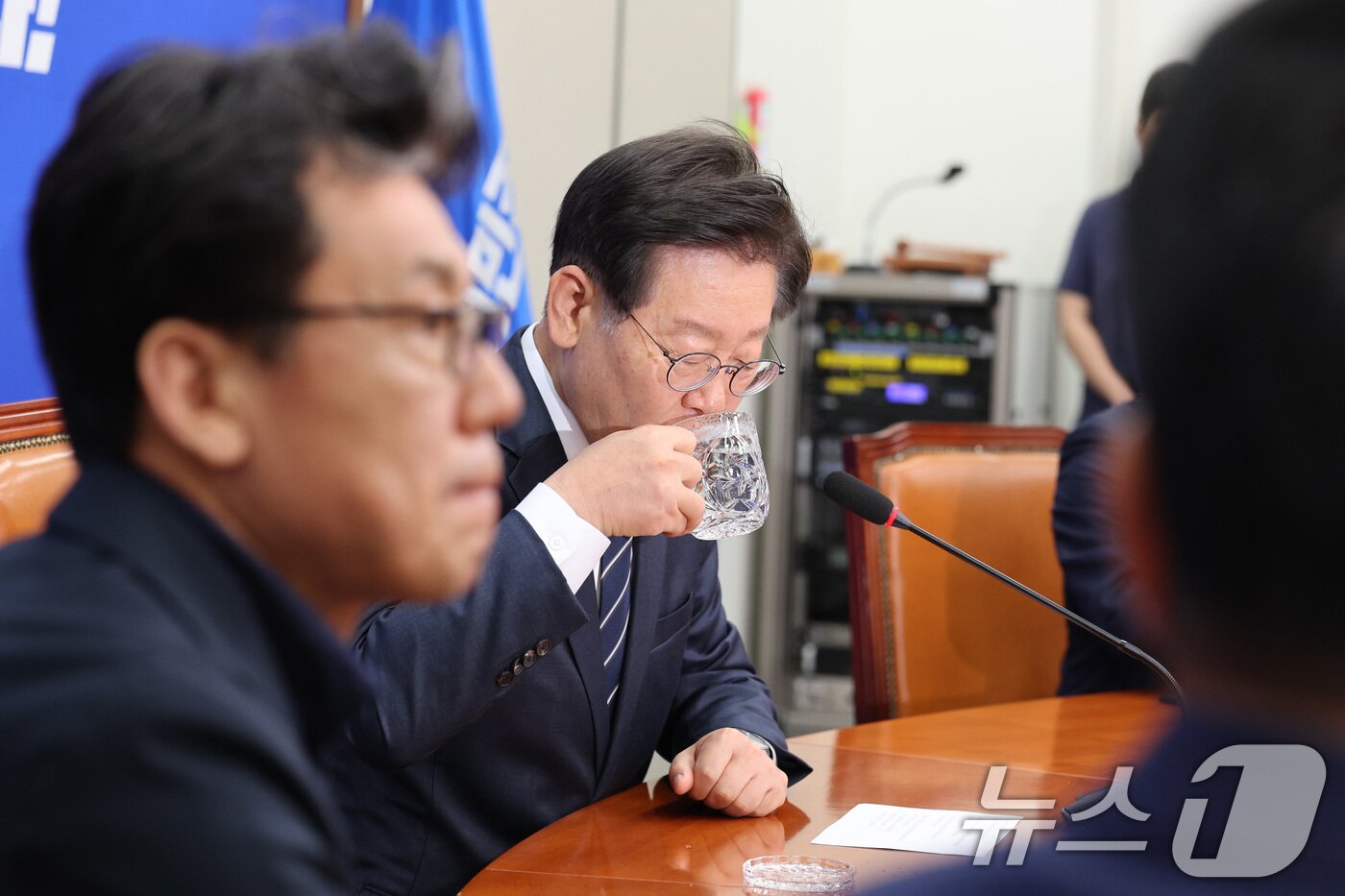
Lee Jae-myung, leader of the Democratic Party of Korea, takes a drink of water at a press conference on pension reform at the National Assembly in Yeouido, Seoul, on the afternoon of the 25th. At the press conference that day, Lee said, “We will fully accept the 44% income replacement rate proposed by the ruling party.” 2024.5.25/News1 ⓒ News1 Reporter Shin Woong-soo
As the political world rekindled the debate, a heated debate over pension reform broke out again in the private sector as well, including civil society and academia.
The view that a new plan should be discussed again in the 22nd National Assembly comes mainly from the fiscal-stability camp.
Yun Suk-myung, Research Fellow Emeritus at the Korea Institute for Health and Social Affairs and a fiscal-stability advocate, told News1,
stressing that the purpose for which pension reform discussions began is the survival of the system through fiscal stabilization: “If the income replacement rate is raised by even a single percentage point, that is not reform but deterioration.”
Research Fellow Yun argued that because the Public Deliberation Committee’s discussions took place on the basis of biased materials provided by the income-security camp, a new forum for discussion must be set up in the 22nd National Assembly.
Oh Gun-ho, Chair of the Policy Committee of Welfare State I Make, also said,
“The ruling and opposition parties have agreed on a 4-percentage-point increase to a 13% contribution rate, but measures to strengthen benefit adequacy, including raising the income replacement rate, need further review, so it is necessary to take more time rather than to handle it in a rush.”
“What is worrying, though, is that it could be pushed back indefinitely yet again,” Chair Oh stressed. “If the government and ruling party are not going to reach an agreement, the government must submit a reform plan when the 22nd National Assembly opens and show the will to wrap up reform within this year.”
On the other hand, voices are also emerging even within the fiscal-stability camp that reform should be wrapped up within the 21st National Assembly at an income replacement rate of around 44%.
Within the income-security camp, opinions are divided between those who say the existing Public Deliberation Committee plan must be held to and those who argue for passing something first.
In a phone call, Oh Jong-heon, Secretary General of the Public Pension Strengthening People’s Action (Pension Action), which includes the two major labor confederations and civic groups, said, “Within Pension Action, the view is that the two parties are engaged in a wasteful debate over content far removed from the demands of labor and civil society or of the Public Deliberation Committee’s citizen representative group,” adding, “There is much criticism over whether it is appropriate to ignore the citizens’ judgment and act as if it were a bargaining session.”
Even so, Secretary General Oh argued for passage within the 21st National Assembly, saying, “Pension reform cannot be a perfect reform that satisfies everyone at once. If pension reform cannot be done even under such favorable conditions, it will be impossible in the future too,” and “Once the 22nd National Assembly is launched and we move into the local elections and the presidential election, it could become realistically even harder.”


