(Keimyung University Newspaper, Contributed Article by Committee Member Yun Suk-myung) Special Feature on Social Issues: “National Pension Reform” (April 5, 2023)
(Pension Future Forum comment:
This is a contributed article by Research Fellow Yun Suk-myung,
written as a “National Pension feature for university students”
for the Keimyung University Newspaper,
with the aim of helping university students,
who are key stakeholders in pension reform,
properly understand the pension reform debate.)
National Pension Reform: Why Is It Urgent?
“Twenty-five years of frozen contributions and more have deepened the National Pension’s fiscal instability;
Korea must respond by drawing on other countries’ experience”
▲ ⓒYonhap News
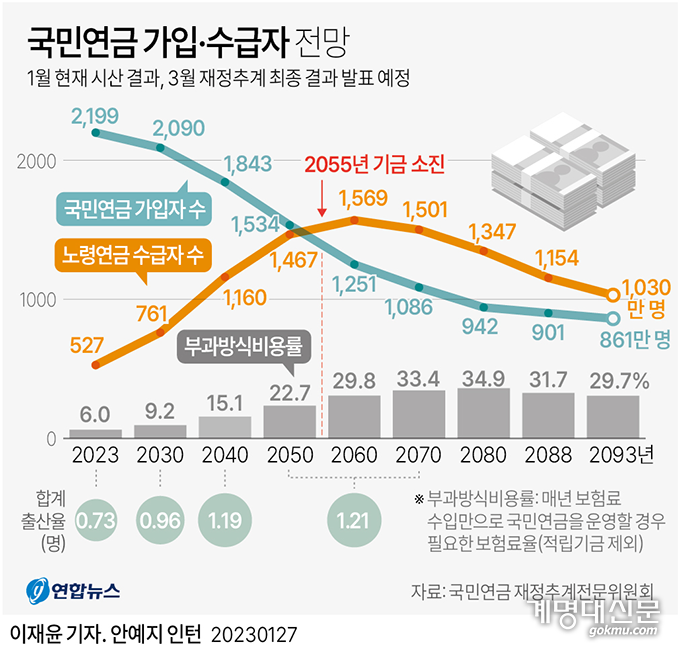
According to the preliminary results of the 5th National Pension Financial Projection released at the end of January, the National Pension fund is projected to be depleted in 2055. The depletion date has moved two years earlier than five years ago. By the time university students now in their mid-20s reach their mid-50s, the fund will be depleted. This projection describes what could happen if no measures are taken until 2055. Fiscal stabilization measures of some kind will surely be taken in the future, including in the 2023 5th National Pension Financial Projection. The future of our National Pension and the old age of today’s university students can be said to depend on how strong those fiscal stabilization measures are and how quickly they are taken. Even in this desperate situation, experts remain sharply divided on the need for and urgency of fiscal stabilization.
● What is the National Pension financial projection system?
Having taken part in every National Pension Financial Projection from the 1st in 2003 to the 5th in 2023, I am regarded as Korea’s leading advocate of fiscal stabilization. That is because, as the secretary member of the 1st financial projection in 2003, I coordinated the setting of a 70-year financial evaluation period and of the fiscal stabilization benchmark: that even at the end of the year 70 years later, that is, in 2073 counting from 2003, at least two years’ worth of pension payments must be secured. The point to understand properly here is that the target date for fiscal stabilization is not fixed; rather, fiscal stabilization efforts must continue in five-year cycles so that this principle is upheld. Taking the 2023 5th National Pension Financial Projection as an example, achieving the fiscal stabilization target set in 2003 means securing at least two years’ worth of pension payments even at the end of 2093, 70 years after 2023. Although a 70-year period was set, meeting the fiscal stabilization target every five years makes it possible to secure two years’ worth of pension payments even 70 years from each of those points, which can ease the worries of the younger generation and university students about fund depletion. The financial projection system can be seen as having been introduced so that the National Pension is run in a way that lets every generation join it without worrying about the fund running out.
The National Pension financial projection system, with its many advantages, did not exist when the National Pension was introduced in 1988. Korea introduced its National Pension very late compared with the major OECD member countries. After the Industrial Revolution, most advanced countries introduced public pensions as the means of converting the traditional private system of supporting older people, that is, support within the family, into a public system run by the state. Having run their schemes over a long period, these advanced countries developed them by gradually raising benefit levels over time. In this process of development, the 1960s were the period when pension benefits in the advanced Western countries were at their highest. After World War II, rapid economic growth during postwar reconstruction and high fertility, symbolized by the baby boom generation, made it possible to run pay-as-you-go pension schemes in which people could pay little and receive a lot. The number of older people receiving pensions was small, while high growth was accompanied by a very high birth rate, so the future looked entirely rosy.
After the worldwide recession that followed the two oil shocks,
the major advanced countries, in order to respond quickly, changed the basic framework
of how they ran their schemes in the direction of cutting pension benefit rates.
● The beginning of the National Pension crisis and its causes
It was in the 1970s that this rosy outlook was brought to a halt, when the whole world went through a severe recession in the wake of the two oil shocks. To respond quickly to this change in circumstances, the major advanced countries changed the basic framework of how they ran their schemes in the direction of cutting pension benefit rates. Led by Sweden’s 1999 pension reform, Germany and Japan, from which Korea learned its pension system, also introduced automatic adjustment mechanisms for pension finances in 2004. They linked their pension systems automatically to changes in economic and social conditions; in other words, they changed them so that the sustainability of the pension system is secured automatically, with political judgment excluded. Today, 70% of OECD member countries have introduced such automatic adjustment mechanisms. In return, governments thoroughly protect, with tax revenue, the old age of low earners harmed by these measures.
The problem is that Korea introduced its National Pension by imitating the pension systems of the era when Western societies paid their highest benefits. Korea’s National Pension, introduced in 1988, was originally designed to be introduced in 1974. Its introduction was merely postponed to 1988 because of the oil shock. Although the National Pension was introduced with a 70% income replacement rate, the highest level even among advanced countries, the contribution rate started at a very low 3%. A scheme that should have collected a contribution rate of at least around 20% started at 3%. Even under these circumstances, after contributions were raised to 9%, they have not been raised by even a single percentage point in the past 25 years, so the National Pension’s fiscal instability is deepening.
● Rather than irresponsible claims, we must grasp the current state and international trends
It is not that there have been no efforts to stabilize the National Pension’s finances. Sensing the change in circumstances just ten years after the scheme was introduced and judging that an overhaul was needed, Korea cut the income replacement rate by 10 percentage points, from 70% to 60%, in 1998. In 2007 it carried out a preemptive pension reform that cut the 60% income replacement rate to 40% by 2028. Up to that point, Korea had taken fiscal stabilization measures it could boast of to other countries. After the 2007 reform, however, the pension system came to be abused as a means of winning votes in elections, and discussion of National Pension reform disappeared. And although fiscal stabilization measures were urgent because of the plunging birth rate, rising life expectancy, and slowing growth, the 4th financial projection in 2018 floated measures bordering on populism.
At the time, some proposed fiscal stabilization measures based on a 30-year financial evaluation period instead of the 70-year period adopted since the 1st projection in 2003. According to the 2018 4th National Pension Financial Projection, the fund would be depleted in 2057. With a 30-year evaluation period counted from 2018, the period would end in 2048. They argued that since the fund would not be depleted by 2048, pensions could be raised in exchange for a slight increase in contributions. The fiscal stabilization plan containing this argument is precisely “Plan (A)” in the 4th National Pension Financial Projection. Even now, as the 2023 5th financial projection is under way, the argument that postponing the depletion date by a few years counts as a fiscal stabilization measure, and that the pension benefit rate can therefore be raised further, still continues. But this amounts to heading in the exact opposite direction from international trends in pension reform.
As a result, Korea missed the golden opportunity for pension reform, and to achieve the same level of fiscal stabilization, it now has to raise contributions by a further 2 percentage points. With the worsening population structure, the pay-as-you-go contribution rate will rise to around 30% in 2060, five years after the fund’s depletion in 2055, and to 34% in 2080. Even so, the claim that pensions can be raised in the name of strengthening public pensions continues. This deceives the majority of the public, who do not understand well how public pensions, which by nature run over extremely long horizons, work.
● Solving the problem requires the interest of university students
As early as the 2003 National Pension Financial Projection, the estimates showed that even if the income replacement rate were cut by 20 percentage points at once to 40%, contributions would have to be raised to around 12%. Because conditions in Korean society have deteriorated so badly over the past 20 years, the preliminary results of the 5th financial projection show that even keeping the income replacement rate at 40% would require raising contributions to 18%–20%, by at least 9 percentage points. If, despite these preliminary results, someone claims that the National Pension benefit rate can be raised by another 10 percentage points to 50% in exchange for raising contributions by 3–4 percentage points, that will only sow confusion among the public and university students.
What we should draw on at such a time is the experience of countries that went through this before us. Japan, from which Korea learned its pension system, bears a contribution rate of 18.3%, more than double Korea’s 9%, yet its pension benefit rate is lower than ours. As a result, even 100 years from now, in 2123, it will still have a year’s worth of payments. If we fail to learn properly what we should learn and simply claim that pensions can be raised, that will ultimately lead our society to ruin. This is why our university students must understand the National Pension correctly. Only then can university students’ old age be secure, and only then will Korea be able to escape a national crisis brought on by pensions.
Yun Suk-myung (Research Fellow, Korea Institute for Health and Social Affairs; former President of the Korean Pension Association) [email protected]
< Copyright ⓒ gokmu.com , unauthorized reproduction and redistribution prohibited >