
(Maeil Business Newspaper, 2024: The National Assembly Speaker Joins the Pension Debate) Kim Jin-pyo Joins the “Pension Battle” — “Fix the Income Replacement Rate First” (May 26, 2024)
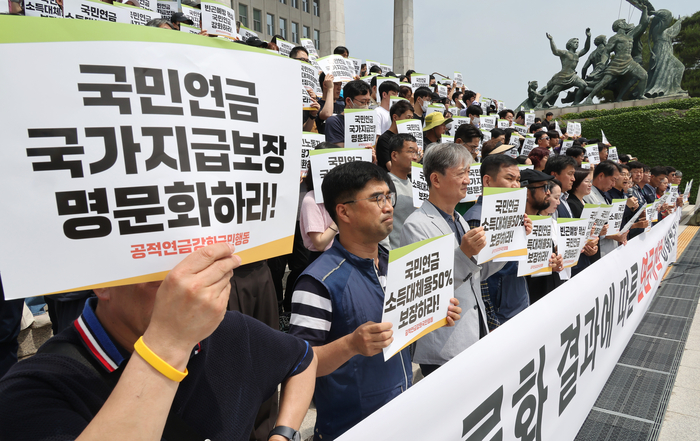
Public Pension Strengthening People’s Action, the two major labor confederations, and lawmakers including Representative Kim Sung-joo of the Democratic Party of Korea and Representative Kang Eun-mi of the Justice Party hold a joint press conference on the steps in front of the main building of the National Assembly on the 22nd, calling for “pension reform in line with the results of the citizens’ deliberation.” [Photo = Yonhap News]
The sharp confrontation between the ruling and opposition parties over National Pension reform comes as the 21st National Assembly’s term nears its end. At issue is whether to first pass at least what the two sides can agree on.
The Democratic Party of Korea argues that, with regard to the contribution rate (the money paid in) and the income replacement rate (the money received), the parameters that can be agreed on in this National Assembly should be raised to open the way for reform.
By contrast, the government and the People Power Party hold that, to build a sustainable pension system, not only parametric reform but also structural reform, including integration with the Basic Pension, must proceed at the same time.
Structural reform is a discussion about changing not only the contribution rate and the income replacement rate but the entire framework of the National Pension system.
Its goal of correcting the current system’s fiscal imbalance and raising its low level of income security is the same as that of parametric reform, but the idea is to resolve these problems within the framework of public pensions, including the Basic Pension, the special occupational pension schemes (the Government Employees, Military Personnel and Private School Teachers pension schemes), and retirement pensions.
To avoid repeating the pension reform chaos that unfolds every five years, the introduction of an automatic adjustment mechanism under which the parameters change according to the state of the fund, and a shift to a defined contribution (DC) system in which people receive what they themselves paid in rather than relying on intergenerational solidarity, are also being discussed.
In October last year, when it announced the draft 5th Comprehensive National Pension Operation Plan, the Ministry of Health and Welfare also said that a social discussion on introducing an automatic adjustment mechanism and shifting to DC should begin.

The government and the ruling party believe that the reform plans now under discussion are not a fundamental solution.
That is why they argue that structural reform and parametric reform must be discussed together.
Their explanation is that applying the parametric reform plans now put forward by the ruling and opposition parties would only push the fund depletion date back by 7 to 9 years from 2055.
Representative Yoo Kyung-joon of the People Power Party, the ruling party’s secretary on the National Assembly Special Committee on Pension Reform, also wrote on social media (SNS) on the 25th that “the 44% income replacement rate plan (put forward by the opposition) is a conditional plan, contingent on agreement on structural reform that includes at least a partial integration of the National Pension and the Basic Pension in this pension reform, or on other accompanying conditions of pension reform.”
People Power Party floor leader Choo Kyung-ho explained on the 26th, “It is difficult to handle structural reform issues such as linking the National Pension and the Basic Pension separately.”
The opposition, by contrast, argues for pushing ahead with parametric reform first.
Democratic Party leader Lee Jae-myung held an emergency press conference on the 25th and said, “Let us carry out a first-stage parametric reform adjusting the contribution rate and the income replacement rate within the term of the 21st National Assembly, and discuss structural reform plans as a second stage in the 22nd National Assembly.”

National Assembly Speaker Kim Jin-pyo speaks at a press conference on pension reform at the National Assembly in Yeouido, Seoul, on the 26th. [Reporter Han Ju-hyung]
National Assembly Speaker Kim Jin-pyo also lent weight to the Democratic Party on the 26th, saying, “Let us carry out parametric reform in the 21st National Assembly and pursue structural reform in the 22nd National Assembly.”
The argument is that, since pension reform is an issue on which agreement is so hard to reach, at least this part should be handled first while the gap between the ruling and opposition parties on parametric reform is as small as it is now.
Experts are divided.
Yun Suk-myung, Research Fellow Emeritus at the Korea Institute for Health and Social Affairs,
said, “The reform plans being discussed in the National Assembly now cannot achieve the reform goal of a sustainable pension system,”
and opposed a hasty reform, saying, “Because interest in pension reform among the younger generation has recently been rising, reform must come through a broad and deep discussion that embraces all generations.”
Yun went on to say,
“If the President announced a concrete timeline for completing pension reform within the next year, the opposition would have no choice but to agree.”
By contrast, Professor Seok Jae-eun of the Department of Social Welfare at Hallym University
said, “It is true that structural reform is needed, and it must be completed,”
but added, “With no agreement between the ruling and opposition parties even on forming the standing committees, I worry that forming the 22nd National Assembly’s Special Committee on Pension Reform will be pushed down the priority list and the momentum for reform will disappear,”
and saw handling parametric reform first as one possible option.
Some point to the ruling party’s mistake of treating the reform plan as a matter of political calculation.
An official well versed in the reform discussions
said, “Since National Pension reform requires concessions for the sake of future generations, public resistance is inevitable,”
adding, “It looks as if, on an agenda that should have been pushed through with resolve, they rashly tried for a ruling-opposition agreement, came up with a plan that was neither one thing nor the other, and are now scrambling to clean up afterward.”
Reporter Ryu Young-wook. Reporter Seo Dong-cheol


