
(Economist, on the 2018 National Pension Financial Projection) [Where Is the Contentious, Trouble-Ridden National Pension Headed?] “Pay More and Get Nothing?” — Distrust Snowballs (August 19, 2018)
(Pension Future Forum comment:
At the 4th National Pension Financial Estimation Committee in 2018,
two fiscal stabilization plans were proposed; their contents
and proponents are as follows.
Plan (A):
Raise the National Pension income replacement rate by 5 percentage points, from 40% to 45%, while raising contributions by 2 percentage points, from 9% to 11%
Plan (B):
Keep the National Pension income replacement rate at 40%; since raising contributions from 9% to 13.5% — an increase of 4.5 percentage points — would still not achieve fiscal stabilization, propose raising the pension eligibility age and using a Finnish-style life expectancy coefficient as additional fiscal stabilization measures equivalent in effect to a further 4-percentage-point contribution increase
Plan (A) was
proposed by the nominee of the Korean Confederation of Trade Unions (KCTU),
Committee Member Jung Hae-sik of the Korea Institute for Health and Social Affairs.
Plan (B) was
proposed jointly, led by the nominee of the Korea Federation of SMEs, Committee Member Yun Suk-myung of the Korea Institute for Health and Social Affairs, together with Professor Kim Soo-wan of Kangnam University and Oh Gun-ho, Chair of Welfare State I Make.)
[Where Is the Contentious, Trouble-Ridden National Pension Headed?]
“Pay More and Get Nothing?” — Distrust Snowballs
Fund depletion in 2057 if nothing changes, and those born in the 1990s on could be left with “no pension”… Controversy spreads to generational exploitation and public pension reform
As the National Pension controversy that recurs every five years grows, there are even calls to abolish the National Pension.
That is because the government has signaled a policy of shortening the pension payment period and raising the contribution rate.
The aim is to put an end to 15 years of stopgap measures. But as fears grow that people may not receive their pensions properly, public backlash is fierce.
The government, which had been about to draw its sword, has hesitated and is watching public opinion. Amid deep distrust and backlash, what measures will it put forward to improve the sustainability of the National Pension?
We also looked at ways to raise the National Pension’s investment returns and at the history of pension reform in advanced countries abroad.

President Moon Jae-in said at a meeting with his secretaries on August 15 that there would be no National Pension reform without the consent of the public. / Photo: Yonhap News
Trust in the National Pension, said to be the last bastion of the public’s old age, is cracking again. That is because the government has signaled a policy of lengthening the National Pension contribution period and delaying the start of payments. For the insured, it means paying in more than before and getting less back later.
The National Pension Service has long promoted the National Pension as a safety net for a comfortable old age, with higher returns than private pensions. But as fears grew that the National Pension might not be paid properly, the insured have even been arguing for its abolition, demanding that all the money they paid in simply be returned.
In response, President Moon Jae-in stepped in himself to calm the situation, saying, “There will never be a unilateral government overhaul of the National Pension without public consent and social consensus.”
But public backlash is not expected to subside easily. Sparked by the government’s latest plans to overhaul the National Pension, the public’s anxiety that they will not get back all the money they paid in is turning into anger.
This is because the National Pension controversy has erupted while public sentiment is already unsettled by the minimum wage increase, the introduction of the 52-hour workweek, and electricity bill shocks caused by the heat wave.
The President Stepped In Himself, but…

The root of the controversy lies in the National Pension’s limited resources. The National Pension’s funds consist of the contributions paid by the insured and the investment returns earned by investing that money.
But with rapidly falling birth rates and population aging, the money to be paid out is growing faster than the resources, so claims of fund depletion surface periodically.
Every five years, the government recalculates the finances, taking into account changes in the social and economic structure such as the economic growth rate and population. This year the government is conducting its 4th financial projection.
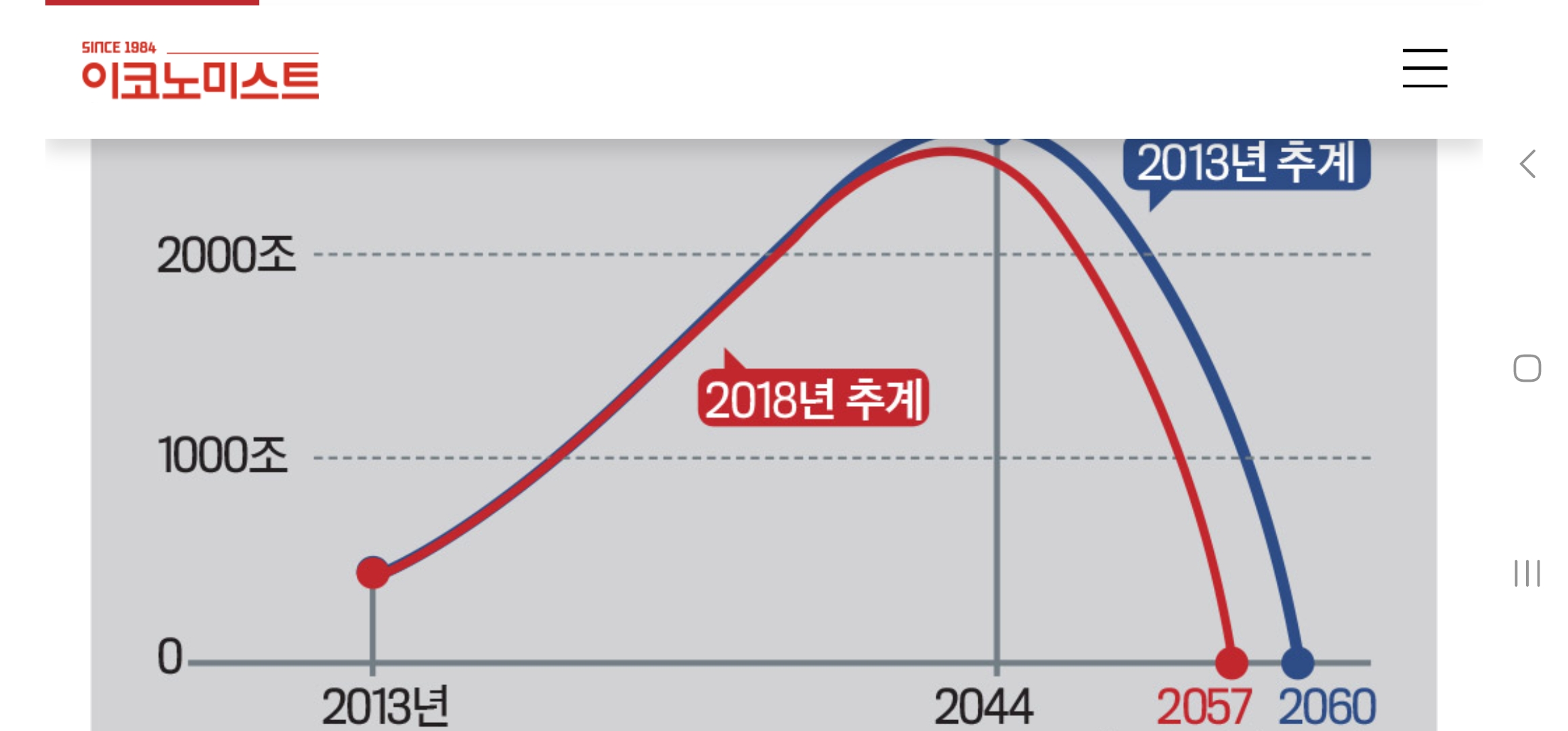
According to the government, the National Assembly, and others, the National Pension Fund is expected to run dry in 2057. At the time of the 3rd financial projection, the government projected depletion in 2060. The date has moved three years earlier in five years.
This means, for example, that even an insured person born in 1993 who works for 30 years from 2017 and faithfully pays National Pension contributions could receive not a single won of pension at 65 (in 2057), the age at which pensions are paid.
In line with these fiscal projections and changes, the government will draw up plans including adjustments to pension contributions and submit them to the National Assembly in October. The focus is expected to be on delaying the depletion date by cutting pension benefits or raising the contribution rate.
The government estimates that delaying fund depletion to 2060, as projected in the 3rd financial projection, would require at least 1,000 trillion won.
More Than 1,000 Trillion Won Needed to Delay Depletion to 2060

Fundamentally, the purpose of the National Pension is to supplement income in old age, when regular income is low.
Broadly, there are two options the government is reviewing internally to prevent fund depletion.
The first is an amount-change option that raises the National Pension income replacement rate, currently 45%, and the contribution rate.
An income replacement rate of 45% means that an insured person with a monthly income of 1 million won who contributes for 40 years receives a monthly pension of 450,000 won. But assuming one starts working at 25, one must keep earning a salary and paying National Pension contributions until 65 to reach the 45% income replacement rate.
Courts recently ruled that the working-age limit for manual labor is 65, not 60, but critics point out that this is unrealistic given Korea’s labor environment, in which most people retire from their companies in their 50s.
The current average contribution period of National Pension insured persons is 24 years. Pension payments come to only 240,000 won a month, so the effective income replacement rate is just 24%. That is why it is mocked as a “pocket-money pension.”
In tandem, proposals to raise the contribution rate are also emerging.
Even if the target is depletion in 2060, as in the 3rd financial projection, the contribution rate, currently 9% (4.5% from workers plus 4.5% from employers), must be raised to 12.9% or more.
This means an office worker earning 3 million won a month would pay 380,000 won a month into the National Pension.
The other is a period-change option that delays the pension eligibility age or lengthens the contribution period. A plan to delay the National Pension eligibility age from the current 65 to 68 is also reported to have been considered.
Minister of Health and Welfare Park Neung-hoo drew a line on August 14, saying, “We have never considered a plan to raise the eligibility age. It is completely untrue,” but pension experts commonly agree that raising the pension eligibility age is inevitable.
On the 17th the government will hold a public hearing centered on these points, put the draft Comprehensive National Pension Operation Plan to the National Pension Deliberation Committee in September, and submit it to the National Assembly in October after the vice-ministerial meeting and the Cabinet meeting.
Instead of Robbing Peter to Pay Paul, Fundamental Reform

Koreans’ average life expectancy was 82.4 years as of 2016, 3.2 years longer than in 2007 (79.2 years). That is 1.6 years longer than the average life expectancy of 80.8 years across all member countries of the Organisation for Economic Co-operation and Development (OECD).
The pension eligibility age is usually set by taking into account life expectancy after pension payments begin.
Most OECD member countries have now raised their pension eligibility ages to 67–68 owing to rising life expectancy and other factors, so Korea is expected to find it hard to stay out of this trend.
Taking into account the sustainability of pension finances, rising life expectancy, and other factors, the United Kingdom decided to raise the pension eligibility age from 65 for men and 60 for women to 66 in 2020, and to 67 in 2026–28.
France, too, decided through its 2010 and 2013 pension reforms to set the pension eligibility age at 67 from 2023.
A plan to extend the mandatory National Pension enrollment age by five years, from under 60 at present to under 65, is also likely to be pursued. It would delay fund depletion while having people pay in more money in step with the later pension eligibility age.
This is being jointly proposed by the National Pension Research Institute, the System Development Committee, and others. If the National Pension is overhauled as the government proposes, people will pay more money for longer than in the past but receive less money for a shorter period than the previous generation.
Such plans are drawing the anger of people in their 20s to 40s, who are at the height of their economic activity.
Their reaction is that it is unacceptable for the government, citing deteriorating finances, to lengthen the contribution period or raise the contribution rate instead, when the National Pension’s income replacement rate is falling and retirement is coming ever earlier.
Kim Hye-jin (39), a large-company employee with 15 years in the workforce, said, “Paying National Pension contributions is saving that moves current spending power into the future; it is not right for it to flow into the previous generation’s income,” and pointed out, “Institutional safeguards or a promise that the state will guarantee payment even if the pension fund is depleted are needed.” (Pension Future Forum comment: For pensions to be paid even after the fund is depleted, someone must bear the burden. That is because the state is a collective formed by individuals. People tell the state to take responsibility, but to whom will the enormous burden created by a state payment guarantee be passed on!)
The pensions office workers pay today are being used to support the elderly, while they themselves may receive pensions worse than today’s or none at all, so anxiety is growing. When the National Pension was launched in 1988, the income replacement rate was 70%. The contribution rate was lower than now: 3% in 1988–93 and 6% in 1993–98.
It is true that the older generations paid in little and received large pensions thanks to the contributions of the younger generations and high economic growth rates.
As of the end of May, the National Pension had raised 806.5 trillion won through pension contributions, investment income, and other sources. After spending 172.4 trillion won on pension benefits and other items, it currently holds 634 trillion won in reserves.
In size, it is counted among the world’s three largest pension funds, along with Japan’s Government Pension Investment Fund (GPIF) and Norway’s sovereign wealth fund (GPF). By government projections, it will grow to 2,561 trillion won in 2043. But owing to a shrinking working-age population due to low birth rates, a growing number of older people who must receive pensions, and low growth, the fund is expected to peak in 2043 and then disappear.
That is the point at which the second baby-boom generation, born in the 1970s and 1980s, retires in earnest, and the millennial generation, whose total fertility rate has plunged to the one-child level, is at the height of its economic activity.
Most of the insured now in the workforce look likely to receive their pensions.
But the children of today’s office workers are expected to have difficulty receiving the National Pension. Keeping the National Pension going beyond 2057 would require raising the contribution rate to 21.4% right away.
To quell public backlash, the government is reassuring people that there has never been a case of pensions going unpaid unless the state went bankrupt, but distrust is not easily subsiding.
From August 10 to 12, when reports on the National Pension overhaul plan came out, more than 900 petitions related to the National Pension were posted on the presidential office’s national petition board.
As an alternative for old-age income security, the System Development Committee proposes a three-tier, multi-pillar system built on the National Pension together with the Basic Pension and retirement pensions.
But the National Pension itself has been promoting a “three tiers of old-age income” scheme since 2008, saying that the National Pension alone cannot meet all old-age income needs and that people should prepare together with the Basic Pension and retirement pensions.
In effect, the System Development Committee is trying to fool the public with a transparent trick.
All citizens residing in Korea aged 18 or older and under 60 must join the National Pension. Like health insurance, it is a compulsory social insurance scheme. For a government that, as a welfare state, must maintain the pension fund system, this is an awkward position.
An official of the National Assembly’s Health and Welfare Committee said, “If the National Pension loses its compulsory nature and the number of insured falls, the poor elderly population will expand, and ultimately more welfare spending may have to come from taxes,” adding, “The more a society ages and has low birth rates, the more important the National Pension’s role becomes as the last bastion protecting people’s old age.”
Government Sounds Out Public Opinion: “Raise the Contribution Rate, Delay the Eligibility Age”

National Pension reform is under scrutiny again. The government is pursuing a pension reform plan under which people pay more and receive less. The National Pension Fund Management Headquarters in Jeonju, North Jeolla Province / Photo: Yonhap News
The latest controversy over the National Pension overhaul has laid bare the problem of intergenerational wealth distribution facing Korean society. Because intergenerational income redistribution is not taking place, the younger generation has even begun to speak of “generational exploitation.”
In fact, the National Pension was in part designed with a structure that favors today’s older people aged 60 to 80. When the National Pension was launched in 1988, many young people had to support not only themselves but their parents as well. A pension structure was therefore designed that applied a high income replacement rate even with low contributions.
The contribution rate, which was 3%, was to be raised gradually in line with economic growth. But the contribution rate, set at 9% in 1998, has been frozen for 20 years. Contribution rates in advanced Western countries are 15% or higher.
There have accordingly been calls for Korea to raise its contribution rate as well, but the political sphere, worried about losing votes, has moved half-heartedly. National Pension insured persons in the 1980s and 1990s, when contributions did not rise, reaped considerable benefits.
President Roh Moo-hyun was the first to attempt an increase, but failed amid the aftermath of the financial crisis, the credit card crisis, and more. The government and the political sphere dithered, watching only the public’s mood.
During the 2007 National Pension reform, private experts on the Pension Committee drew up a pay-more, receive-more reform plan raising the contribution rate to 12.9% and the income replacement rate to 50%, but it was blocked by a government that felt burdened by it.
At each of the 1st (2003), 2nd (2008), and 3rd (2013) National Pension financial projections, an overhaul was discussed, but no fundamental solution was found, and stopgap measures merely passed the problem on to the next time.
Then the need for pension reform, suppressed for the past 15 years, burst out this year. Having been suppressed for so long, the pension reform problem has grown, and public backlash has grown with it.
Unable to respond even to forecasts that the National Pension’s resources would soon hit their limit, the government has meanwhile focused its efforts on raising the pension’s investment returns.
Over the past 10 years, in its medium-term investment plans, the National Pension’s management committee has increased risk and alternative investments, raising the share of overseas equities instead of bonds and buying income-generating real estate.
Internal conflict over portfolio adjustments is also said to have been severe, as the government’s plan was pushed through despite opposition from the private-sector members.
But criticism also persists over whether a profitability-based investment approach is appropriate, given that the National Pension is the last shield responsible for the public’s old age.
Last year the fund’s investment return was 7.28%, up 2.59 percentage points from the previous year. It exceeded the 5% minimum return needed to sustain the pension under its medium-term operating policy. This was because domestic and overseas stock markets were extremely hot, and bond markets remained stable despite the U.S. Federal Reserve’s (Fed) interest-rate hikes.
But this year the National Pension’s return plunged to 0.49% through May. That is less than one-tenth of the return in the first half of last year (5.72%). This is because domestic equity returns nosedived from 26.31% last year to -1.18% this year.
Pension management focused on returns may increase the uncertainty of future pensions.
Hence some argue that rather than accumulating the National Pension, it should be switched to a pay-as-you-go (PAYG) system in which the current generation pays only the pensions of the current retired generation.
But critics note that this has limits in Korea’s spindle-shaped population structure, in which those being supported come to outnumber the generation supporting them. Accordingly, the government has set the principle that National Pension reform is inevitable given changes in the population structure and other factors.
National Pension Returns Plunge This Year

However, there is also criticism that the government is turning a blind eye to the problem of the public pensions that actually run deficits and receive trillions of won of taxpayers’ money every year.
In fact, according to the Ministry of Economy and Finance, national treasury subsidies to public pensions exceeded 20 trillion won over the five years from 2014.
As the number and salaries of civil servants increase, pension payments are also growing, and since pension finances cannot sustain them, taxpayers’ money is covering the gap.
Hence the view that all public pensions should be converted to a “defined contribution” system that pays only the principal of contributions plus interest, so as to reduce state support, is also gaining ground.
Yun Suk-myung, Research Fellow at the Korea Institute for Health and Social Affairs,
stressed, “Problems can be fixed only after going through a painful ordeal. Just as advanced countries stabilized their national pension finances by raising contributions and lowering income replacement rates, we must create a depoliticized environment for discussion and reach a social consensus that allows the National Pension to be sustained.”
ⓒEconomist (https://economist.co.kr) “Economist, Economic News for Tomorrow” — unauthorized reproduction and redistribution prohibited

