(Yonhap News TV) “Watered-Down” Pension Reform Controversy — Can Korea Reach a Social Consensus as Other Countries Have? (October 30, 2023)
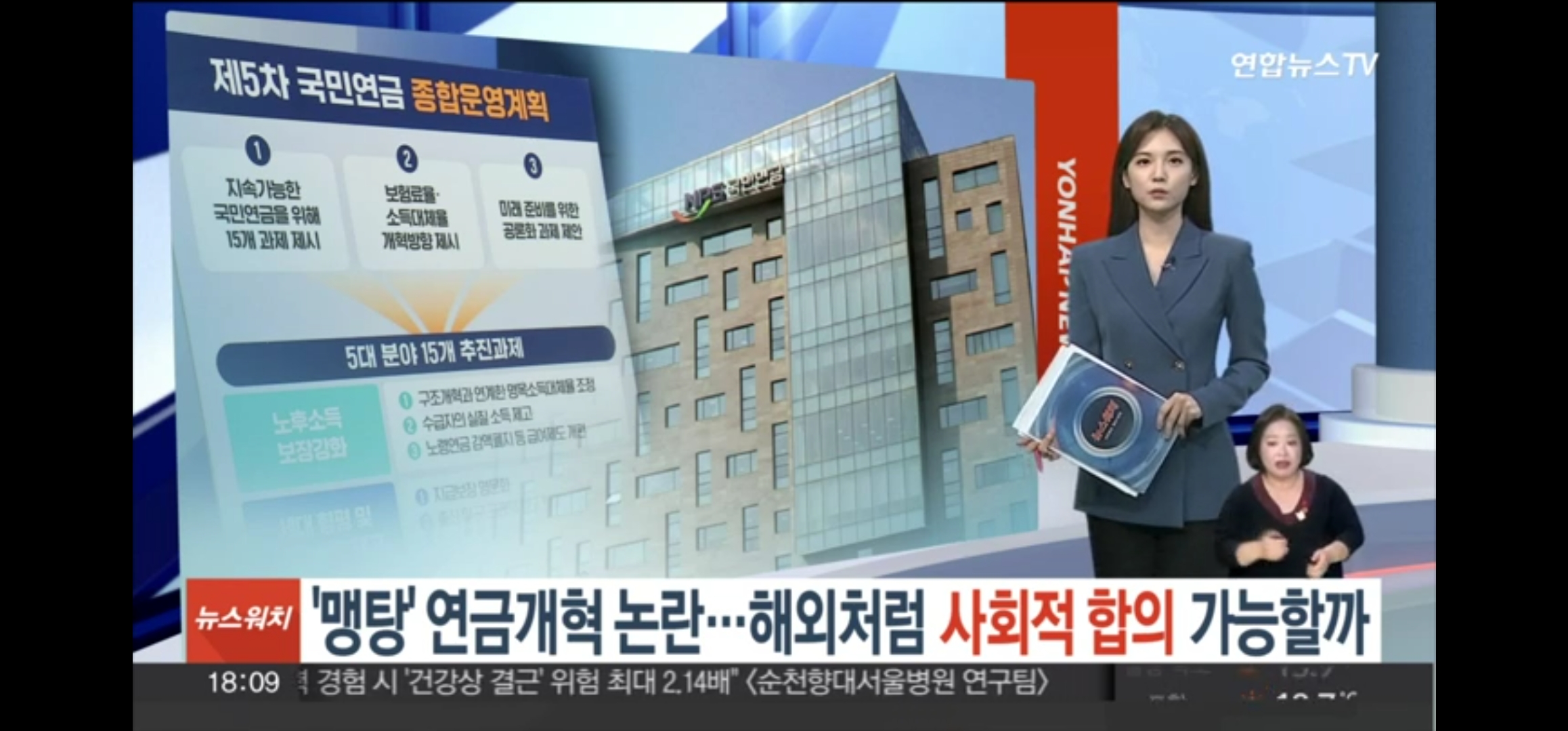
(Pension Future Forum comment:
Generation-differentiated contribution rates
and the introduction of an automatic adjustment mechanism are emphasized.)
[Anchor]
Criticism that the pension reform plan, stripped of its key figures, was a mere formality continues unabated.
So how have other countries handled pension reform?
In the end, the key was who would build a social consensus, and how.
Reporter Choi Deok-jae reports.
[Reporter]
The pension reform plan left out the key figures — the “contribution rate” (the money paid in), the “income replacement rate” (the money received), and the “eligibility age” (the age at which benefits begin) — making it hard to escape criticism that it is “watered-down.”
In the United Kingdom, the 2007–2014 pension reforms were led and resolved by a commission made up of experts.
A Pensions Commission of a small number of experts set out the direction and principles of reform, and the British government accepted most of them.
In Germany and Sweden, in 2001 and the 1990s respectively, the political sphere stepped forward to solve various social problems such as long-term unemployment and worked hard to persuade labor unions, opposition parties, and others.
Whether experts or the political sphere took the lead, what they had in common was that, one way or another, they ultimately built a social consensus.
The problem is that it is hard to see who will carry out our reform, and when.
The reform plan has gone to the National Assembly, but the 21st National Assembly’s term ends in June next year.
With the general election in April, it is unclear both who will hold the discussions and how much time there is.
On top of that, the plan puts forward tasks whose very concepts are unfamiliar, such as generation-differentiated increases in the contribution rate, the introduction of an automatic adjustment mechanism, and a defined contribution approach, raising concern that the golden opportunity for a social consensus could be missed.
<Yun Suk-myung / Research Fellow, Korea Institute for Health and Social Affairs>
“People in their 40s and 50s need to have their contributions raised somewhat faster than those in their 20s and 30s, to secure intergenerational equity. And it seems that only by introducing an automatic adjustment mechanism (for benefit amounts) can sustainability be secured.”
If proper reform fails yet again this time, intergenerational conflict is expected to grow even larger.
This has been Choi Deok-jae, Yonhap News TV. ([email protected])