(YTN Radio) [Head-On] Yun Suk-myung: “Twenty Years Wasted, Structural Reform Is Urgent — Parametric Reform? Not Reform but Deterioration” (May 27, 2024)
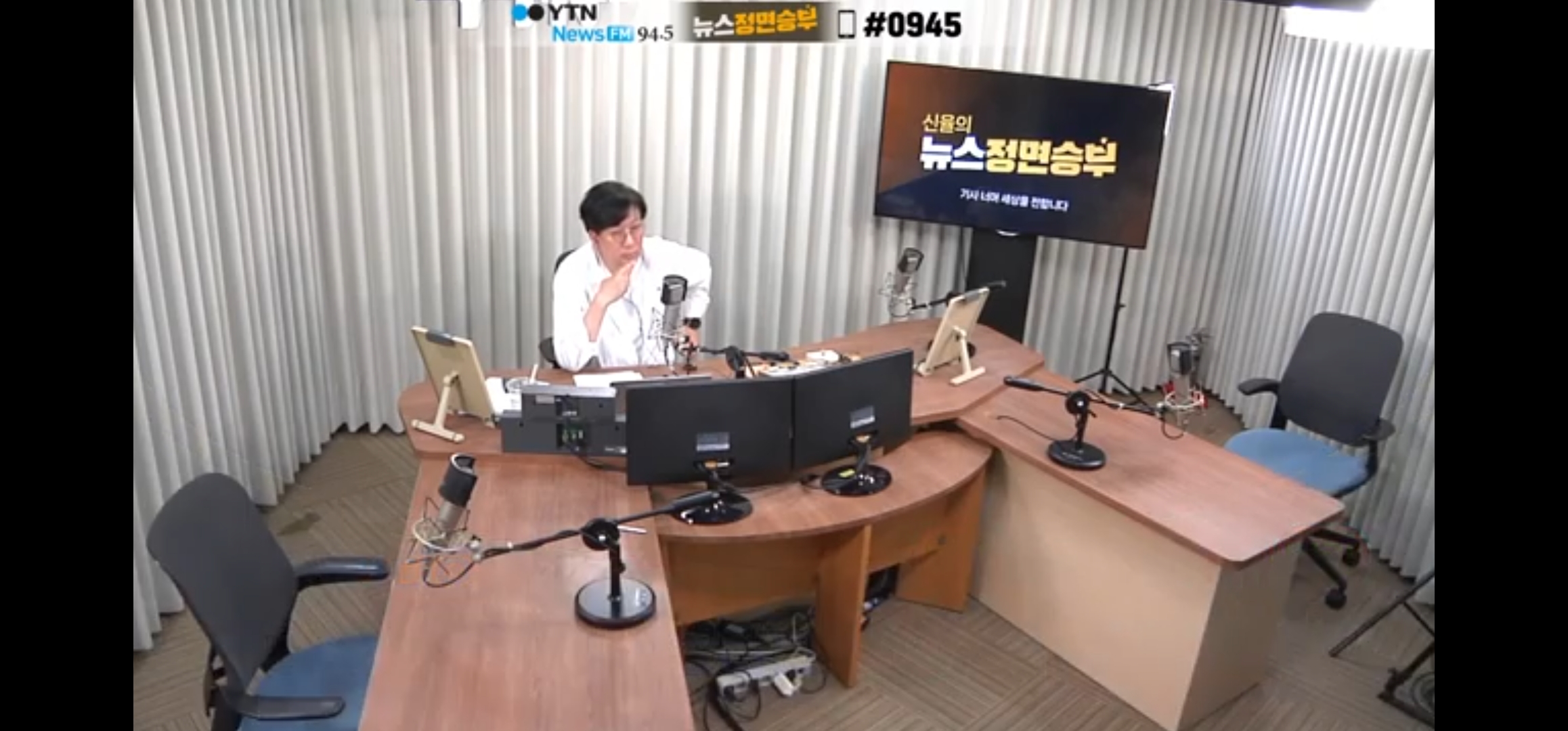
[YTN Radio, Shin Yul’s News Head-On]
■ Broadcast: FM 94.5 (17:00–19:00)
■ Air date: Monday, May 27, 2024
■ Host: Shin Yul, Professor, Department of Political Science and Diplomacy, Myongji University
■ Guests: Yun Suk-myung, Research Fellow Emeritus, Korea Institute for Health and Social Affairs; Jeong Se-eun, Professor, Chungnam National University
* The text below may differ from the actual broadcast; for the precise content, please check the broadcast.
◇ Shin Yul, Professor, Department of Political Science and Diplomacy, Myongji University (hereafter Shin Yul): This is part four of Shin Yul’s News Head-On. In today’s part four, we will look at pension reform. First, what they call parametric reform—why must the words be so difficult? Opinion is split two ways: “Parametric reform, or whatever it is, should be done first,” and “No, it should be done together with structural reform.” We will hear each position in turn. First, we have Research Fellow Emeritus Yun Suk-myung of the Korea Institute for Health and Social Affairs on the line. Dr. Yun, hello.
▣ Yun Suk-myung, Research Fellow Emeritus, Korea Institute for Health and Social Affairs (hereafter Yun Suk-myung): Yes. Hello.
◇ Shin Yul: Dr. Yun, I have a request. These economic terms are far too complicated. So instead of saying “parametric reform,” please put it simply, something like “how much you pay and how much more you get.” The floor leaders of the ruling and opposition parties just failed to reach an agreement at their meeting. Is it really acceptable for them to throw around words only they understand, like parametric reform and structural reform, while claiming it is for the people? What is this?
▣ Yun Suk-myung: It must feel very difficult. So I am worried about whether I can explain it simply today. Parametric reform, as the anchor said a moment ago: there is what you receive and what you pay, right? What you receive is the pension benefit, which is called the income replacement rate, and what you pay is called the contribution rate, right? Changing those numbers for what you receive and what you pay is parametric reform. Structural reform, on the other hand, is this. Our National Pension is a bit complicated: people do not receive pensions 100% in proportion to their own income; there is a part where people with higher incomes share with those with lower incomes. There is what is called an income redistribution function. First, if we keep the basic framework of our National Pension, eliminating that income redistribution function and moving to a 100% earnings-related pension would count as structural reform. Then there is the structural reform now being talked about in political circles, the KDI plan and so on, right? What that means is this. Under our National Pension, no matter how much you pay in contributions (when we first introduced it, contributions were only 3%, and now we pay 9%, right?), what you receive is fixed in advance. The Korean term for this is a bit difficult; in English it is called a “defined benefit” scheme. Since benefits are fixed and contributions collected are low, there is no incentive to reform. Because what you receive is fixed. But we are an OECD member, right? Seventy percent of OECD member countries used to run their schemes this way, but if you do that, the scheme becomes hard to sustain for various reasons, does it not? So they changed their schemes. Instead of fixing what you receive, they fixed only what you pay. Then, this year, we receive the National Pension at 63, right? When you reach that age, there will be a total of the contributions you have paid up to age 63, right? On top of that total, if you have paid in, say, 100 million won over the years, there will be the interest it has earned, right? Combine them, and whether that comes to 200 million or 300 million won, at the point of turning 63 (Sweden, for example, does it this way), take the age group that has turned 63. In Korea this year, that would be people born in 1961, I think? Then Statistics Korea produces rough figures for how many more years people born in 1961 will live, right? If that figure is, say, 25 years, then multiplying 25 years by 12, since the pension is paid monthly, gives the number of months you will receive the pension until death, right? You divide the 200 million won, or the 300 million won, by that number of months and pay it out in monthly slices. That way there is no source of fiscal instability in the pension. Moving over to that is what is called structural reform.
◇ Shin Yul: Now, Doctor, you said 63, for example. Could we not raise the eligibility age to 65 instead of 63?
▣ Yun Suk-myung: The law already provides that it will become 64 in 2028 and rise to 65 in 2033.
◇ Shin Yul: In that case, do we not need to narrow the pension crevasse? That is, to shorten the period when people get no money, should we not also pursue labor reform and raise the retirement age?
▣ Yun Suk-myung: Yes, of course. Right now we say pensions are small and only ask for more, while strongly opposing labor market reform. I took part for about a year in the Continued Employment Research Group for a Super-Aged Society under the presidential Economic, Social and Labor Council. Now, the militant unions at large companies (there is the income crevasse our host mentioned, which is a reality, is it not?) insist unconditionally that, since it is hard to make ends meet, the retirement age be extended to 63 or 65. But as you well know, young people these days face what is called an employment ice age, a cliff, and find it hard to get good jobs, right? Young people say things like, “Getting to work until 60 is already a great blessing, is it not? We want to get good jobs too.” They say things like that, right? But if the retirement age is suddenly extended by three or five years, it becomes that much harder for young people to find work, does it not? There is a way to solve this. Japan is already doing it. Keep the retirement age at 60, and up to age 65 use post-retirement re-employment, paying 70% of the pre-retirement salary while the employer pays all the National Pension contributions. So since it is hard to extend the retirement age by three or five years outright, if we go with post-retirement re-employment and people receive about 30% less, could we not hire young people into those same jobs? As a way for generations to thrive together, people would also earn a salary, and contributing longer would raise their pension amounts too, would it not? I have argued for this a lot, but it does not seem to be well received. By the labor movement.
◇ Shin Yul: So, looking at what you just said, Doctor, structural reform is something that cannot be done right away—must the two go together? Must changing the numbers, what we receive and what we pay, go together with structural reform? Or can they go separately? How do you see it?
▣ Yun Suk-myung: First of all, whether structural or parametric, if done properly, the two can end up converging on a similar point. But right now they are being discussed as if they were far apart. What I said 20 years ago was this: at the time, I argued that we should carry out parametric reform gradually. My point was that if we kept carrying out parametric reform, it would eventually amount to structural reform. But we have now wasted more than 20 years, have we not? We do not have as much time as we used to. So, to give you my conclusion first, we need to carry out structural reform as soon as possible, and if we cannot get to structural reform in one step, we have to go through an intermediate stage. But that intermediate stage is not the kind of parametric reform discussed by the citizen representatives of the National Assembly’s Special Committee on Pension Reform, which is now being debated in Yeouido political circles. The parametric reform that came out of there is not reform but “deterioration.” So whether it is parametric or structural reform, the essence of the content should first be laid out in detail, and only then should people say, “Take my plan; I will not accept yours.” But right now, it is called a reform plan, yet when expert groups such as pension committees look at it, it is not a reform plan but a deterioration plan that shifts even more of the burden onto the younger generation and future generations. If you ask me about it, I will answer in detail.
◇ Shin Yul: Please answer briefly. What should be done? In your view, Doctor.
▣ Yun Suk-myung: Well, I think I should give you the answer I referred to as a reform plan. There is a point on which all of Korea’s media are somewhat confused. The key to the 5th National Pension financial projection is that even if the income replacement rate is kept at 40%, raising contributions by 6 percentage points to 15% within 10 years still falls far short of achieving fiscal stabilization. Yet because the National Assembly special committee agreed to raise contributions to 13%, they are saying that since this has been agreed, what difference does an income replacement rate of 43%, 44%, or 45% make, when it is only a 1 or 2 percentage point difference, so just accept it, and they are pressuring Yongsan day after day, are they not? But the very big problem is this: according to the 2023 results of the 5th National Pension financial projection, even if the income replacement rate is kept at 40%, contributions must be raised to 19.8%, or 20%, if the burden is not to be shifted onto future and later generations after the reform. Yet what is being discussed now is not leaving the income replacement rate at 40% but raising it by 4 percentage points to 44% while collecting contributions of only 13%, which means that after the overhaul, every year, an amount equivalent to 9 percentage points of contributions is shifted onto future generations as extra burden and debt. That is why I call it a deterioration plan.
◇ Shin Yul: So you are saying people must pay much more, right?
▣ Yun Suk-myung: What we pay now must be much more, and what we receive, from here—
◇ Shin Yul: Must be cut?
▣ Yun Suk-myung: Raising it by even 0.1 percentage point is a 100% deterioration plan.
◇ Shin Yul: I see. We will invite you again later and hear about it in detail. Let us leave it there for today. Thank you.
▣ Yun Suk-myung: Yes, thank you.
◇ Shin Yul: That was Research Fellow Emeritus Yun Suk-myung of the Korea Institute for Health and Social Affairs.
YTN Seo Ji-hoon ([email protected])
[Copyright (c) YTN. Unauthorized reproduction, redistribution, and use as AI data prohibited.]
https://m.ytn.co.kr/news_view.php?s_mcd=0101&key=202405272020245976&pos=#return
Attachments
- Screenshot_20261113_224138_Samsung Browser.jpg(473.1 KB)ViewDownload
- Screenshot_20261113_224149_Samsung Browser.jpg(618.0 KB)ViewDownload
- Screenshot_20261113_224200_Samsung Browser.jpg(722.3 KB)ViewDownload
- Screenshot_20261113_224210_Samsung Browser.jpg(585.0 KB)ViewDownload
- Screenshot_20261113_224222_Samsung Browser.jpg(635.2 KB)ViewDownload
- Screenshot_20261113_224243_Samsung Browser.jpg(656.3 KB)ViewDownload
- Screenshot_20261113_224251_Samsung Browser.jpg(445.7 KB)ViewDownload