
(Pension Future Forum Comment) [Exclusive] If the National Pension’s Returns Stay at 6.5%, Fund Depletion Is Delayed by 33 Years (October 23, 2025)

(Pension Future Forum comment:
This is an article about Representative Kim Nam-hee,
who has argued most frequently,
and until recently most forcefully,
that if the fund is invested well,
the depletion date of the National Pension fund
can be pushed back substantially.
Representative Kim’s
standing committee in the second half of the 22nd National Assembly
is the Legislation and Judiciary Committee.
One has to wonder whether,
even now that the KOSPI has fallen sharply,
Representative Kim still holds the same view.
In the Advisory Committee to the 22nd National Assembly Special Committee on Pension Reform,
some advisory committee members
requested data on the depletion date of the National Pension fund
under investment return assumptions lower than the 4.5%
adopted by the Fifth National Pension Financial Estimation Committee in 2023,
but to this day
they have not
received it.)
National Assembly Budget Office estimate
Average return of 6.82% over the 37 years since inception
Fund depletion pushed back from 2057 to 2090

View original
A National Assembly analysis has found that if the National Pension maintains an annual investment return of 6.5%, the fund’s depletion will be delayed until 2090.
That is up to 33 years later than the 2057 depletion date projected when the National Assembly agreed on National Pension reform in March. The point at which the fund turns to a deficit was also estimated to be pushed back by 29 years, from 2041, the pre-reform projection, to 2070.
According to the “Financial Projection Based on National Pension Fund Investment Return Assumptions,” which the National Assembly Budget Office submitted on the 23rd to Representative Kim Nam-hee of the Democratic Party of Korea, a member of the National Assembly’s Health and Welfare Committee,
the fund would be depleted in 2090 assuming a National Pension investment return of 6.5% a year, and in 2073 at a 5.5% return.
This is the first time an estimate assuming a 6.5% annual return has been produced. The National Assembly Budget Office used variables such as the “future population projections” and the “macroeconomic outlook” applied in the government’s projections.
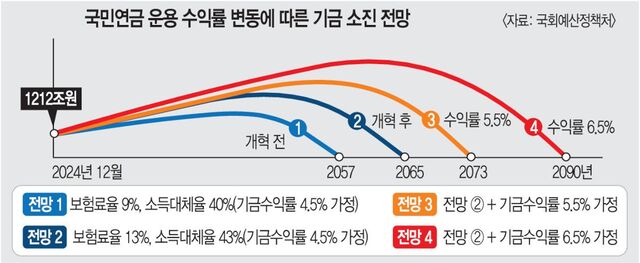
View original The government is keeping the 4.5% annual return assumed in the Fifth National Pension Financial Projection of 2023 as its baseline. In March, together with the National Assembly, it adjusted the return assumption to 4.5–5.5% a year and arrived at a parametric reform. Accordingly, from next year the contribution rate, meaning what people pay in, will rise from 9% to 13% by 0.5 percentage point a year over eight years, and the income replacement rate, meaning what people receive, will be adjusted from 40% to 43% from next year.
The National Pension fund’s investment return has averaged 6.98% a year over the past three years. Over the 37 years since the fund was established in 1988, its average annual return has also stayed at around 6.82%.
Some critics ask whether the government is assuming overly pessimistic fund investment returns and thereby adding to the public’s burden from next year.
But the government’s position is that, since the pension reform in March, it cannot produce separate projections for return assumptions above 5.5% a year. An official at the National Pension Service said, “We cannot produce anything other than the scenario of raising returns by 1 percentage point (5.5%). We produce projections only for scenarios on which a policy agreement has been reached.” This appears to take into account that the fund’s returns can fluctuate widely from year to year depending on domestic and international economic conditions.
Representative Kim said, “The sustainability of the pension can be improved through efforts such as improving fund management,” adding, “Rather than viewing the pension outlook only negatively, we need to pursue improvements to the system while striking a balance between stability and profitability.”
Reporter Lee Jung-heon ([email protected])
Reporter Kim Young-sun

