
(Newspim) [Interview] Former Korean Pension Association President Yun Suk-myung: “Young People’s Pensions Can Be Raised Even If the Income Replacement Rate Stays at 40%” (February 19, 2025)
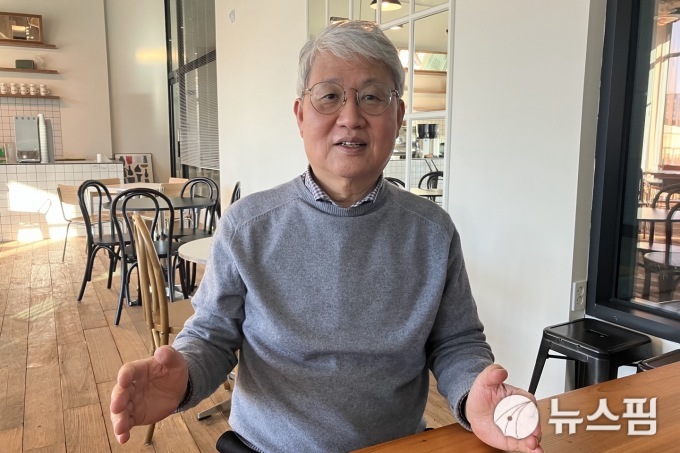
[Sejong=Newspim] Reporter Shin Do-kyung = Yun Suk-myung, Research Fellow Emeritus at the Korea Institute for Health and Social Affairs (KIHASA) (former President of the Korean Pension Association), gives an interview on the National Pension to Newspim at a café in Sejong on the 18th. February 19, 2025 [email protected]
The government and the National Assembly are speeding up their discussions with the aim of achieving pension reform within this month.
Acting President Choi Sang-mok, Deputy Prime Minister and Minister of Economy and Finance; National Assembly Speaker Woo Won-shik; People Power Party Emergency Committee Chairman Kwon Young-se; and Lee Jae-myung, leader of the Democratic Party of Korea, will hold a four-way meeting of the consultative council on state affairs on the 20th. The discussion is expected to center on adjusting the contribution rate (what people pay in) and the income replacement rate.
Yun said, “The ruling party will call for a 13% contribution rate, a 40% income replacement rate, and the introduction of an automatic adjustment mechanism, while the opposition party will call for raising the income replacement rate,” explaining, “If agreement is difficult, the contribution rate should first be raised from the current 9% to 13%, and the income replacement rate should be discussed later together with structural reform.”
Yun criticized, “Even if the income replacement rate is kept at 40%, the pensions young people receive can be increased through the introduction of an automatic adjustment mechanism, re-employment after retirement, narrowing the Basic Pension’s coverage, and differentiating the income replacement rate,” adding, “Any plan that raises the income replacement rate by even 0.001 percentage point is a deterioration.”
On adjusting the income replacement rate through structural reform, Yun explained, “It kills four birds with one stone,” adding, “If a policy of re-employment after retirement is introduced, the National Pension’s income replacement rate rises by 5 percentage points, five years’ worth of wages and severance pay also increase, and the number of the insured grows, so the pension’s sustainability can be protected.”
Yun is a pension expert who took part in all five National Pension Financial Estimation Committees, the first through the fifth (2003–2023). He is currently active as Research Fellow Emeritus at KIHASA and as a leader of the Pension Future Forum. Since 2006 he has attended meetings of pension experts at the Organisation for Economic Co-operation and Development (OECD) as Korea’s representative, and he has served as President of the Korean Pension Association.
The following is a Q&A with Yun.
- There is intense interest in the National Pension. Why is National Pension reform important?
▲ Because people have to prepare for old age. When people start working in their 20s, their income is good, so they think it will last to the end. Watching the debate over the National Pension, young people may think, “I’ll take care of it myself, so why is the state annoyingly interfering?” But just as winter soon comes, a time comes to think about old age. In that respect, the state has been sustained by the continuous lives of many individuals, and it has to guide the people in a good direction. Those with experience running the state looked at this and concluded that “when it comes to old age, if it is left to individual freedom, people lack experience of old age and so fail to prepare properly,” and continuity matters. Even for the people themselves, isn’t saving whatever money is left over different from setting money aside first and then spending?
- In a survey by the Righteous Youth Alliance, support for abolishing the pension reached as high as 30%.
▲ That should be interpreted not as a call to abolish the National Pension system but as a demand for fiscal stabilization strong enough to assure them that they, too, will receive it. Under the National Pension, you pay 9% of your income and receive 40%. As a means of preparing for old age, it is the best of Korea’s systems. So rather than abolishing it, what matters is moving in the right direction.
- Some argue that the state need not run it and it could simply be entrusted to financial institutions.
▲ The current National Pension is a “defined benefit (DB)” system in which people pay less in contributions and receive more in pensions. To maintain the system, there is no choice but to move to a defined contribution (DC) system in which people receive what they pay in. So people ask why financial institutions can’t just do it, but in Korea the returns on retirement pensions are extremely low. Companies such as Samsung Life Insurance and Mirae Asset Securities take fees for one reason or another. Little money goes back to the subscribers. When the state manages it, it keeps no profit for itself and adds on enough to preserve the money’s real value. There is no financial product as good as this. Sweden’s National Pension, which is run on a DC basis, pays out the contributions individuals have paid plus a certain amount of interest.
- Tomorrow the acting president, the Speaker of the National Assembly, and the leaders of the ruling and opposition parties will hold a four-way meeting. What do you expect them to discuss?
▲ On pension reform, the ruling party is showing a united front for the first time in a long while. The alternative the ruling party proposes is a 13% contribution rate, a 40% income replacement rate, and the introduction of an automatic adjustment mechanism. I think they have finally come to their senses. The opposition party will call for raising the income replacement rate. At about 43%, there is a chance it will be accepted. But the ruling party must not stray from its path for the sake of negotiating. The National Pension system today is like a plane once built to carry 100 people that now has 300 on board. The automatic adjustment mechanism is a new engine with greater thrust that lets this plane cross the Pacific. If it is not introduced immediately, the generation now receiving pensions will receive 1.8 million won a month and the burden will be passed on to future generations. It is not only the young who should bear the pain; with the introduction of the automatic adjustment mechanism, the pensions of people like me who are already receiving them must also be able to be cut automatically. The generations must share the pain.
- How do you think the income replacement rate should be discussed at tomorrow’s four-way meeting?
▲ If the income replacement rate is not adjusted, they should not reach an agreement. Any plan that raises the income replacement rate by even 0.001 percentage point is a deterioration. It is an issue that leaves no room for compromise. However difficult it may be, the ruling party must not give up. The Democratic Party is pressing for it to be passed as soon as possible because it does not want a headache when it takes power in the next administration. If this is not a pension reform show, the 13% contribution rate on which there is social consensus should be pursued first. They say it cannot be pursued separately from the income replacement rate, but under the Roh Moo-hyun administration, too, only the income replacement rate was lowered. So if agreement is difficult, the contribution rate, which the Roh Moo-hyun administration failed to raise, should first be raised to 13%, and the income replacement rate should be discussed later together with structural reform by forming a special committee on pension reform.
- From the public’s standpoint, people may object, asking why only what we pay in is being adjusted.
▲ To balance the National Pension’s finances, we would have to pay a contribution rate of 19.7%. Japan’s contribution rate is 18.3%. The president must persuade the people. The approach I propose is the introduction of re-employment after retirement. If re-employment after retirement is implemented to make up for the pensions cut by the introduction of an automatic adjustment mechanism, pensions increase for those with middle or higher incomes. Middle-income groups, on the other hand, may see their pensions decrease. So the number of Basic Pension recipients should be reduced and more should be paid to people with low incomes. Also, whereas the same 40% now applies to all income groups, applying it differently could also be considered. The idea is to give an income replacement rate of up to 50% to low-income people who have been insured for 25 years or more. The money saved on Basic Pension recipients, whose benefits are funded entirely by taxes, would be spent on vulnerable groups. Vulnerable groups could then receive larger pensions, and a sustainable system could also be built. Of course, companies may dislike this because the income ceiling would rise. The government should also apply a complementary approach in the form of incentives for companies.

[Seoul=Newspim] Reporter Kim Hak-seon = Yun Suk-myung, Research Fellow at the Korea Institute for Health and Social Affairs, gives a keynote presentation on the afternoon of the 12th at the 2018 Newspim Policy Diagnosis Seminar, “National Pension Reform! How Should It Be Done?”, held at the National Assembly Library in Yeouido, Seoul. September 12, 2018 [email protected]
-Why must the automatic adjustment mechanism be introduced immediately?
▲ If agreement is reached on a 40% income replacement rate, fiscal stabilization can be attempted through the agreed contribution increase, and the remaining 5 percentage points can be broken down through the automatic adjustment mechanism. Achieving the full 40% income replacement rate through financing alone would require collecting contributions of nearly 20%, which is impossible. In other words, Korea cannot switch to Sweden’s DC system right away. So it should use the life expectancy coefficient, a Finnish-style semi-automatic stabilizer. Finland deducts from monthly pensions in proportion to how much more people receive, so as to keep the total the same. That reduces pensions, but if the labor market is reformed so that people work longer and contribute longer as average life expectancy rises, pensions do not decrease. That has the same effect as raising the contribution rate by 2 percentage points.
- Some say that introducing an automatic adjustment mechanism will cut pensions.
▲ That is because Korea’s mandatory contribution age is 59. That is why a policy of re-employment after retirement must be introduced. If the retirement age is extended, young people cannot get into workplaces. So the idea is to re-employ people after retirement at about 80% of their salary at retirement and give them all the same social insurance benefits. Since the pension accrual rate is 1 percentage point a year, extending it by five years raises the income replacement rate by 5 percentage points. Raising the mandatory contribution age by five years can have the effect of raising the income replacement rate by 5 percentage points. Then young people can receive larger pensions than the generation now receiving them. What matters in receiving a pension is the contribution period.
- If the ruling and opposition parties reach an agreement, what is the next task for pension reform?
▲ The pension systems must be integrated. At present they are divided into the Government Employees Pension, the Military Pension, and the National Pension. The Government Employees Pension and the Military Pension cannot be merged because their designs are too different. But the Government Employees Pension and the National Pension can be merged. This year the deficit subsidy for the Government Employees Pension amounts to about 10 trillion won. It is covered by the public’s taxes. Those receiving the National Pension may object, asking why only the National Pension should be reformed while the Government Employees Pension is not. So the National Pension, the Private School Teachers Pension, and the Government Employees Pension should be integrated so that they can be compared.
- If the opposition party does not accept the 40% income replacement rate the ruling party insists on, what happens next?
▲ If no agreement is reached and the opposition party passes it alone, Acting President Choi Sang-mok can exercise his veto. But if the ruling and opposition parties agree on a formula that raises the income replacement rate, the veto can no longer be exercised. It is better not to shift the burden onto future generations, even if it takes longer, than to do it quickly.
- When is the golden opportunity for pension reform?
▲ June of this year. At the very least, they must go as far as declaring that the contribution rate will be raised and an automatic adjustment mechanism introduced. After June, a presidential election or local elections are scheduled, so it will not be easy. The income replacement rate can be handled together with structural reform.
- What would you ask of the public in the process of National Pension reform?
▲ Civic-mindedness for the sake of future generations is important. Unlike Southern European countries such as Greece and Spain, the Northern European countries north of Germany have Lutherans as a result of the Reformation. They dislike the state needlessly interfering with them, but in return they have a mindset of strictly fulfilling their obligations to the state. If the state has to reform the pension system because it is unsustainable, they follow along out of civic-mindedness even if they do not like it. For the pension system to work properly, the thinking is: I will receive as much as I paid in, and in return I will claim my rights on condition of having fulfilled my obligations. But in Korea there is intergenerational conflict over the National Pension. The National Pension’s unfunded pension liability exceeds 1,825 trillion won, reaching 83% of GDP. Before our generation passes on, we must reduce the debt for future generations even a little, doing what earlier generations failed to do.
- What would you ask of the government in the process of National Pension reform?
▲ If the people knew the real situation, they could not help but realize that the path we must take is a single-log bridge with only one way across. The job of informing the people lies with the Ministry of Health and Welfare, the ministry in charge. All pension-related information must be disclosed transparently. It makes no sense that the general public and the press cannot see the financial projection report for the Government Employees Pension, into which a deficit subsidy of 10 trillion won goes every year.


