
(Kyunghyang Shinmun) [Saenuri Party’s Government Employees Pension Reform Plan] “Pay More and Receive Less” Than the Government Plan — Emphasis on Introducing an Income Redistribution Function (October 27, 2014)
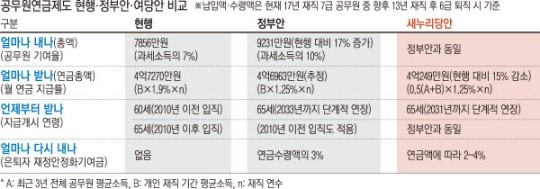
• Pay 10% of taxable income for up to 40 years… a clear intent to abolish the pension
• Reflects the average income of civil servants over the last three years; the higher the pension, the bigger the cut
• Graduated fiscal stabilization contributions… monthly pensions of 4.38 million won (438×10,000 won) or more frozen for 10 years
The gist of the Government Employees Pension reform plan the Saenuri Party announced on the 27th centers on “more for the lower, less for the upper” (下厚上薄) pension payments and fiscal savings. Its intensity of “paying more and receiving less” is even stronger than that of the government plan the Ministry of Security and Public Administration announced on the 17th as the final plan of the government and the ruling party.
The Saenuri Party’s amendment to the Government Employees Pension Act aims ultimately to bring the scheme into balance with the National Pension through a “more for the lower, less for the upper” reform. To that end, its biggest difference from the current system and the government plan is the introduction into the benefit formula of the A value (the average standard income of all civil servants over the last three years) that the National Pension currently uses.
<Click here to view a larger image>
Under the current system, serving civil servants receive pensions according to the formula “B (the individual’s average income over the service period) × 1.9% (accrual rate) × n (years of service).” The government plan lowered the accrual rate, changing it to “B × 1.25% × n.” The Saenuri Party plan has changed it again, to “(0.5 × A + 0.5 × B) × 1.25% × n.” Previously, because the formula was based on the B value, one’s own average income, the higher the rank, the larger the benefit. Under the Saenuri Party plan, lower-ranking civil servants are expected to see smaller cuts, and some may even see increases. This is the “income redistribution” function the Saenuri Party advocates. The ceiling on standard monthly income, the basis for calculating pension amounts and paying contributions, will also be lowered, as in the government plan, from the current 8.04 million won, or 1.8 times the “average standard monthly income of all civil servants,” to 6.7 million won, or 1.5 times.
The Saenuri Party also decided to freeze for ten years the pensions of civil servants receiving high pensions of 4.38 million won or more a month, twice the average pension.
As in the government plan, the contribution rate of current serving civil servants will rise by 3 percentage points over three years from 2016, from 7% to 10% of taxable income. The cap on the years of service for which contributions must be paid will also be extended from the current 33 years to as many as 40 years.
For civil servants newly appointed from 2016 onward, the contribution rate will be 4.5%, the same as the National Pension, and the accrual rate will also be lowered to 1.0% by 2028 in line with the National Pension’s planned reduction. This is the point at which it becomes clear that the Saenuri Party plan ultimately aims to abolish the Government Employees Pension.
The Saenuri Party plan also proposed strong remedies for fiscal savings. First, the pensionable age will be pushed back from the current 60 to 65. Currently, those who entered the service before 2010 receive their pensions from 60, and those who entered after 2010 from 65. The government plan raised the age by one year every two years from 2025 to 2033, but the Saenuri Party plan brings this forward by two years, raising it by one year every two years from 2023 to 2031.
Levying a fiscal stabilization contribution on pension recipients so that they share the pain is also part of the fiscal savings. The government plan imposed a flat 3.0%, but the Saenuri Party plan imposes a graduated 2–4% depending on the level of the pension.
Yun Suk-myung, Research Fellow at the Korea Institute for Health and Social Affairs, said,
“If the contribution rate is raised rapidly over a short period of three years, the short-term deficit will shrink, but because the government will have to pay that much later, the effect on long-term fiscal stability is negligible.”
<Reporters Kang Byung-han and Jung Hwan-bo [email protected]>

![(KBS TV. 이슈&뉴스] 공무원 연금, '세금 먹는 하마'?...'사회적 합의' 절실 (2013년 10월 23일)](/_next/image?url=%2Fuploads%2Feditor%2F2026%2F11%2Fcfe4824d207e450c8cad3a7c73e2fb04-Screenshot_20261122_221550_Samsung-Browser.jpg&w=128&q=75)