“The Current Pension System Is at a Stone Age Level — An Automatic Adjustment Mechanism Is Needed” (June 14, 2023)
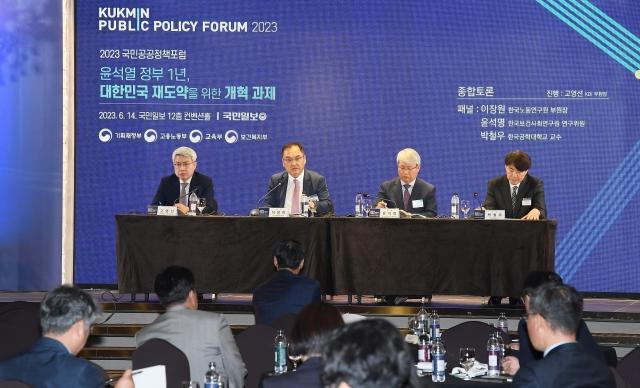
[Kookmin Public Policy Forum] Presentations on “Pension and Education Reform”With the total fertility rate at 0.78 and a steep “demographic cliff” ahead, reform of the pension and education systems is inevitably required. Experts stressed that the pension and education systems can be sustained only through sweeping institutional reform.
Speaking on the 14th at the session “The Direction of Pension Reform for Our Survival” of the Kookmin Ilbo Public Policy Forum, held at the Kookmin Ilbo Building in Yeouido, Seoul, Yun Suk-myung, Research Fellow at the Korea Institute for Health and Social Affairs (KIHASA),
said, “Korea today is living in the era of the Fourth Industrial Revolution, but when it comes to the pension system, I would rate it at the level of the Neolithic Age,”
adding, “We must overcome low fertility and population aging and build a sustainable pension system through reform of an entirely different order from anything so far.”
Research Fellow Yun first warned that people must realize Korea’s population structure is in a serious state.
“Korea faces such a serious aging crisis that its median age will rise to 62.2 by 2070, and if things continue as they are, the fund will be depleted in 2057,” he said, pointing out that “even so, the optimism that ‘we can simply collect taxes and hand them out’ is rampant.”
He noted that the political sphere also bears responsibility for this.
“The pension system must be designed with the distant future in view, but today’s decision-makers are putting forward policies that look only 10 to 20 years ahead,” Research Fellow Yun said,
chiding that “the political sphere must explain to the public the enormous National Pension deficits that will arise if the current pension system is maintained, and must keep up a social dialogue.”
In particular, Research Fellow Yun stressed, “There is no pension system that lets people pay little in contributions and still live adequately.”
He argued, “The sustainability of the National Pension must be secured by raising contributions by a set rate every year for the next ten years and introducing an ‘automatic adjustment mechanism.’”
An automatic adjustment mechanism is a system that automatically adjusts pension benefits in line with the fertility rate and the economic growth rate.
“The pension system is not the exclusive possession of one generation; all generations must be able to benefit from it,” he said. “Sustainability must be taken into account without fail.”
In the session “One Year of the Yoon Suk-yeol Administration: Three Major Reforms for Korea’s Renewed Leap,” Professor Park Cheol-woo of Tech University of Korea said, “If small and medium-sized provincial cities are hollowed out as the population declines, regional universities will inevitably face a crisis of survival,” adding, “What is needed is sweeping university reform, not simply cutting enrollment quotas but also raising the quality of education and reorganizing space.”
Professor Park stressed in particular that, as the “quantity” of human resources shrinks, the productivity of education must be raised to improve their “quality.” He went on to criticize, “To do so, each university must recover its autonomy and exercise creativity, but universities today are far too dependent on the Ministry of Education,” adding, “Local intellectuals must develop ideas themselves to raise the quality of education and play a leading role in their local communities.”
Professor Park assessed positively the current administration’s emphasis on autonomy in education policy. “The Yoon Suk-yeol administration has made universities’ autonomous innovation the keynote of higher education reform and, while pursuing the Regional Innovation System & Education (RISE) university support framework, has transferred the Ministry of Education’s powers to local governments,” Professor Park said. “It has gotten the first step right so that the central government, the private sector, and local governments can solve problems together.”
He advised, however, that the government must work to raise the productivity of human resources. That is, it must train the workforce to be deployed in new industries and ensure that these workers enter the labor market and are used efficiently. “Human resources, which are declining sharply as the population structure changes, must be developed creatively, and greater effort must go into the training–matching–utilization stages of the workforce so that their capabilities can be fully exercised,” Professor Park pointed out.
Reporter Gu Jeong-ha [email protected] , Reporter Hwang Min-hyeok [email protected]
[Source] - Kookmin Ilbo
[Original link] - https://www.kmib.co.kr/article/20230615500164