(Kookmin Ilbo Interview) “920 Trillion Won in the Fund, Yet 2,500 Trillion Won Owed … Subscribers May End Up Paying 30% of Their Wages in National Pension Contributions” (January 26, 2022)
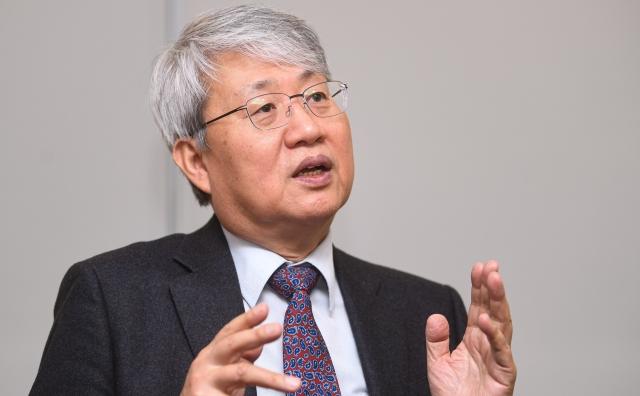
[Interview] Yun Suk-myung, Former President of the Korean Pension Association
“The National Pension Depleted in 2055?
An Optimistic Projection That Does Not Reflect the Steep Fall in Fertility
Reform Must Be Hastened So That People Pay More and Receive Later”
[Yun Suk-myung, Research Fellow at the Korea Institute for Health and Social Affairs (KIHASA), stressed the urgency of pension reform time and again.
“Pension reform is not a matter of political interests or of rival camps. There is no time to waste. If we leave the pension problem as it is, we have no future.”]
A report recently released by an economic research institute set the portal sites ablaze. It said that if the National Pension is not reformed, its reserves will run dry in 2055, and that, starting with those born in 1990, who will turn 65 that year and begin drawing a pension, people will not receive a single won. The reaction of Yun Suk-myung (61), Research Fellow at KIHASA and a former president of the Korean Pension Association, was calm. In his view, the projection that the National Pension will be depleted in 2055 is, if anything, optimistic, because it does not properly reflect population aging that is faster than expected, low fertility, and low growth, and he expects the fund to actually be depleted earlier than that.
Research Fellow Yun received his doctorate from Texas A&M University with a dissertation on the U.S. pension and health security systems. Over nearly 30 years of researching public pension systems, he has consistently warned of the deteriorating finances of pensions and the urgency of reform. We asked him about ways to reform the National Pension to secure sustainable old-age income security, and for his assessment of the presidential candidates’ pension pledges.
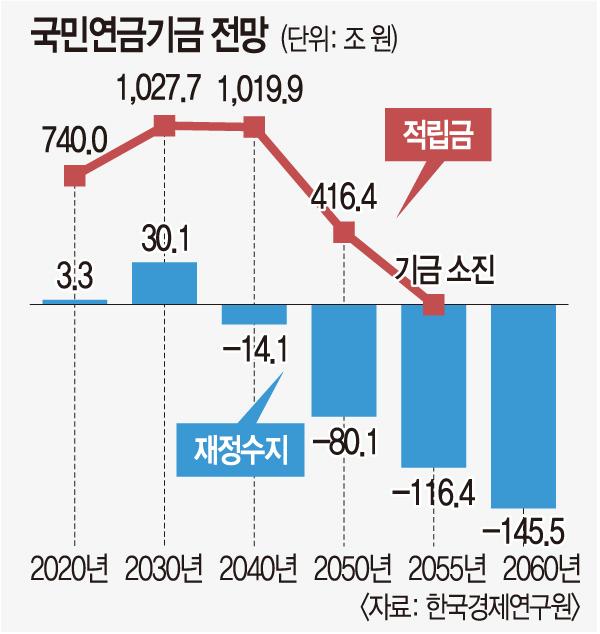
— The report by the Korea Economic Research Institute projecting that “the National Pension will turn to deficit in 2039 and be depleted in 2055” was based on data published by the National Assembly Budget Office two years ago. That timeline is earlier than the Ministry of Health and Welfare’s projection of “a deficit in 2042 and depletion in 2057.”
“The 2057 depletion date was calculated on the assumption of a total fertility rate of 1.3 or above (1.32 in 2030, 1.38 in 2060). The actual fertility rate was 0.84 in 2020, was projected to be in the 0.7 range last year, and is expected to fall below 0.7 this year. Even the 2055 depletion estimate reflects the 2019 new population projections and is therefore out of step with current conditions.”
— Does that mean the projected depletion date will be brought forward further once the data are updated?
“That is what the various indicators suggest. If pension reform is not carried out, the cumulative deficit of the National Pension will reach 17,000 trillion won by approximately 2088, when the generation born in 1990 will be passing away. Under current economic, demographic, and social variable assumptions, it would exceed 20,000 trillion won.”
— The figure of 20,000 trillion won is difficult to grasp intuitively. What is the actual fiscal condition of the National Pension?
“The National Pension Fund currently exceeds 920 trillion won in accumulated reserves. However, this amount is merely the tip of the iceberg visible above the waterline; submerged beneath it is 2,500 trillion won in future benefit obligations promised to the insured. This means the current shortfall exceeds 1,500 trillion won. Germany, Sweden, and Norway have all shifted to systems in which contributors receive benefits commensurate with what they have paid in, but South Korea remains committed to a defined benefit arrangement in which a fixed payout level has been promised — one under which the National Pension is designed to pay out approximately twice the amount of contributions paid in. The National Pension’s latent liability is growing by more than 400 billion won per day.”
— Even when the reserves run dry, is there not the so-called “pay-as-you-go” (PAYG) method, under which each year’s pensions are paid from the contributions collected that year? I understand that Germany has held out that way for more than 50 years.
“Over that period, Germany has borne contributions as much as five times, and at least twice, as high as ours. Its unfunded pension liability is incomparably smaller than ours. It is fundamentally different from us. According to National Assembly Budget Office data, under pay-as-you-go the pension contribution would rise to 32% of income in 2090. For the Government Employees Pension it would be 48.4%, and for the Private School Teachers Pension 67.3%. Today the contribution is 9% of income (for workplace-insured members, split half and half with the employer). Even so, it has not been raised by even 1 percentage point for more than 20 years because people find it burdensome. Are we then going to tell future generations, overnight, to pay a third of their income in contributions?”
Research Fellow Yun cited data released last October by the Finnish Centre for Pensions. “Finland, whose total fertility rate is 1.35 to 1.45, has published data showing that if its fertility rate fell to 1.0, its contribution rate would in the long run soar from the current 24.4% to 37%. Our fertility rate is even lower than that. We are in a situation where we must either pay more in contributions or receive drastically reduced pensions.”
— Still, it is not as if people will stop receiving pensions from 2055 right away, is it?
“Those who accuse me of needlessly frightening the public with fear marketing say that, in that case, the government can simply collect taxes and pay pensions out of them. The National Pension is not the only problem. The cumulative national liabilities of two schemes, the Government Employees Pension and the Military Pension, exceed 1,100 trillion won. In 2020 alone, they added more than 100 trillion won to national liabilities. On top of that, there are the Private School Teachers Pension, the National Health Insurance, and long-term care insurance. Greece, which faced a sovereign default crisis, spent half of its fiscal deficit on covering pension deficits. Korea is a country where 40% of the economically active population does not pay a single won in income tax — are we to cover all of it with taxes?”
— How did things come to this?
“The National Pension, introduced in 1988, imported a rosy system designed in the 1960s, the golden age of Western societies in terms of both economic growth and population structure. By the time we introduced it, it was already so late that Sweden had set up a parliamentary task force (TF) on pension reform. On top of that, to encourage people to join, the scheme let them receive 70% of their pre-retirement income (an income replacement rate of 70%) in return for a contribution of 3%. The plan was to publicize what a good system it was and to raise contributions as quickly as possible, but that proved difficult in terms of political economy.”
— What have successive administrations done in the meantime?
“The 1998 reform under the Kim Dae-jung administration, which put the Kim Young-sam administration’s reform plan into practice, was of great significance. It lowered the income replacement rate by 10 percentage points to 60% and introduced the financial projection system, which periodically checks the state of pension finances. It also gradually raised the eligibility age to 65. In 2007, under the Roh Moo-hyun administration, the income replacement rate was cut again, by 20 percentage points to 40%. There was also a plan to raise contributions to 12.9%, but it fell through because of opposition in the political arena. I put the finishing touches on the Roh Moo-hyun administration’s white paper on pension reform. Its last section said, ‘We have carried out half of the reform. The next administration must reform the other half.’”
— Yet no administration since then has accomplished the other half.
“In 2015, the Park Geun-hye administration raised the Government Employees Pension contribution rate to 18% and the pension eligibility age to 65. It was not a genuine renewal, so it was more an overhaul than a reform. The Moon Jae-in administration drew up four reform plans, but what it put forward were overhaul plans that would increase the National Pension’s liabilities further. The idea was to have people pay 3 to 4 percentage points more in contributions and receive 5 to 10 percentage points more in pensions. It got to the point where I, who had been calling for pension reform, said the discussion had to be stopped. It also made the Government Employees Pension worse by hiring 110,000 civil servants. For now, the financial problem is masked because these people are paying contributions, but after a certain period it can only fester and burst. When it comes to pensions, it can only be regarded as the worst administration ever.”
— The chances are slim, but if the population grew or the economy expanded and contribution revenue rose, could the National Pension’s finances not improve at least a little?
“Because Korea has been an ultra-low-fertility country for more than 20 years since 2000, at a conservative estimate more than 8 million members of the economically active population who would have supported pension beneficiaries were never born. Even if the fertility rate rose right away, that could not be reversed. The top priority is to change the system itself so that the pension system is sustainable. Our National Pension is the most unbalanced in the world between what is paid in and what is received. Citizens of Organisation for Economic Co-operation and Development (OECD) member countries who receive pensions at our level pay contributions in the 20% range. A pension system is not a magic wand. It is a system in which you receive as much as you paid in, and receiving as much as you paid in means the principal plus the economic growth rate.”
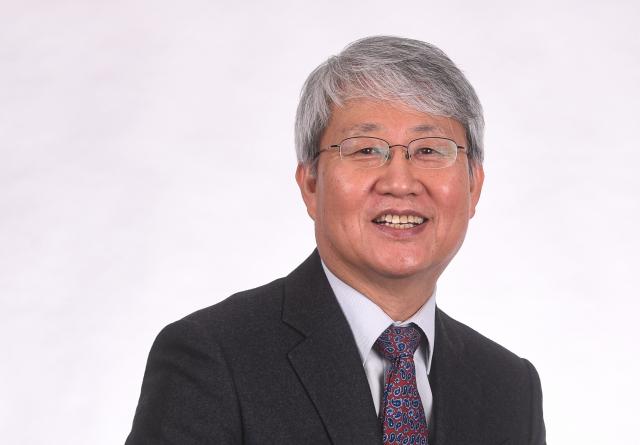
— What about the presidential candidates’ pension pledges? Lee Jae-myung, the Democratic Party of Korea’s candidate, and Yoon Suk-yeol, the People Power Party’s candidate, have both said, without offering concrete pledges, that they would create a body to discuss pension reform.
“Because politicians practice five-year politics, they try to look away, telling themselves it is not their problem. Even if they cannot present a concrete reform plan, should they not at least have principles or a direction for how they would overhaul the system once in power? I am skeptical of a social consensus body. The current administration also had a committee, but it wasted its time. It was not social consensus; it merely borrowed the name.”
— Candidate Lee has pledged not to cut the pensions of older people who work. He would abolish the in-service old-age pension reduction system, under which the National Pension is reduced for those with an income of around 3.5 million won a month.
“I am not negative about that pledge. Because pensions are also taxed, there is a problem of double taxation. The OECD also recommends abolishing it, and in Japan, which has the same system, there is a move to abolish it. Even so, the Ministry of Health and Welfare keeps the system as an expedient born of necessity, to save pension finances even by such means. He keeps silent on pension reform, which loses votes, and has put forward as a pledge only the abolition of the reduction, which wins votes.”
— Candidate Yoon said that “pension reform is an issue that absolutely must be addressed,” but put it off until after taking office, saying, “If I become president, I will present a grand plan.”
“That is cowardly. Judging by the major presidential candidates’ handout-style youth support pledges, they are so tender toward the younger generation, yet when it comes to pensions, which will cause that generation the most pain, they could not care less. If they care about the nation’s future and young people, they should come forward with a reform plan and be judged on it. If shouldering the responsibility alone is too burdensome, why not agree that, whoever is elected, no one will use pensions to win votes or turn them into a political issue, and issue a joint declaration? The MZ generation and society should demand that the candidates put forward at least a pledge of this kind.”
— The pledge of Ahn Cheol-soo, the People’s Party’s candidate, is the most proactive. He has proposed a unified pension system that would merge the National Pension and the Government Employees, Military, and Private School Teachers pensions on the basis of the National Pension. Sim Sang-jung, the Justice Party’s candidate, has also pledged to pursue a merger of the Government Employees Pension and the Military Pension.
“Pension integration is an important issue. Take the Government Employees Pension: its contribution rate and income replacement rate differ from the National Pension’s, which has become a source of controversy over unfairness and of conflict. In Japan, with the unification of public pensions in 2015, the government employees’ pension was changed to be exactly the same as the national pension system. Japan’s government employees’ pension was originally a system in which civil servants paid nothing and the state covered everything with taxes, but through a 1959 reform it became a system like ours today, in which the state and the individual each bear half. Korea’s Government Employees Pension was introduced in 1960, so the two have effectively the same history, yet while Japan’s government employees’ pension has been merged with the national pension, Korea’s is moving further away from the National Pension.”
— Let us look at the situation in other countries at this point. How have other countries carried out reform?
“Germany introduced an automatic adjustment mechanism for pensions in 2004 under Chancellor Schröder. It calculates pensions every year according to key variables such as the fertility rate, the speed at which life expectancy increases, and the economic growth rate. When the fertility rate falls, life expectancy rises, and the economic growth rate falls, this has a negative effect on the pension system. If those changed figures are applied to the German economy and the system is judged unsustainable, pensions are cut automatically. There is no room for politics to intervene in pensions, and since pension liabilities do not grow any further, there is nothing to worry about. After the 2008 financial crisis, Greece moved to halve the pensions of high-benefit recipients while greatly strengthening the pensions of vulnerable groups. If anything, it improved in a far more sustainable direction than ours.”
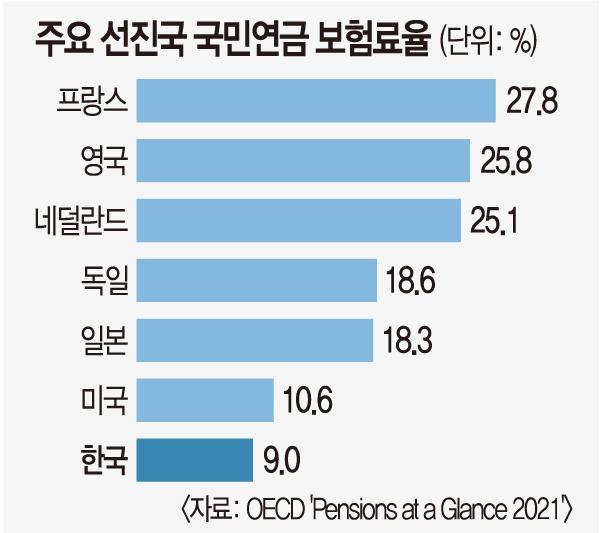
Research Fellow Yun recounted an episode from a Korea–China–Japan seminar of pension experts in December 2020. “Japan is a country that has secured reserves sufficient to pay a year’s worth of pensions even in 2120, a hundred years from now. Near the end of the seminar, a Japanese official asked how Korea could pay so much less than Japan and yet receive more. Japan collects 18.3% of income in contributions and aims to guarantee an income replacement rate of 50%. Its income replacement rate is 10 percentage points higher than ours, but it is based on a two-person household of a husband and a full-time homemaker. In effect, we pay only half the contributions Japan does and receive more in pensions. It was rubbing salt in the wound — did that official really ask out of ignorance?”
— So in the end, is the only solution to pay more and receive less? What reform plan is feasible?
“The automatic adjustment mechanisms introduced by Germany and other European countries ultimately mean cutting the pension amounts people receive. Considering public resistance, paying more and receiving the same as now is more realistic than cutting pensions. One option is to raise contributions to 13–14% and apply a life-expectancy coefficient like the one Finland introduced. The total amount promised as a pension would still be paid in full, but the monthly amount would be reduced to take into account that the period of receiving a pension lengthens as average life expectancy rises.”
— There are also scholars who talk about a “receive later” approach that delays the point at which pensions are drawn.
“Norway has extended it so that pensions can be drawn even from age 75, and other countries are also pushing it back to 67–69. In our case, the pension eligibility age will rise to 65 from 2033, but it must be pushed back further in the medium to long term. The upper age limit for pension coverage must be adjusted as well. At present, the statutory mandatory contribution age for the National Pension is capped at 59. If people could pay contributions until 69 or 74, the pensions they receive would increase.”
— Is making people contribute to the pension for longer not linked to extending the retirement age? “I am not saying the retirement age should be extended across the board. Older workers who want to keep working would work for lower wages in the form of post-retirement reemployment, as in Japan. Is that not the only way young people will still be hired?”
— It is true that the National Pension is so inadequate for old-age security that it is called a “pocket-money pension.” Is the “pay more, receive more” approach impossible?
“The current income replacement rate of around 43% is not low compared with other countries. But it is based on 40 years of contributions, and because the average contribution period of the National Pension is short, at 25 years, the effective income replacement rate is under 30%. Estimating the expected contribution periods of those born in 1970, the lowest-income first decile has 19.4 years and the highest-income tenth decile 33.9 years. That is a gap of 15 years. Vulnerable groups have short contribution periods and therefore small pensions, and if contributions are raised further to lift the income replacement rate, the number of people who cannot pay contributions or cannot even join at all may increase. With pensions, if someone receives more than they paid in, someone else receives less. Raising the income replacement rate sends even more benefits to those who already benefit.”
— That points to deepening pension polarization. According to 2018 statistics, 21.3% of the 21.84 million people subject to National Pension coverage were left in coverage gaps because of contribution exemptions, under which no contributions are paid, and long-term arrears.
“That is why the current administration’s plan to raise the income replacement rate in the name of strengthening public pensions shifts the burden onto later generations and polarizes old-age income. High earners in the middle and upper brackets with good jobs also join retirement pensions and personal pensions. Genuinely strengthening public pensions means drawing vulnerable groups into the National Pension and subsidizing their contributions.”
Reporter Kwon Hye-sook [email protected]