
(Seoul Sinmun) “Cutting the Number of Civil Servants Comes First — Pension Reform and the Pay System Must Be Fixed” (January 23, 2020)
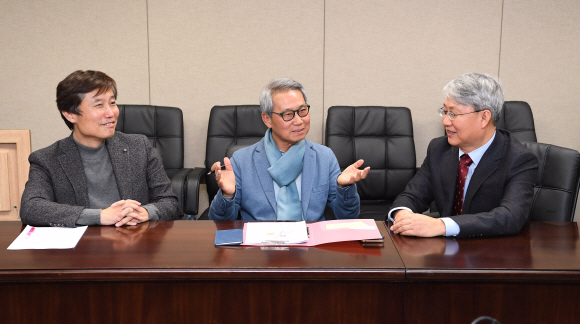
From left: Kim Tae-il, Professor of Public Administration at Korea University; Lee Geun-myeon, former Minister of Personnel Management; and Yun Suk-myung, Research Fellow at the Korea Institute for Health and Social Affairs, hold a roundtable on the direction of Government Employees Pension reform on the 22nd in a conference room at the Seoul Sinmun building in Jung-gu, Seoul. They stressed that Korean society must share an understanding of the urgency and importance of reform and that the political world must step forward and lead the debate. Reporter Oh Jang-hwan 5zzang@seoul.co.kr
Last year’s Government Employees Pension deficit was 2.2 trillion won.
That deficit must be filled entirely with state money.
The gap between the Government Employees Pension and the National Pension, a mere “pocket-money pension,” is also more than sixfold. To ride out the waves of a shrinking economically active population and growing welfare needs in an era of low fertility and population aging, the problem of the Government Employees Pension, which squeezes public finances, must be solved.
Seoul Sinmun explored the problems of the Government Employees Pension and future solutions with three experts: Lee Geun-myeon, former Minister of Personnel Management, who led the 2015 Government Employees Pension reform; Yun Suk-myung, Research Fellow at the Korea Institute for Health and Social Affairs; and Kim Tae-il, Professor of Public Administration at Korea University.
They stressed, “Government Employees Pension reform is an unpopular policy, but it is a task that must be done for future generations,” adding, “Politicians need the leadership to persuade the public.”
● With Fewer Births, Korea Has Become a Bad Country for Sustaining a Pension System
Yun Suk-myung (hereafter Yun): Professor Bonoli of the University of Lausanne in Switzerland, a prominent social and political scientist in the pension field, visited Korea last year and said, “I have never seen a country with such a bad population structure (as Korea).” The seriousness of the problem lies in the fact that Korea has become the country on earth with the least favorable conditions for sustaining a pension system.
Lee Geun-myeon (hereafter Lee): Because annual births have fallen below 400,000, in 20 years fewer than 400,000 people will be entering society each year. Can such an ultra-low-fertility country guarantee 20 years into the future? Pensions must be backed by robust economic growth and sufficient taxes. Otherwise, they are a house built on sand.
Yun: The Government Employees Pension, reformed with great difficulty in 2015, is drifting in a worse direction.
Lee: Whether it is Government Employees Pension or National Pension reform, if sustainability is not guaranteed, the direction must be changed toward improving the structure and reducing the public’s burden, but politicians do not want to do this. The 2015 Government Employees Pension reform was achieved after many twists and turns. It was a very rare case of agreement among the ruling and opposition parties and the civil servants’ unions, and its results were also significant. But as the scale of government subsidies has grown again and the financial projections have worsened, problems are emerging. In the short term the Government Employees Pension must be reformed, and in the medium term the civil service pay system must be fixed. Why does no one talk about raising civil servants’ productivity? The way to drastically lower the public’s burden is to reduce the number of civil servants. Yet we are adding civil servants even as the number of citizens to be served shrinks. How will the public view this mismatch? What is more, the problem is that decisions that will keep placing burdens on young people are being made without their participation.
● Average Pay of 5.3 Million Won, High by Global Standards
Kim Tae-il (hereafter Kim): The Government Employees Pension was designed on the basis that, in exchange for paying low salaries, the government would take responsibility for civil servants’ old age. It was a promise to guarantee their retirement if they worked faithfully without minding the meager pay or chasing private gain. Now the situation is different. The public sees it as unjust preferential treatment. People think civil servants already enjoy plenty and have secure jobs. If only for the sake of equity, we must examine whether it is reasonable to maintain the current Government Employees Pension system, and reform it.
Yun: The Government Employees Pension was originally introduced in 1960 with an income replacement rate of 40% and a pensionable age of 60. But in 1962 the age requirement was abolished and the income replacement rate was raised to as much as 76%. It went completely into reverse. Back then the idea was to pay civil servants later for the sacrifices they made while in service, but now the average civil servant’s pay is about 5.3 million won, a high level even by global standards. Even so, what was raised was never lowered, and what is called the reform applies only to newly hired civil servants. The reform hardly applies to existing civil servants at all.
Kim: I agree 100%. Existing civil servants lost little from the 2015 Government Employees Pension reform. The Ministry of Personnel Management explained that after the 2015 pension reform civil servants pay twice as much as the public but receive 1.7 times as much, which is sophistry. That would be true if the structure paid out only as much as one pays in. But one does not receive only as much as one pays. The National Pension is a structure in which you pay 1 and receive 2, while the Government Employees Pension is one in which you pay 1 and receive 3.4.
● The Government Employees Pension Has Become a Bomb Passed On to Future Generations
Lee: I do not agree with that. First of all, civil servants pay twice as much as the public. The individual contribution rate is 4.5% for the public and 9% for civil servants. So the base is twice as large. Yet what they receive is only 1.7 times the National Pension.
Kim: If you compare, for example, how much a civil servant who retires after some 30 years of service receives in pension with how much a comparable large-company employee pays in and receives, the actual amounts differ greatly. The Ministry of Personnel Management says the Government Employees Pension is no better than the National Pension, but that is nonsense. In the past, some people became civil servants at 20, retired at 40, and drew a pension. Even now, because of exception clauses, people who retire in their 50s receive it immediately. The National Pension is not like that.
Lee: The increase in civil servants will also end up burdening the public. If the pension is left as it is, it becomes a bomb passed on to future generations. Why is the political world sitting still? If it is not done now, it cannot be done, and letting the moment slip like this is a deception of the public. Will civil servants reform their own pensions? Private companies raise wages in consideration of labor productivity, corporate growth, and inflation. But the government raises civil servants’ wages according to its fiscal room. Productivity is ignored. Even before Government Employees Pension reform is discussed, the fundamental problem has not been touched at all.
Kim: The reason the public regards the Government Employees Pension as a privilege is that they see it as unfair. If asked whether maintaining the current Government Employees Pension structure is truly justified given the special nature of public service, I would say no. I believe it is right to reduce it to about the level of the National Pension. In the end, it is a question of fairness.
Lee: It must be seen as a problem of the pay system as a whole. Unless the view of civil servants’ overall pay and productivity changes, the problem can only go around in circles. Reforming the Government Employees Pension alone is not enough. If we miss this moment, we will pay a greater price. That price is showing our children that intergenerational equity is not just. The government right now is not unable to carry out pension reform; it is choosing not to.
Kim: Instead of spouting the sophistry that the Government Employees Pension is no better than the National Pension, the government must disclose the “facts” transparently, just as they are. Only by putting the issue on the table that way can the debate begin.
● On Pensions, the Government Must Take Responsibility for Sustainability
Yun: That is right. Major advanced countries disclose pension-related information very transparently, but we are sliding further and further into secrecy. When problems are raised, they are busy only defending themselves with strange logic. If this problem festers and bursts later, there will be no way to contain it. Our society must quickly share an understanding of the urgency and importance of reform, and actors must emerge who will actively discuss it for the sake of society’s common values.
Kim: In fact, pensions are politics. The principle of public finance is sustainability, and the government must take responsibility for sustainability. For both the Government Employees Pension and the National Pension, the sooner they are reformed, the smaller the real burden. When the United Kingdom reformed its pensions, it went through a process in which scholars gathered for long debates and traveled around the regions to persuade people. The same goes for French President Emmanuel Macron. We too must carry out pension reform through such a process.
Yun: In our case, people seeking to maximize the interests of particular groups gather to hold a social dialogue, but important decisions should be made through fierce debate among people who are more objective and free from interests. At some point, interest groups began to lead the dialogue, and the debate has been drifting in a strange direction. Our society is turning the pension problem into a political issue. Reform plans should be drafted outside politics, and those plans should be debated within politics.
Senior Reporter Choi Kwang-suk [email protected]
Reporter Lee Hyun-jung [email protected]

![(KBS TV. 이슈&뉴스] 공무원 연금, '세금 먹는 하마'?...'사회적 합의' 절실 (2013년 10월 23일)](/_next/image?url=%2Fuploads%2Feditor%2F2026%2F11%2Fcfe4824d207e450c8cad3a7c73e2fb04-Screenshot_20261122_221550_Samsung-Browser.jpg&w=128&q=75)