
(Seoul Sinmun) 45% of the Nation’s Debt Is “Pension Liability” — Link Benefit Amounts to the Growth Rate, as Germany and Japan Do (January 17, 2020)
[Time Is Running Out: Government Employees Pension Reform]
<2> Only “Half Reforms” So Far:
The Tax-Eating Hippo
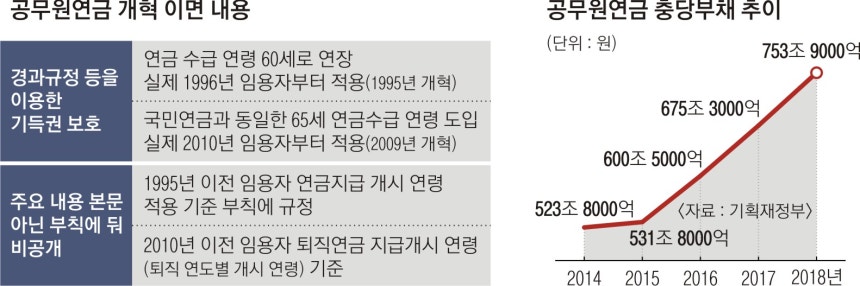
The Government Employees Pension posted its first deficit in 1993, a shortfall of 6.5 billion won (65 hundred million won). Since its introduction in 1960, the Government Employees Pension had gone 33 years without one. By last year, the Government Employees Pension’s deficit had reached 2.2 trillion won. The biggest reason pension deficits are growing so fast and so steeply is that pension spending exceeds pension revenue. There have been four Government Employees Pension “reforms” so far, but each time they ran into civil servants’ opposition and stopped at “half reforms.”

View original
This is the year of the Government Employees Pension “financial re-estimation” (a long-term review of pension finances, including revenue and expenditure).
Under the Government Employees Pension Act, the National Finance Act, and other laws, the government must, every five years from 2015, recalculate the cost of the pensions paid to retired civil servants and their survivors and restore financial balance.
Yet the Ministry of Personnel Management, the ministry in charge, is currently keeping pension-related information tightly under wraps and not releasing it.
Professor Heo Man-hyeong of Chung-Ang University said on the 16th, “Information must be disclosed and countermeasures drawn up so that third parties, including the public who fill the Government Employees Pension deficit, can properly grasp the state of the pension,”
adding, “Ultimately, the Government Employees Pension must be scaled back, and the shortfall in retirement provision must be addressed by introducing private pensions, such as private companies’ retirement pensions.”
● Reversing Course from a Sustainable Pension to Grabbing Privileges
Even setting aside this year’s financial re-estimation, the Government Employees Pension is a “critically ill patient” that cannot be left untreated.
The Government Employees Pension deficit is projected to more than double, from 2.2 trillion won this year to 5.1 trillion won in 2028. By 2028, the structure will be one in which two serving civil servants support more than one retired civil servant.
Last year, national liabilities stood at 1,700 trillion won. Of this, the state money that must be poured into the Government Employees Pension, that is, the accrued pension liability, amounts to some 754 trillion won.
That is about 45% of total national liabilities. The accrued pension liability is an estimate, at present value, of the pension amounts the state must pay in the future to serving and retired civil servants.
The Government Employees Pension, which today cannot survive without subsidies from the national treasury, was originally designed to be sustainable.
“When the Government Employees Pension was introduced in 1960, the average benefit rate (the ratio of the pension to pre-retirement income) was 40%, and the eligibility age was 60.
By the early 1990s, however, it had risen to 76%, an increase of as much as 90%.
The survivor pension also rose from 40% to 70% of the pension the spouse had received before death.
The pensionable age was lowered sharply, so that 20 years of membership qualified a person for a pension even in their 40s.” (Fifty-Year History of the Government Employees Pension, Ministry of Public Administration and Security, 2011)
In this way, unlike its original design, the Government Employees Pension slid backward into “grabbing pension privileges.”
This is evident from the fact that when the pension was introduced, Koreans’ average life expectancy was about 55, yet pensions were payable from 60, and the pension benefit rate was only 40%.
Later, however, it went into reverse, so that a pension that had been paid from 60 could be drawn even by people in their 40s after just 20 years of membership.
The structure of ever-expanding Government Employees Pension benefits was, in the end, an act of self-harm that led to a parade of pension deficits.
In the end, as unmanageable deficits put it on the operating table, the pension start date was changed so that pensions are received at 65 from 2033.
Even so, the income replacement rate of the Government Employees Pension is currently as high as about 60%. That means that someone who earned 1 million won a month before retirement receives 600,000 won as a pension.
By contrast, the National Pension’s income replacement rate will fall in stages from the current 45% to 40% in 2028.
● Cutting Short-Term Fiscal Costs to Create an Illusion of Reform
There have been four Government Employees Pension reforms so far, but instead of the fundamental remedy of cutting the pensions received, they chose the stopgap of having members pay higher contributions, which only made things more tangled.
They protected the vested interests of serving and retired civil servants and instead forced the sacrifice of benefit cuts on newly appointed civil servants, who cannot voice opposition, creating intergenerational pension conflict even within the civil service.
Such pension reforms created, on the surface, the illusion of reducing the fiscal burden in the short term, but in the long term, far from improving the finances, they are enlarging the deficit.
The increase of 174,000 civil servants by 2022 will also inevitably expand the burden on state finances.
One pension expert said, “As the increase in civil servants raises contribution revenue from new civil servants, the deficit subsidy seems to be smaller than expected,”
but warned, “The problem is that the Government Employees Pension’s imbalance between revenue and expenditure has a morphine effect in the short and medium term but will deepen the instability of pension finances in the long term.”
In an era of low fertility and population aging, the pension problem can only grow worse.
Critics point out that the abnormal situation in which astronomical sums of taxpayers’ money underwrite civil servants’ retirement must not be allowed to continue.
There is criticism that it is not the proper attitude of public servants for civil servants, who more than anyone should worry about state finances and fill the nation’s coffers, to be worsening state finances instead.
The proposal that the pension structure must move toward “paying more and receiving less” is persuasive.
In 2017 the Constitutional Court ruled that “the right to receive a pension (of civil servants and others) is not immutable but may be changed depending on state finances, the degree of burden on the next generation, social policy circumstances, and so on.”
Yun Suk-myung, Research Fellow at the Korea Institute for Health and Social Affairs (KIHASA), said, “Japan, Finland, Sweden, Germany, and others already prevent instability in pension finances by automatically linking pension benefit amounts to the economic growth rate when it falls,”
adding, “The Government Employees Pension should also be overhauled in this direction.”
Senior Reporter Choi Kwang-suk [email protected]

![(KBS TV. 이슈&뉴스] 공무원 연금, '세금 먹는 하마'?...'사회적 합의' 절실 (2013년 10월 23일)](/_next/image?url=%2Fuploads%2Feditor%2F2026%2F11%2Fcfe4824d207e450c8cad3a7c73e2fb04-Screenshot_20261122_221550_Samsung-Browser.jpg&w=128&q=75)