
(Seoul Sinmun) The Betrayal of Pensions — Civil Servants Born with “Golden Spoons,” the Public with “Dirt Spoons” (January 16, 2020)
[Time Is Running Out: Government Employees Pension Reform]
Government Employees Pension and National Pension Benefits
Differ More Than Sixfold
2028 deficit projected at 5.1 trillion won… doubled in nine years ↑
Within two years, civil servants up by 170,000-plus, adding to the burden
“Under Fiscal Pressure, the Golden Opportunity for Reform Must Not Be Missed”
Voices are growing louder that the Government Employees Pension deficit must be reduced to ease the burden on state finances caused by low fertility, population aging, and growing welfare funding needs.
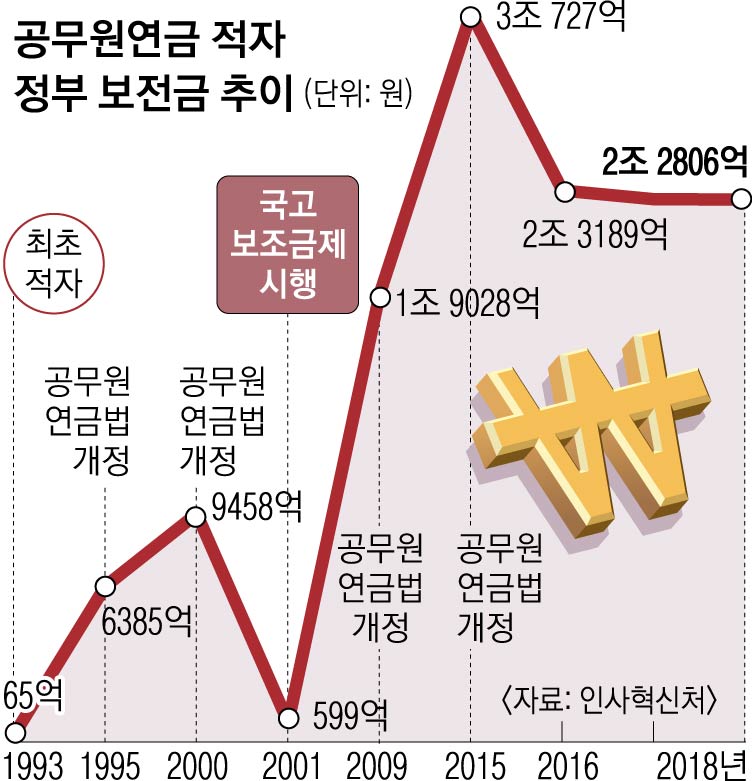
The Government Employees Pension deficit is projected to more than double, from 2.2 trillion won last year to 5.1 trillion won in 2028.
Some point out that this year, after the April general election, is the golden opportunity for pension reform, because with the local elections and the presidential election in 2022, pension reform will be practically impossible in the period around them.
This is the year of the Government Employees Pension “financial re-estimation” (a long-term review of pension finances, including the Government Employees Pension’s revenue and expenditure).
The whole world is now waging a “pension reform war,” including over civil servants’ pensions; French President Emmanuel Macron, for one, launched pension reform last year despite fierce union opposition.
Countries are reworking their pension systems in the direction of “paying more and receiving less” to reduce the fiscal burden from a working population shrinking under low fertility and population aging and from rising welfare budgets for the stability of people’s retirement.
Critics say that Korea, too, can no longer put off Government Employees Pension reform.
Through the 2015 pension reform, the government declared that it would save 72 trillion won in government subsidies for Government Employees Pension deficits by 2030, but contrary to the original plan, the subsidy burden is growing heavier.
According to the Ministry of Personnel Management on the 15th, the Government Employees Pension deficit subsidy was more than 2.3 trillion won in 2016 and more than 2.28 trillion won in each of 2017 and 2018, showing no decline.
These figures were 150 billion won, 130 billion won, and 84 billion won higher, respectively, than the deficit subsidies originally projected after the 2015 Government Employees Pension reform.
The Government Employees Pension, which survives on the public’s taxes, is a “critically ill patient who must go onto the operating table right away,” yet the government is sitting on its hands.
Moreover, the number of civil servants will grow by 174,000 by 2022.
The Government Employees Pension deficit will grow further, which can only lead in the end to a larger fiscal burden.
The government has reworked the Government Employees Pension four times so far, including in 2015, yet the deficit is growing instead because these were reforms “in name only.”
The problem of equity between the Government Employees Pension and the National Pension also remains unresolved.
Last year the average Government Employees Pension benefit was 2.4 million won a month, more than six times the National Pension’s 370,000 won.
Compared with the National Pension, called a “pittance pension,” the basic framework of the Government Employees Pension, called an “aristocratic pension,” must be changed, but civil servants, who are the stakeholders, are not giving up their vested interests. Pension privileges are also part of why even students at top universities these days line up for the Grade 9 civil service exam.
By contrast, Japan, whose history of introducing pensions is almost the same as Korea’s, at first had the state bear civil servants’ pensions, but through its 2015 pension reform it merged the civil-servant pension with the Employees’ Pension Insurance (the pension for company employees) and eliminated the preferential treatment civil servants had received.
Yun Suk-myung, Research Fellow at the Korea Institute for Health and Social Affairs (KIHASA), said, “The Government Employees Pension is a ‘time bomb’ about to go off,” adding, “Bold reform of the Government Employees Pension is urgent to prevent a fiscal collapse.”
Senior Reporter Choi Kwang-suk [email protected]

![(KBS TV. 이슈&뉴스] 공무원 연금, '세금 먹는 하마'?...'사회적 합의' 절실 (2013년 10월 23일)](/_next/image?url=%2Fuploads%2Feditor%2F2026%2F11%2Fcfe4824d207e450c8cad3a7c73e2fb04-Screenshot_20261122_221550_Samsung-Browser.jpg&w=128&q=75)