(Chosun Ilbo) “The Moon Jae-in Administration’s Attempt to Overhaul the National Pension Was a Fraud That Misled the Public and Ended There” (December 13, 2023)
(On Naver alone,
this interview drew 1,056 comments.
Without proper reform,
a ‘pension Goryeojang’ (abandonment)
could be our fate—that is the expression
used in this interview.)
[The People Sun Jung-min Meets]
25 Years of Pension Reform Research:
Yun Suk-myung, Research Fellow at the Korea Institute for Health and Social Affairs
“Without proper reform, a ‘pension Goryeojang’ at the hands of the MZ generation is possible”
Yun Suk-myung, a Research Fellow at the Korea Institute for Health and Social Affairs (KIHASA),
argued in an interview with this newspaper on the 3rd
that “pension reform has come to this pass because of those who distorted the problem of elderly poverty and exploited it for populism —
some politicians, civil servants, professors, and civic groups.”
Yun, who has sharply criticized government policy while belonging to a government-funded research institute,
said that “reform can succeed only if the government transparently informs the public of the facts about pension reform and of the course of its meetings.”
/Reporter Lee Tae-kyung
In his first policy address to the National Assembly since taking office, delivered last month, President Yoon Suk-yeol presented pension reform, together with labor and education reform, as one of three priority tasks for overcoming the crisis. That is a measure of how pressing it is. The government plans to create a ‘Public Pension Reform Committee’ as a social grand-compromise body to deliberate on pension reform. Rather than announcing a specific reform plan itself, the government intends to induce experts and stakeholders to come together and reach an agreement. For old-age income security, the government has also pledged to raise the Basic Pension from 300,000 won to 400,000 won a month.
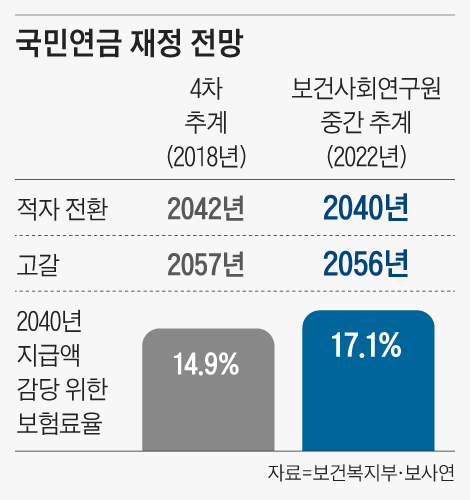
Options under discussion for reforming the National Pension include raising the contribution rate from its current 9% or adjusting the income replacement rate (the ratio of the amount received in old age to average lifetime income) at around 40%, in order to delay the depletion of the reserves, projected for 2057. The Government Employees Pension, the Military Pension, and the Private School Teachers Pension, which receive trillions of won from the national treasury every year, are also areas in urgent need of reform.
Pension reform has been a ‘hot potato’ for successive administrations. As population aging has increased the number of pension beneficiaries while the falling fertility rate has shrunk the economically active population, pension finances have continued to deteriorate. Every administration has known well that improvement is needed, but the political judgment that a ‘pay more, receive less’ reform does not help win votes has tended to take precedence. Yun Suk-myung, 61, a Research Fellow at KIHASA, a government-funded research institute, said that “the Moon Jae-in administration’s pension overhaul was a fraud perpetrated on the nation,” adding: “Pension finances become far worse 70 years out, at the end of the fiscal assessment period, yet the administration called a ploy that could only push back the fund-depletion date by a few years (along the way) a ‘fiscal stabilization plan’ and, under the fine-sounding banner of ‘strengthening public pensions,’ passed off deterioration as reform.”
He stressed that “over the years, some stakeholders, including certain civil servants and professors, have formed a cartel, concealing and distorting information and delaying pension reform,” and that “reform is impossible with an approach that says government finances should bear all the responsibility.” He proposed: “If the president steps forward just a little more actively, proper pension reform is possible. Let us produce a ‘pension reform fact report’ and live-stream the reform committee’s meetings on YouTube to raise transparency.”
Graphic: Song Yun-hye
The pension cartel of civil servants, professors, and others must be broken
-How urgent is pension reform?
“Whatever is falling has no wings. The accrued liabilities of the Government Employees Pension and the Military Pension reached 1,138 trillion won as of last year. The National Pension is a time bomb as well. It holds 928 trillion won in reserves (provisional figure at the end of March), but the reality of the National Pension is that its cumulative deficit will reach 17,000 trillion won by 2088. Merely to maintain the current pension system, the National Pension would have to raise its contribution rate from 9% to over 18%, and the Government Employees Pension would have to raise its rate more than twofold, from 18% to 38%. The Private School Teachers Pension also urgently needs reform. Although things deteriorate rapidly the longer reform is put off, the mood that dominates our society is ‘you worry too much’ and ‘that is decades away.’”
-How did things come to this?
“It has come to this because some civil servants and experts in collusion with particular administrations formed a cartel and did not disclose information properly. The Ministry of Economy and Finance and the Ministry of Personnel Management water it down by saying ‘accrued pension liabilities are not national debt,’ but it is all a burden on the people. Some in the political sphere and in civic groups are saying, ‘Let us put a provision for a state guarantee of benefit payment into the National Pension.’ Rather than even thinking about fixing the system, they are in effect saying the state should take responsibility for everything. There is probably no other country like this in the world.”
Merging the Government Employees Pension and the National Pension is the trend of the times
-Which is more urgent, the National Pension or the Government Employees Pension?
“The National Pension has been reformed twice: in 1998, just ten years after its introduction, and in 2007, less than 20 years after it. The Government Employees Pension was reformed in 2010 and 2015, but it still falls short of the level of the 2007 National Pension reform. When liabilities are growing by 100 trillion won every year for the sake of members of the special occupational pension schemes, such as the Government Employees Pension, who make up a mere 3–4% of the population, would the public accept reforming the National Pension alone? Unlike employees of private companies, civil servants mostly stay on until the retirement age, so their pension amounts keep growing, and because they pay twice as much, the government also pays twice as much for them. Operating the Government Employees Pension and the National Pension as an integrated system is the trend of the times.”
-How do you assess the Moon Jae-in administration’s attempt at pension reform?
“The Moon Jae-in administration’s pension overhaul plan was a fraud perpetrated on the nation. The fiscal assessment of the pension requires discussing system overhaul while looking at the fiscal condition 70 years ahead, but the Moon Jae-in administration shortened the assessment period to 40 years and put that forward as a reform plan. Given rising life expectancy, projections should cover at least 70 years, yet it misled the public with nothing more than a fund-depletion date pushed back by a few years.”
The Basic Pension’s National Pension–linked reduction must be abolished
-The progressive camp says the state can take responsibility for old age, as in Europe.
“Even the Nordic countries they say they admire, such as Sweden and Norway, have since the 2000s cut benefits considerably through pension reform and changed their systems toward selection and concentration on low-income older people. Finland introduced a ‘life expectancy coefficient’ that cuts pensions in step with rising life expectancy, and Germans pay contributions more than twice as high as ours. The claim that the state guarantees pension payment in Germany or Japan is also untrue.”
-Would raising the Basic Pension not help reduce elderly poverty?
“The Basic Pension, paid to 70% of all older people, falls far short in poverty-alleviation effect relative to what is put into it. It is true that Korea has the highest elderly poverty rate among the countries of the Organisation for Economic Co-operation and Development (OECD), but there is a ‘trap of averages.’ The bottom 25% of older people by income are the poorest group in Korea’s entire population, but by a conservative estimate, the top 50% of older people have more assets or income than people of all ages as a whole. For example, beneficiaries of the Government Employees, Military, and Private School Teachers Pensions and retirees from large companies are far better off than young people. Yet because of various deductions, an older person with, for example, earned income of 4 million won a month can still receive the Basic Pension. Moreover, even those who own expensive real estate are classified as poor older people if they have little or no disposable income at present. In fact, Korea has the lowest income-redistribution effect through transfer spending among OECD member countries. About one-third of Basic Pension beneficiaries are in absolute poverty, at 580,000 won a month or less, but another third are not poor older people even by the OECD’s relative poverty standard (970,000 won a month). Although the reality behind Korea’s high elderly poverty rate lies in the polarization of older people’s incomes, the political sphere hides this and abuses it as a means of winning older people’s votes.”
-In the last presidential election, most candidates pledged to raise the Basic Pension by 100,000 won.
“Even if it is raised, I believe it is right to raise it on a differentiated basis: about 100,000 won for the bottom 30% by income and about 50,000 won for the 30–50% bracket. Even if talk of a broken pledge arises and the president apologizes, part of it should be withdrawn, and that decision should stand before the judgment of history. The idea that poverty can be alleviated by an equal ‘1/n’ split is merely the by-product of a cowardly debate that has grossly distorted the concept of universal welfare adopted by European countries. The 49 trillion won of Basic Pension expenditure in 2030 is an enormous sum—enough to build 33 light aircraft carriers or seven medium-to-large aircraft carriers. In a country surrounded by the United States, China, and Russia, given defense spending, we cannot just keep harping on the OECD average. In past elections, the political sphere caused trouble every time, and in the end it created a Basic Pension paid to 70% of older people. If things go on like this, the next presidential candidates will have no choice but to pledge to raise the Basic Pension to 500,000 won.”
-What should be done about the linked reduction between the Basic Pension and the National Pension?
“It makes no sense to cut the Basic Pension once the National Pension reaches a certain amount. Because of this, vulnerable groups will be even less likely to join the National Pension. The linked reduction scheme, which undermines the principles of the pension system, should be abolished altogether. It is only natural that diligent National Pension contributors receive more, and at the same time efforts must also be made to alleviate absolute poverty.”
-What are the principles of pension reform?
“A pension must provide adequate old-age security, apply universally to the current generation, and remain sustainable for the next generation as well. Finding the greatest common denominator among these three dimensions is important, and political sustainability has now emerged as an important issue. If the current generation does not reform properly, there is also a possibility that the MZ generation, which took no part in the decision-making, will grow up and carry out a ‘pension Goryeojang,’ cutting off pension payments to the older generation. Trying to achieve every policy objective with the pension system alone makes problems hard to solve; the best solution must be derived by combining several systems, such as the National Basic Living Security System (NBLSS) and extended employment through labor-market reform.”
Closed-door reform talks should be opened to the public on YouTube
-How should the ‘Pension Reform Committee’ be run?
“If you go into past pension committees and social grand-compromise bodies, they select puppet members and then relentlessly pressure and threaten (the real experts). When you state the facts, they waste time nitpicking, and they openly speak for particular groups. All closed-door meetings should be live-streamed on YouTube and disclosed to the public. Before that, I propose that pension reform start with the publication of a ‘fact report.’ The idea is to begin by agreeing on a minimum set of facts: the agencies in charge of pensions would write a report and release it to the press, and experts would verify it.”
-Is pension reform possible?
“The atmosphere is much better now than in 2007, when the Roh Moo-hyun administration carried out pension reform. The political sphere just keeps making excuses, but I believe it is possible if the president steps forward just a little more actively. If the president shows the will, public opinion will likely help too. Pension reform is bound to be noisy—how could it be done quietly? But history will judge.”
☞Yun Suk-myung
He graduated from the Department of English Language and Literature at Korea University and received a master’s degree in economics from the same university. In 1997, he received his Ph.D. from Texas A&M University in the United States for research on the U.S. Social Security system and joined the Korea Institute for Health and Social Affairs. In 2000, he moved to the National Pension Research Institute, where he served as Director of the Research Coordination Office, and in 2006 he was recruited back to KIHASA, where he held posts including Director of the Social Security Research Division. He is now in his 16th year as a Grade 1 Research Fellow.
Sun Jung-min, Deputy Editor, Social Policy Department [email protected]