(The Scoop) Is the National Pension Politics’ ‘Slush Fund’? — The Truth Behind the 120 Trillion Won Evaporation [Perspective+] (October 23, 2026)
The Scoop: Perspectives from the Desk and the Field
(Behind the Bull Market, Part 8 )
Accountability in the Dark
Is the National Pension Fund Management Committee Independent?
The Problems Hidden in Decision-Making in the Dark
The Committee’s Structure Must Be Put on the Table for Innovation
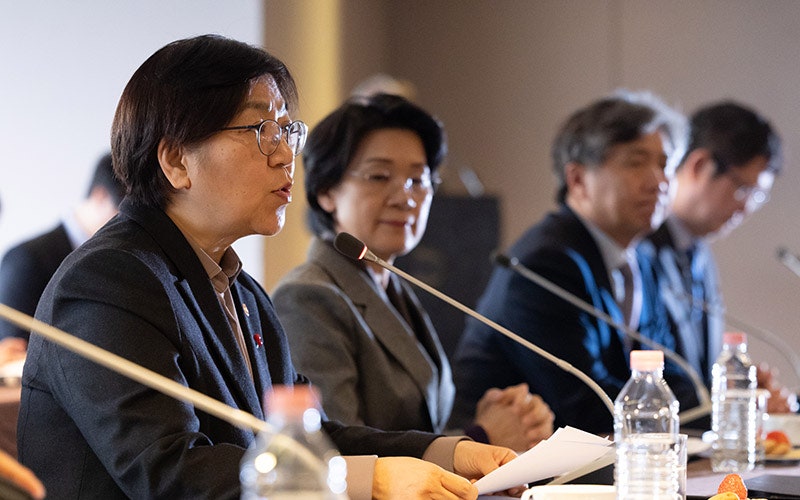
The chair of the National Pension Fund Management Committee is Minister of Health and Welfare Jung Eun-kyeong. Jung is a medical expert. [Photo | Newsis]
Pensions and the Government’s Imprint
The chair of the Canada Pension Plan Investment Board (CPPIB) is a private-sector expert. The board’s members, too, are experts such as CEOs from finance and business, economists, and lawyers. Canada is not alone in this. The Netherlands’ public pension fund (ABP) is similar in nature. Of the 13 members of the Board of Trustees, ABP’s highest decision-making body, 12 are representatives of workers and employers. Even at a glance, it is independent.
There is a reason the two countries have removed the ‘government’s imprint’ from the bodies that decide the investment direction of their pensions. The money these bodies manage is the people’s money, into which not even the government’s influence should be allowed to seep. What about Korea? Regrettably, it is the opposite. Those who have seized power have, without exception, tried to use the National Pension as their own ‘slush fund.’ As a result, this has often stirred controversy, and there have even been cases that escalated into legal problems.
A Fund Committee with Weak Independence
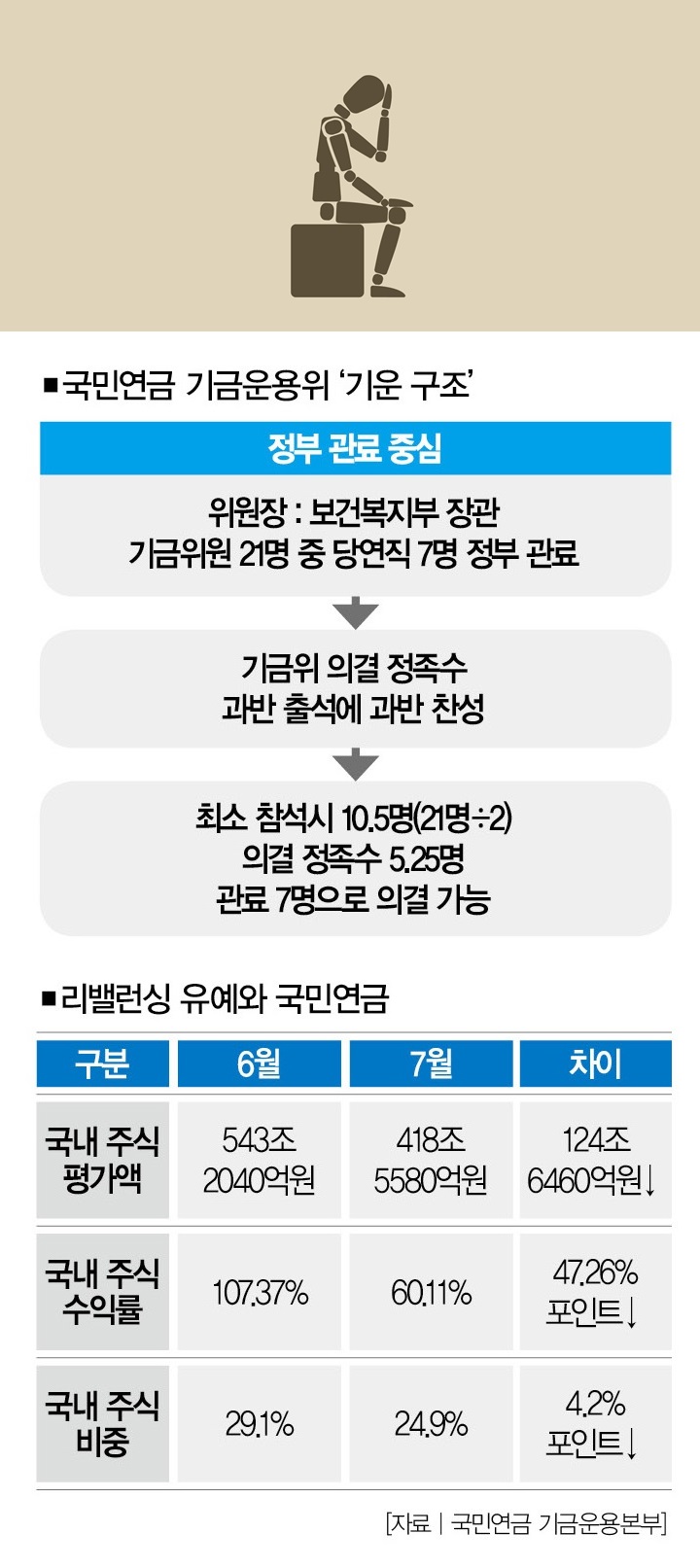
Will the Lee Jae-myung administration, which has proclaimed itself the ‘People’s Sovereignty Government,’ be any different? It is not easy to answer, because it is no different from previous administrations. The structure of the National Pension Fund Management Committee (hereinafter, the Fund Management Committee) is still not independent. The chair of the Fund Management Committee is the Minister of Health and Welfare (Jung Eun-kyeong). Of the committee’s 21 members, seven are ex officio, and all of them are government officials. Whether one wants it or not, it is a structure in which the ‘government’s influence’ cannot help but come into play.
Let us take an example. The Fund Management Committee’s quorum for resolutions is ‘attendance by a majority of members (11) and approval by a majority of the members present (5.25).’ If only the minimum number of members (11) attended a Fund Management Committee meeting, government officials alone could handle the people’s money as they pleased. Innovation or Regression?
Even so, the Lee Jae-myung administration and the ruling party have never signaled any intention of reforming this ‘government-biased system.’ Some point out that, far from innovating, they are in fact taking ‘steps backward.’ The reason is a bill co-sponsored in July by 11 lawmakers of the Democratic Party of Korea.
The gist of this bill, whose lead sponsor is Representative Park Sun-won, a Supreme Council member of the Democratic Party of Korea, is as follows: “… When there are grounds prescribed by Presidential Decree, such as sharp fluctuations in the market, the Minister of Health and Welfare may, after deliberation by the Fund Management Committee, temporarily suspend the sale or purchase of assets to achieve the target allocation….”
Simply put, the bill would have the ‘grounds for rebalancing’ the National Pension’s managed assets prescribed by Presidential Decree, which could become a factor threatening the Fund Management Committee’s independence. [※Note: Rebalancing means readjusting asset allocations that have shifted with market price fluctuations back to their target allocations through purchases and sales.]
View original [Graphic | The Scoop, Illustration | Getty Images Bank]
Operating in the Dark
Nor is the Fund Management Committee operated transparently. While managing the people’s money, it does not kindly disclose the process to the very people whose money it is. Examples abound. The Fund Management Committee has placed under a four-year seal the process by which it raised the National Pension’s target allocation for domestic stocks from 14.4% to 20.8% in January and May this year.
This decision increased the domestic stocks in the National Pension’s managed assets by 212.785 trillion won (from 330.419 trillion won at the end of January to 543.204 trillion won at the end of June), but the public will be able to learn the reasons and background only in 2030.
Moreover, the Fund Management Committee attached a proviso at the time that the ‘additional 212 trillion won’ could not be rebalanced until the end of June. In effect, the committee prevented the fund from buying and selling assets in line with market conditions, and there is no way to know why it made this decision either. It is a classic case of operating ‘in the dark.’
The Trap of the Rebalancing Suspension
The problem is that the opaque decision on the ‘rebalancing suspension’ narrowed the National Pension’s options in managing its assets. Unable to sell domestic stocks in the rising market of June, the National Pension failed to make ‘additional purchases’ in the plunging market of July. Meanwhile, the valuation of its domestic stocks fell by 124.646 trillion won (from 543.204 trillion won at the end of June to 418.558 trillion won at the end of July). This is precisely the truth behind the ‘controversy over the National Pension’s 124 trillion won evaporation’ that recently erupted during the National Assembly audit.
Of course, the government and the ruling party protest that ‘it is not a realized loss.’ That is not wrong. Even so, it does not change the essence of the problem. Let us hear the pointed criticism of Professor Kim Sang-bong (Economics) of Hansung University.
“The National Pension was not created with taxes. Because it is money paid in by contributors, there is an obligation to return it later. In this respect, blocking rebalancing is the same as saying not to make returns. If the rate of return turns negative when rebalancing has been held back, it is also unclear who should bear responsibility for that. Politics must not intervene in the market and damage the purpose of the National Pension.”

View original Is the decision-making structure of the National Pension Fund Management Committee truly transparent? [Photo | Newsis]
A Chronic Disease and the Alternatives
What do you think? Can we safely entrust our retirement assets to such an opaque Fund Management Committee? Is it not time to find an alternative that secures the committee’s independence? This is not a problem of the Lee Jae-myung administration alone. It is a chronic ill created by successive administrations. So there is no reason for the ruling and opposition parties to split over it.
Since this is a matter involving the people’s money, it must be put up for ‘public deliberation’ as soon as possible. That is the role politics must play for the people. It is for the same reason that we examined this issue in the final installment of our series ‘Behind the Bull Market.’ The National Pension is not the slush fund of those in power. It goes without saying.
Lee Yoon-chan, Editor-in-Chief, The Scoop
[email protected]
Kang Seo-gu, Reporter, The Scoop
[email protected]