
"Japan Ridicules South Korea's National Pension … The Four Public Pension Schemes Must Be Integrated" (August 9, 2022)
- #국민연금법
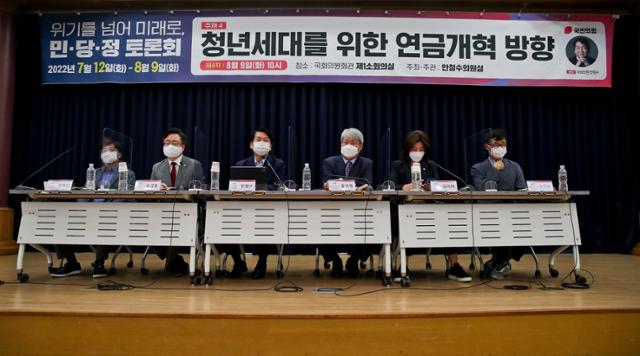
(Cumulative deficit of 20 quadrillion won by 2092 if the National Pension is left unreformed The presidential office is contemplating parametric reform … "Structural reform is necessary" The ruling party calls for "social consensus through a national referendum" Yet the Ministry of Health and Welfare remains passive, deferring the matter to the National Assembly)
"Two years ago, a Japanese government official asked me, 'What is South Korea's secret to collecting low contributions while paying out large benefits from the National Pension?' That was Japan — which has already integrated its public pension schemes — laughing at us. Neighboring countries see South Korea as entirely complacent about pension reform."
Yun Suk-myung, a Senior Research Fellow at the Korea Institute for Health and Social Affairs (KIHASA) and a pension specialist, made these remarks at a policy forum on "The Direction of Pension Reform for the Younger Generation," held on the 9th at the National Assembly Members' Office Building and hosted by Representative Ahn Cheol-soo of the People Power Party. He stated that "it is a mistake to be optimistic simply because 950 trillion won has accumulated in the National Pension Fund — that is being deceived by concealed information," and called on the audience to face the reality that future pension expenditures amount to 2,500 trillion won and that the cumulative deficit could reach 22,650 trillion won by 2092.
Experts attending the forum concurred that the sustainability of the National Pension is at a precarious level and that structural reform is urgently needed. The presidential office had recently indicated that it was considering "parametric reform" — a partial adjustment of the contribution rate (the contribution ratio) and the income replacement rate (the benefit rate) — and the experts criticized that fiscal soundness cannot be strengthened without structural reform.
(omitted) As an alternative, the experts proposed "the integrated operation of the four public pension schemes (the National Pension, Government Employees Pension, Private School Teachers Pension, and Military Pension)." The argument is that the benefit payment structures of the National Pension and the Government Employees Pension should first be unified, with the long-term goal of consolidating all four pension schemes into a single system. The experts explained that applying identical standards for calculating pensionable earnings and the income redistribution function would enhance intergenerational and inter-class equity. However, they added the condition that pension finances and institutional frameworks should be managed separately in consideration of conflicts among stakeholders. Japan already introduced such "pension unification" in 2015 in order to improve pension fiscal soundness. Senior Research Fellow Yun stated that "the reform would substantially reduce the massive national debt arising from the Government Employees Pension." (omitted) A proposal was also raised to introduce, adapted to Korean conditions, an "automatic stabilizer" model already in operation in some European countries. An automatic stabilizer is a mechanism whereby contributions are first raised significantly, after which benefit amounts are automatically reduced in accordance with the pace of population aging. This reduces the burden of having to repeatedly undertake parametric reform in response to changing fiscal conditions. (omitted) However, the Ministry of Health and Welfare, the ministry with primary jurisdiction, showed a passive stance toward structural reform and deflected responsibility for pension integration to the National Assembly. First Vice Minister of Health and Welfare Cho Kyu-hong stated, "Integrating public pension schemes is a matter to be discussed across multiple ministries, and since the interests of stakeholders are very intricately intertwined, it is desirable for the National Assembly to take the lead in those discussions." He also pushed back on the proposal to introduce an automatic stabilizer, saying, "While it may allow for flexible pursuit of fiscal stabilization, there is a concern that it could weaken old-age income security." https://m.hankookilbo.com/News/Read/A2022080916340003156![(연금연구회 성명서 보도. 노컷뉴스) [칼럼] 연기금 카지노 책임론?…'쉬운길' 선택의 결과일 수 있다 (2026.10.20.)](/_next/image?url=%2Fuploads%2Feditor%2F2026%2F10%2Fc6f13b0799b440d0874a9f72413c6f58-0004200449_003_20261020063615439-1.jpg&w=128&q=75)
![(연금연구회 성명서 보도. 중앙일보) [취재일기] 국민 노후보다 코스피를 지킨 국민연금 (2026.10.19. )](/_next/image?url=%2Fuploads%2Feditor%2F2026%2F10%2F7e92f70b0ec843bbb869a4cf46b01f72-0003558751_001_20261019052229249.jpg&w=128&q=75)