Pension Future Forum 11th Seminar — Press Release
- #국민연금법
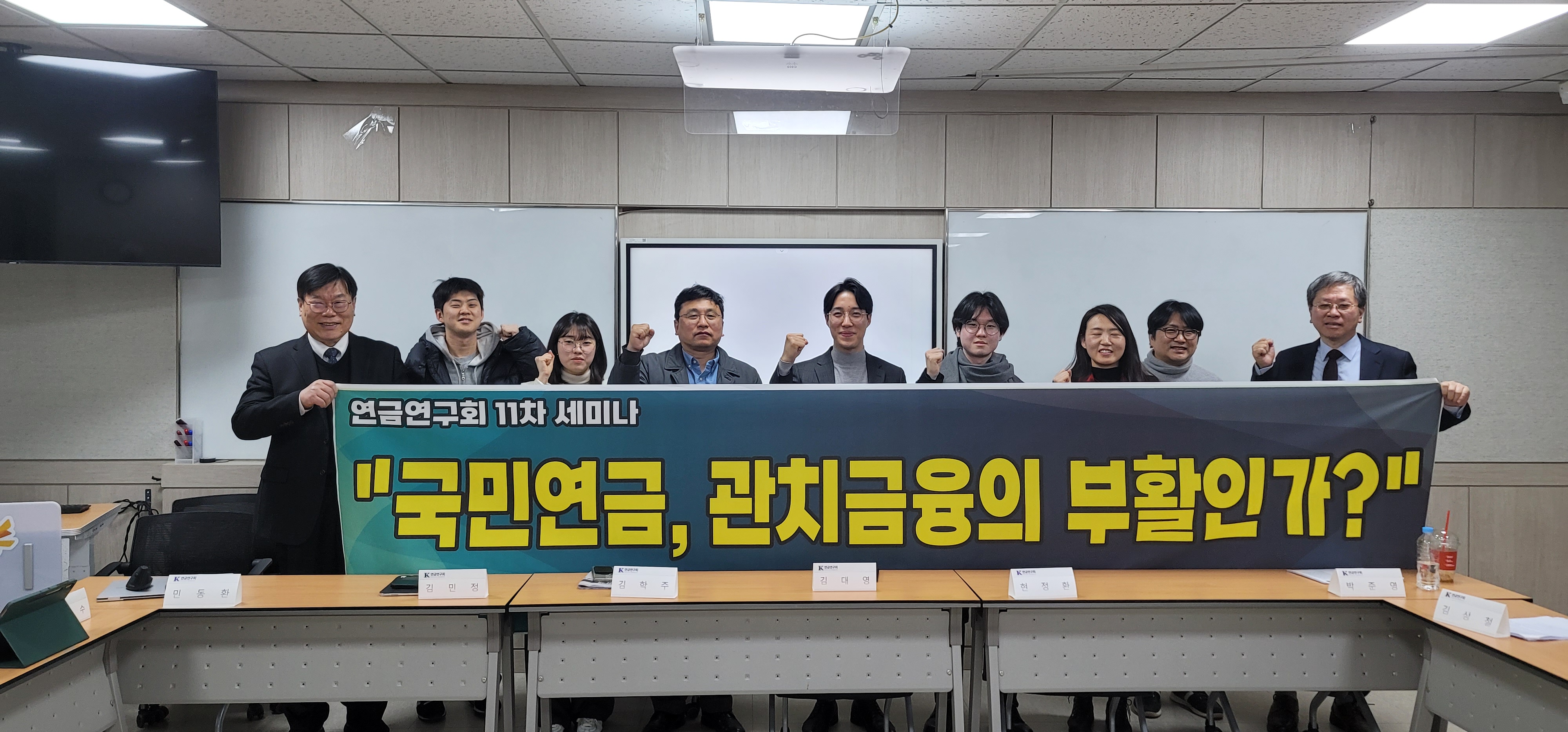
This is the press release for the Pension Future Forum's 11th seminar, held at Dongguk University on January 5, 2026, beginning at 3:00 p.m.
(Please refer to the attached file!)
(January 5, 2026)
Pension Future Forum 11th Seminar — Press Release
<Please report on this from 3:00 p.m. on January 5, 2026.>
The Pension Future Forum (Leader: Yun Suk-myung, Research Fellow Emeritus at the Korea Institute for Health and Social Affairs) will hold its 11th seminar at Social Science Building L306 (Smart Lecture Hall), Dongguk University, on January 5, 2026, beginning at 3:00 p.m.
This is a seminar on the theme "The National Pension: A Revival of State-Directed Finance?"
We ask for your keen interest and for your cooperation in reporting on it!
<Presenters' Press Release>
1. Hyun Jeong-hwan, Professor, Department of International Trade, Dongguk University
- Long-term assessment of the government's recent exchange-rate response -
The fundamental causes of the recent plunge in the value of the won (the surge in the exchange rate) include the fulfillment of the pledge to invest on the order of $20 billion a year in the United States, inflationary expectations stemming from fiscal expansion, and doubts about the adequacy and liquidity of the foreign exchange reserves.
Because the National Pension is the property of its contributors, using it as an instrument of exchange-rate stabilization is inconsistent with the purpose of the National Pension; it will simultaneously erode the National Pension's investment returns and stability, and it will bring forward the date of the National Pension's depletion.
Although the foreign exchange reserves are managed by the Bank of Korea, they are the property of the people, and so greater transparency in the management of those reserves, adherence to appropriate guidelines, and a reporting obligation to the National Assembly are required, and the public character of the foreign exchange reserves must be strengthened.
2. Kim Hak-ju, Department Chair, Department of Social Welfare, Dongguk University (Advisory Committee Member, 22nd National Assembly Special Committee on Pension Reform)
The Possibility of Policy-Driven Pension Fund Management and the Structural Tension in National Pension Governance - Focusing on a Normative Interpretation of the Investment Policy Statement (IPS) -
The National Pension is repeatedly invoked as a 'policy instrument' across a range of policy issues — exchange-rate stabilization, funding for public rental housing, the governance of financial companies — and the controversy is growing.
Professor Kim Hak-ju of Dongguk University diagnosed this phenomenon as a structural problem of 'new state-directed finance,' in which policy objectives flow into the criteria governing pension fund management even in the absence of any explicit instruction.
In his presentation paper he offered a normative interpretation under which the core of the National Pension's Investment Policy Statement (IPS) lies in 'maximizing long-term returns within permitted risk limits' and 'independence in fund management.'
He further pointed out that the current governance is vulnerable to the infiltration of policy objectives at the stages of agenda-setting, decision-making, and the assignment of accountability, and that this may weaken the sustainability of the system and intergenerational trust.
As concrete policy alternatives, he proposed the introduction of a dual-lock mechanism (Double-lock) for policy-linked agenda items, the statutory codification of a principle requiring government fiscal compensation whenever investment returns are impaired, and a meaningful strengthening of the independence of fund management governance.
<Discussants' Press Release>
1. Kim Dae-young, Certified Tax Accountant (Advisory Committee Member, 22nd National Assembly Special Committee on Pension Reform; representing the younger generation)
The National Pension is not the government's 'five-minute standby' ATM. That is because, under the pretext of defending the exchange rate, the government is itself leading what is plainly a 'breach of duty' — an act that in a private company would warrant immediate arrest — and is in effect waging a dangerous gamble with the survival of future generations as collateral.
A pension engulfed by the specter of state-directed finance has no future. The government must stop holding out its hand for the people's retirement savings and must guarantee the independence of fund management.
2. Kim Min-jeong, a member of the younger generation (Master's Program in Policy Studies, Seoul National University; Youth Representative, Public Deliberation Committee, 21st National Assembly Special Committee on Pension Reform; Former Youth Future Committee Member, National Assembly Futures Institute)
The issuance of foreign-currency bonds by the National Pension violates the core principles of fund management and is a measure that undermines the foundation of trust in the system as a whole. The National Pension is not a tax but a fund built on contributions that the people have accumulated in preparation for old age; it is an asset of the people, for which transparency and independence must be guaranteed ahead of any policy necessity whatsoever.
If, notwithstanding this, the pension fund is deployed for the purpose of a short-term macroeconomic response in the form of exchange-rate stabilization, 'independence of fund management' will be compromised, and a structure that accepts fixed interest costs and uncontrollable financial volatility erodes the principles of 'profitability' and 'stability.'
In particular, at a time when the younger generation's confidence in the pension is already low, the issuance of foreign-currency bonds will act as yet another trigger for a collapse of trust that threatens the sustainability of the system. We affirm that the National Pension is an old-age income security system grounded in an intergenerational agreement, and we urge that the fund be managed in a manner consistent with its intrinsic purpose and principles.
3. Min Dong-hwan, a member of the younger generation (Graduate Student, Department of Economics, Sogang University; Representative of Pension Reform Youth Action)
The amendment to the National Pension Act passed in March 2025 failed entirely to resolve the substantive problems of the National Pension and instead increased the burden on future generations.
The depletion of the National Pension Fund will go beyond a mere fiscal burden: it will have an enormous impact on both workers and businesses, to a degree that makes the expression 'pension socialism' no exaggeration.
A rising exchange rate is functioning as a factor that raises the rate of return on National Pension fund investments. The injection of National Pension funds for exchange-rate stabilization, carried out by the political establishment, is an act of shifting the burden onto future generations for the sake of the political establishment's own selfish short-term interests.
Injecting National Pension funds to stabilize the exchange rate has brought forward the date of the National Pension Fund's depletion and amplified the unfunded liability that future generations must bear. Selling the dollars held in the National Pension's overseas investment portfolio and drawing down the foreign exchange reserves in order to stabilize the exchange rate is a temporary expedient. Unless the problems cited as the fundamental causes — such as the interest-rate differential, the fiscal deficit, and the weakening of confidence in the won — are resolved, the exchange rate will rise again in time.
4. Park Jun-young, a member of the younger generation (Major in Industrial and Management Engineering, Kyung Hee University)
The shaking of the people's piggy bank by an uncool government and foreign exchange authorities is holding 30 years of the people's lives hostage for the sake of a mere 30 won on the exchange rate. A stopgap prescription that has forgotten its proper duty and its principles is nothing more than a state-scale currency-speculation gamble that stakes the nation and its people as the wager. A government that forgets history has no future!
5. Yun Suk-myung, Research Fellow Emeritus, Korea Institute for Health and Social Affairs (Advisory Committee Member, 22nd National Assembly Special Committee on Pension Reform)
The National Pension has made considerable efforts to secure transparency in fund management. The fruit of those efforts is that the scale or the direction of strategic and tactical asset allocation is determined only after a resolution of the National Pension Fund Management Committee. Strategic currency hedging conducted through the recently formed task force (TF) exposes considerable problems from the perspective of managing the National Pension Fund. This is because it amounts to forgoing the returns that would have been earned had such measures not been taken.
Under the 2025 National Pension Fund Management Guidelines, the National Pension is required to be managed in the order of profitability, stability, and public purpose. With respect to the strategic currency hedging that has recently become controversial, the guidelines lay down the principle that "no hedging is to be undertaken." It is a grave problem to tear down at a stroke, at the government's convenience, the Fund Management Committee and the fund management guidelines that rest on the National Pension Act.
Professor Kim Hak-ju's proposals in today's presentation — "the introduction of a dual-lock mechanism (Double-lock) for policy-linked agenda items, the statutory codification of a principle requiring government fiscal compensation whenever investment returns are impaired, and a meaningful strengthening of the independence of fund management governance" — must be put into effect without delay.