(Pension Future Forum Announcement) Additional Explanatory Material on the Biased Operation of the 21st National Assembly's Public Deliberation Committee (Posted October 11, 2026)
(On September 28, 2026, from 2:00 p.m.,
in Conference Room 1 of the National Assembly Members' Office Building,
the 22nd National Assembly Special Committee on Pension Reform hosted
a debate. There,
regarding the 21st National Assembly Public Deliberation Committee's
biased operation,
panelist Committee Member Yun Suk-myung raised objections.
After the debate, on the same day,
Oh Gun-ho, Co-Representative of Welfare State I Make, a panelist at that day's debate,
sent additional material
and asked that it be made properly known.
We are posting the relevant material here.)
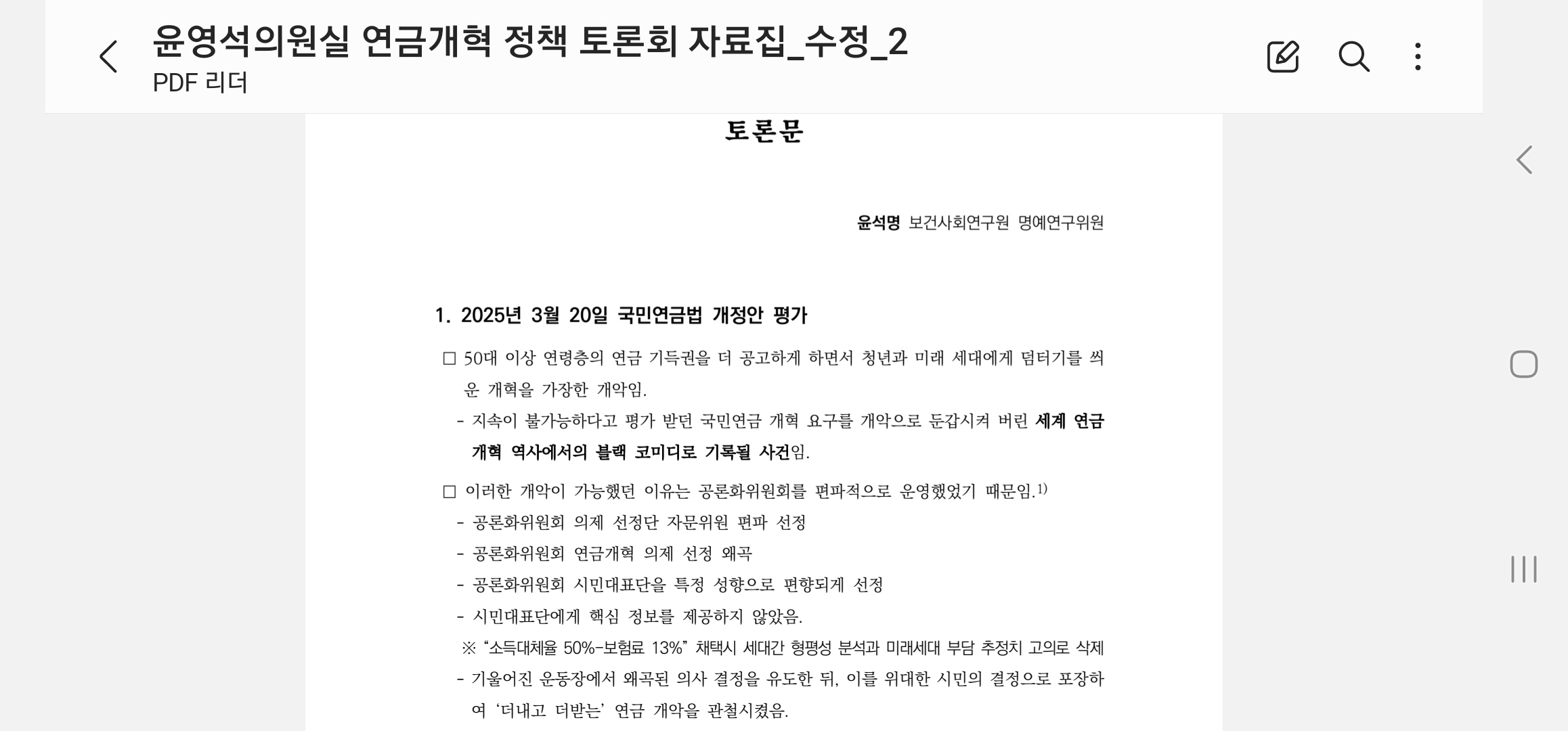
The following is the content of the discussion paper in which Committee Member Yun Suk-myung raised the problem at the September 28 debate.
<Assessment of the March 20, 2025 Amendment to the National Pension Act>
□ A deterioration disguised as reform, which further entrenched the pension vested interests of those aged 50 and over while saddling young people and future generations with the bill.
- An event in which demands to reform a National Pension long assessed as unsustainable were turned into a deterioration—an event that will be recorded as a black comedy in the history of pension reform worldwide.
□ This deterioration was possible because the Public Deliberation Committee was operated in a biased manner.
- Biased selection of the advisory members of the Public Deliberation Committee's agenda selection group
- Distortion of the Public Deliberation Committee's selection of the pension reform agenda
- Biased selection of the Public Deliberation Committee's citizen representatives toward a particular orientation
- Key information was not provided to the citizen representatives.
※ The intergenerational equity analysis and the estimates of the burden on future generations under the "50% income replacement rate–13% contribution rate" option were deliberately deleted
- After inducing a distorted decision on a tilted playing field, they packaged it as the great decision of the citizens and pushed through the "pay more, receive more" deterioration of the pension.
(The following is what Co-Representative Oh Gun-ho asked us to add. It is a JoongAng Ilbo article of April 25, 2024.)
A problem was found in the material for the income security argument (Plan 1) in the citizen representatives' learning video posted on the "Public Deliberation for Pension Reform" website. Professor Kim Yeon-myeong of the Department of Social Welfare at Chung-Ang University presents it on behalf of the income security argument.
Plan 1 raises the income replacement rate from 40% to 50% and contributions from 9% to 13%. Plan 2 embodies the fiscal stabilization argument, raising only contributions, to 12%.
In the final survey of the citizen representatives, 56% favored Plan 1 and 42.6% favored Plan 2.
In the video, Professor Kim said, "The core of the income security argument is how far to raise the level of public pensions (here referring to the National Pension) to secure old-age income. The income replacement rate (the ratio of the old-age pension to lifetime average income) is set to fall to 40% (42% this year), and the central claim of the income security argument is to raise it to 50%."
Showing how the old-age pension of a 40-year contributor changes if the income replacement rate rises from 40% to 50%, Professor Kim stressed that raising the replacement rate is unavoidable.
The figures are presented for three groups: a low-income group (lifetime average income of 1.5 million won), an average-income group (3 million won), and a high-income group (5.9 million won). A contributor earning 3 million won who pays contributions for 40 years would see the monthly pension rise by 300,000 won, from 1.2 million won to 1.5 million won.
Professor Kim went on to say, "It is designed so that low earners gain relatively more."
According to the video material, a low earner with a lifetime income of 1.5 million won would see the monthly pension rise by 500,000 won, from 630,000 won to 1.13 million won. A high earner's would rise by 450,000 won, from 1.78 million won to 2.23 million won. By Professor Kim's account, the low-income group gains the most.
Professor Kim gave the explanation while displaying a graph of the changes in pension amounts on the screen.
The error lies in the low-income part.
Professor Kim put the pension at 630,000 won at a 40% income replacement rate and explained that raising the rate to 50% would increase the pension by 500,000 won.
But 630,000 won is the wrong figure.
According to the National Pension Service's table of expected pension amounts, the correct figure is 900,650 won. Contrary to Professor Kim's claim, the actual increase is only about 230,000 won.
The increase was wrongly presented as more than twice the actual amount.
In reality, raising the income replacement rate increases the pensions of the high-income group the most and those of the low-income group the least.
Moreover, because many in the high-income group are employees of large companies who pay contributions for a long time, they benefit more from an increase in the replacement rate.
Oh Gun-ho, Chair of the Policy Committee of Welfare State I Make, points out in his book, "Raising the income replacement rate concentrates the effect more on the high-income group."
Yet Professor Kim misleadingly suggested that the low-income group benefits more.
Before distributing this video and three kinds of explanatory materials to the 500 citizen representatives, the Public Deliberation Committee conducted a first survey (March 22–25),
in which support for Plans 1 and 2 stood at 36.9% and 44.8%, respectively.
In the second survey after the materials were distributed (on the 13th), this reversed to 50.8% and 38.8%.
After that, the erroneous material was not corrected through the first to fourth debates and the final survey (on the 21st).
Moreover, it was only belatedly, on the 17th, that the video material was posted on the Public Deliberation Committee's website for the general public to see.
Professor Kim Yeon-myeong said, "The figure is indeed wrong. I meant to correct it but missed it."
Professor Kim said, "Viewed as a whole, I think it is an excessive interpretation to see a single figure on one slide (of the presentation) as having had a major effect (on the result)."
Welfare Specialist Reporter Shin Sung-sik