Bifurcation into an "Old Pension" and a "New Pension": The Truth About the National Pension as Articulated in the KDI Reform Proposal (Hankook Ilbo Deep&wide, March 18, 2024)
- #연금특위
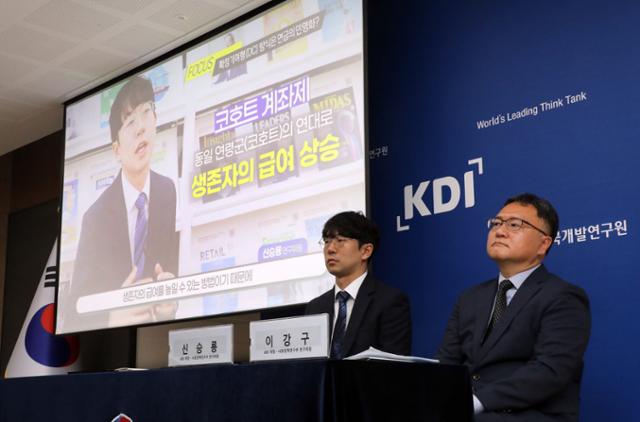
The reform proposal put forward by the Korea Development Institute (KDI) — calling for a dualization of the National Pension — has been attracting considerable attention. KDI has proposed restructuring the system so that benefits are commensurate with contributions, with all National Pension insured enrolling in a new pension scheme from the point of reform. The proposal envisions operating the current National Pension as an "old pension" and the new scheme as a "new pension," with the two running in parallel.
◇ The KDI Reform Proposal as a Lens on the Vulnerabilities of the National Pension
The problems of the National Pension are confirmed in the data as well. While the majority of OECD member countries have adopted fully earnings-proportional pension systems, Korea applies a contribution rate of only 9% — half the OECD average of 18% — despite incorporating an income redistribution function.
KDI appears to estimate the pension payment shortfall through 2023 at 609 trillion won, inclusive of such factors. Furthermore, it projects that a delay of approximately five years in implementing reform would cause the shortfall to surge to 869 trillion won. The KDI proposal appears to have been advanced with the aim of accelerating reform in order to prevent further growth of the liability.
It is important to note that even the KDI estimate represents a minimum figure. The unfunded pension liability — the shortfall relative to the total pension payments required to cover current beneficiaries and the insured until their deaths — amounts to 1,825 trillion won (as estimated by Professor Jeon Young-jun of Hanyang University, a member of the Pension Future Forum). The proposal is for the state to assume responsibility for the shortfall while ensuring that the new pension does not accumulate additional liabilities. To this end, the plan calls for all of the insured to transition to the new pension beginning in 2024, under which benefits will be strictly proportional to contributions paid.
KDI projected that raising the contribution rate to 15.5% in 2024 alone, combined with sound fund management, would make it possible to achieve an annual investment return of 4.5%. The proposal also allows for an income redistribution function to operate within specific birth-year cohorts — that is, within the same cohort. Through the Cohort Collective Defined Contribution (CCDC) mechanism, the income redistribution function would be able to operate even under a defined contribution (DC) framework.
◇ The KDI Proposal as a Desirable Direction in Broad Outline
Viewed in broad outline, the KDI proposal appears to represent a desirable direction for reform — if it can actually be implemented. The difficulty is that even this proposal rests on rather optimistic assumptions. Most notably, it assumes that the total fertility rate will rise to 1.21 by 2040, whereas Statistics Korea has already projected a decline to approximately 1.0. The feasibility of achieving an average annual investment return of 4.5% must also be examined carefully. The proposal assumes an identical return for all cohorts despite the fact that different generations will experience different phases of economic boom and recession. Cohorts that are unlucky in this regard are likely to receive less than they contributed even under the KDI proposal's principle of benefits commensurate with contributions.
https://www.hankookilbo.com/News/Read/A2024030813370000072
![(A Column Criticizing the Composition of the Public Deliberation Committee's Advisory Group) The Direction the National Assembly's Pension Public Deliberation Committee Should Take [Opening the Morning] (February 29, 2024)](/_next/image?url=%2Fuploads%2Feditor%2F2026%2F09%2F0f71042c781c4ddc88219c0c242968f4-0000787991_001_20240229061156460.jpg&w=128&q=75)
![The IMF's Alarming Warning About the National Pension [Opening the Morning] (2023.12.07.)](/_next/image?url=%2Fuploads%2F2026%2F02%2F0000774057_001_20231207074901525.jpg&w=128&q=75)