(Newspim Report on the National Assembly Special Committee on Pension Reform) An Era Is Coming Where One Working-Age Person Supports One Older Person — Making the Retirement Pension a Quasi-Public Pension Is 'Urgent' (Posted September 28, 2026)
Retirement Pensions Grow to 500 Trillion Won
No Direct Impact from Population Aging
Toward a Core Pillar of the Multi-Tiered Pension System
Stronger Savings Through Limits on Early Withdrawals and Termination
Higher Returns Through Wider Coverage and Fewer Products
[Sejong = Newspim] Reporter Shin Do-kyung = Calls came one after another to move quickly on 'making the retirement pension a quasi-public pension'—under which retirement pensions, now grown to about 500 trillion won, would be received as a pension rather than as a lump sum—in order to build a sustainable old-age income security system.
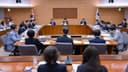
At the 'Policy Debate on Structural Reform for a Sustainable and Fair Pension System,' held on the 28th in Small Conference Room 1 of the National Assembly Members' Office Building, pension experts said that retirement pension reform is important as a core pillar for making up for the National Pension's fiscal limits and completing the multi-tiered old-age income security system.
◆ One Working-Age Person to Support One Older Person in 46 Years — Shifting Retirement Pensions from Lump Sums to Pensions Is 'Urgent'
Korea's pension system currently has a 'pay-as-you-go' structure where the contributions paid by the current working generation are immediately used to pay pensions to the currently retired older generation. Unlike a 'funded' system, where one's own contributions are accumulated and withdrawn later with interest, it is based on the principle of 'intergenerational support.' Accordingly, as the older population grows in a super-aged society, the problem of fund depletion is emerging.
Last year, the Ministry of Health and Welfare implemented the third pension reform to solve the fund depletion problem. Under it, the National Pension contribution rate (the amount paid in), previously 9%, is raised by 0.5 percentage points a year for eight years to 13%, and the income replacement rate (the amount received) has been raised to 43% as of this year.
However, the old-age dependency ratio is projected to soar. According to a presentation by Professor Yang Jae-jin of the Department of Public Administration at Yonsei University, 4.1 working-age people supported one older person in 2022. But in 2072, 46 years from now, one working-age person will have to support one older person.
Experts said that since Korea's pension system is multi-tiered, the pension reform should be followed by an overhaul that makes the retirement pension a quasi-public pension.
Korea's pension system consists of the Basic Pension, the National Pension, the retirement pension, personal pensions, and the special occupational pension schemes (the Government Employees, Military, and Private School Teachers Pensions). The argument is that since the retirement pension is not directly affected by population aging, it should be converted to pension form rather than being received as severance pay.
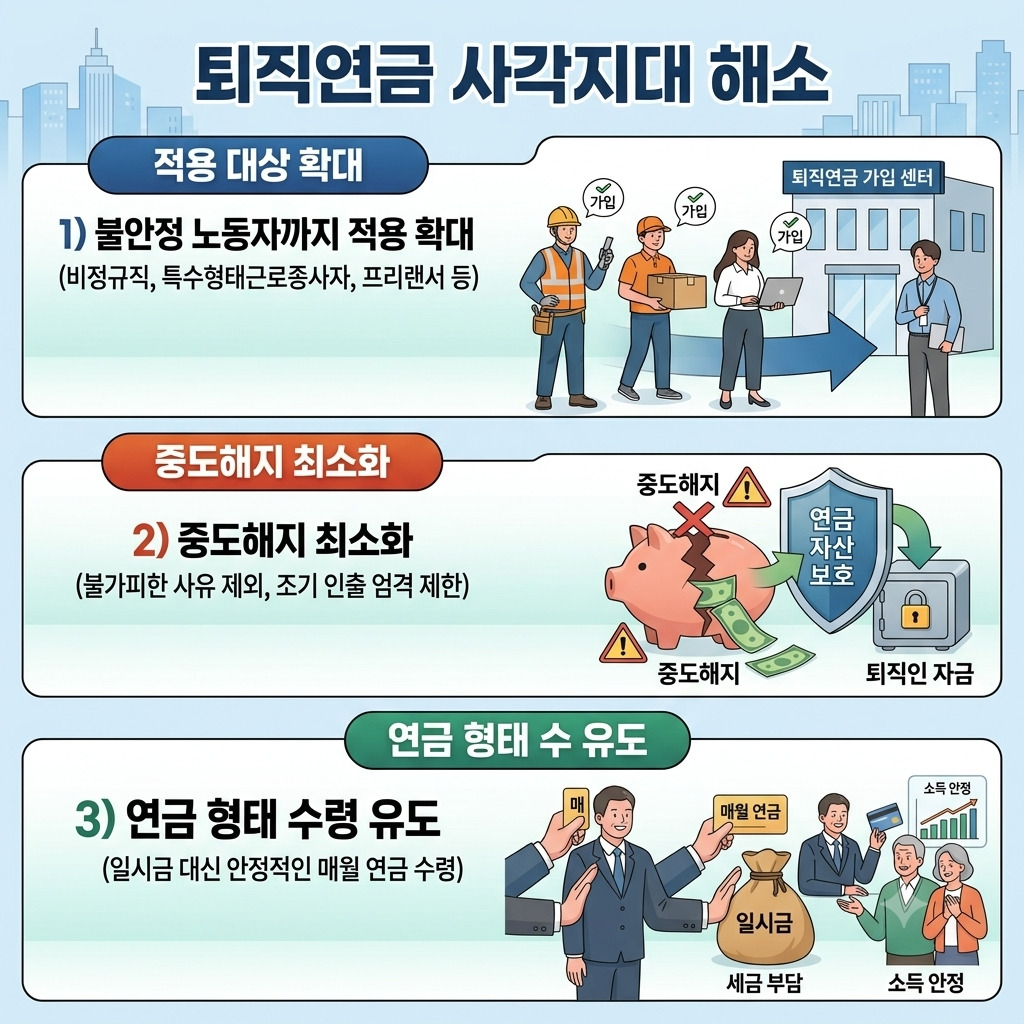
Professor Yang emphasized, "Converting severance pay into retirement pensions must be made mandatory, and their savings function must be strengthened by strictly restricting early withdrawals and the termination of Individual Retirement Pension (IRP) accounts." He added, "Receiving benefits as a pension rather than as a lump sum after retirement should be made the rule."
He stated, "If the retirement pension is converted into a genuine pension, it can supplement the lowered income replacement rate of the National Pension up to approximately the 20% level."
Professor Kim Hak-ju of Dongguk University also voiced the need to turn the retirement pension into a genuine pension.
Professor Kim pointed out that poverty rates vary by older generation, from 56.3% for those born in the late 1930s to 18.7% for those born in the late 1950s. Saying that the current overhaul of the National Pension alone cannot solve poverty, he proposed that lump-sum receipt of retirement pensions, which currently stands at 90%, be restricted in principle.
◆ Retirement Pension Coverage Must Be Expanded — 'Boosting' Returns with Fewer Products
Oh Gun-ho, co-representative of Welfare State I Make, presented specific guidelines for converting retirement benefits into pensions.
Although the retirement pension is a statutory mandatory system, it applies only to workers employed on a regular basis for one year or more. Oh said that the law must be amended to extend retirement pension coverage to precarious workers and to allow short-term contract workers to enroll in a retirement pension during their employment period.
Like Professor Kim, he also emphasized minimizing the early termination of retirement pensions. Under the current system, retirement pensions may be terminated at will when workers change jobs, making it difficult to build up reserves. Among new retirement pension beneficiaries last year, the average accumulated amount for those receiving a pension was 150 million won, while for lump-sum recipients, it was 18 million won.
Oh stated, "While the proportion of new retirement pension beneficiaries receiving a pension instead of a lump sum is increasing, it remains at a low level," adding, "People must be encouraged to receive their retirement pensions in the form of a pension upon retirement."
He stated, "Policies should be designed to secure reserves by regulating early termination, and to encourage the receipt of pensions."
Yun Suk-myung, Research Fellow Emeritus at the Korea Institute for Health and Social Affairs (KIHASA), emphasized converting retirement pensions to a fund-based system and making their investment management more efficient.
Committee Member Yun suggested, "To maximize the interests of the insured, Australian-style retirement pension operating principles should be introduced." He added, "Competition among retirement pension providers should be encouraged, and the number of qualified retirement pension products should be reduced to 50 or fewer to significantly raise the returns for the insured."