(JoongAng Ilbo Report on the Debate) Proposal to Put 100 Trillion Won in Excess Semiconductor Tax Revenue Into the National Pension — Government: "Funds for Other Areas Will Decrease" (Posted September 28, 2026)
(This is a JoongAng Ilbo article
that covers the debate in detail
from a neutral standpoint.)
A proposal has been made to inject 100 trillion won in excess tax revenue collected from the semiconductor boom before the National Pension Fund is depleted.
The intent is that by expanding the fund in advance and accumulating investment returns, the burden on future generations can be reduced.
On the other hand, a counterargument was raised that the imbalance between contributions and benefits must first be reduced. The government expressed the position that an accurate long-term financial diagnosis is necessary before injecting funds from the national treasury.
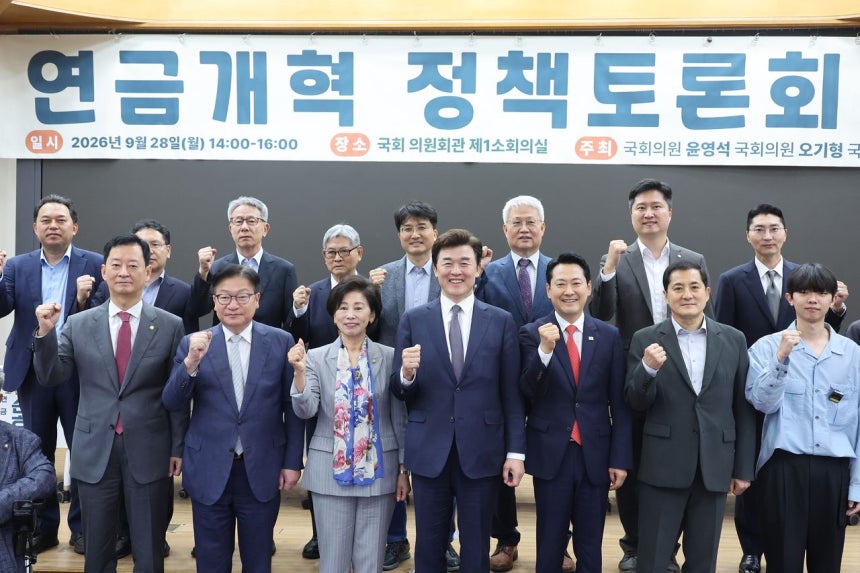
At a pension reform policy debate held on the 28th, organized by Chairman Yoon Young-seok of the National Assembly Special Committee on Pension Reform and the committee's ruling- and opposition-party secretaries, Representatives Oh Ki-hyung and Ahn Sang-hoon, Professor Yang Jae-jin of Yonsei University, who gave the presentation, stated, "The goal is to ensure that the fund is not depleted and can continue to generate investment returns."
It is a proposal to enjoy the compounding effect by injecting funds now, rather than putting in massive amounts of taxes after the fund has run dry.
Professor Yang presented a plan to inject a total of 100 trillion won—50 trillion won per year for the first two years—and subsequently inject 0.25% of the gross domestic product (GDP) every year.
The plan maintains a contribution rate of 13% and an income replacement rate of 43%, while gradually raising the pension eligibility age to 68.
Professor Yang estimated that if the fund return is assumed to be 5.5% per year, a fund equivalent to 9.5 times the annual pension expenditure will remain even after 70 years.
However, Professor Kim Hak-ju of Dongguk University countered, "Attempting to solve the problem by increasing investment returns while leaving the imbalance unattended is ultimately nothing more than building a sandcastle."
He argued that the balancing contribution rate corresponding to a 43% income replacement rate is 21.2%, so a gap remains even if the contribution rate is raised to 13%.
On the injection of national treasury funds, too, he said, "The money for the Future Fund does not fall from the sky either; in the end, it is taxpayers' money."
The government also urged caution. Shin Sang-hoon, Director General of the Economic Structural Reform Bureau at the Ministry of Finance and Economy, said, "Once public funds are injected, the injection is likely to continue for a considerable period,"
adding, "The burden would have to be borne by means other than contributions, and it would also shrink the resources available for other areas."
He went on to say that, rather than first deciding whether to inject public funds, the government should draw on a long-term financial diagnosis to examine approaches that serve sustainability and intergenerational equity.
Opinions were also divided over the automatic adjustment mechanism, which adjusts pension amounts and other parameters according to life expectancy or the scheme's fiscal condition.
Professor Kim compared this to a "seatbelt," stating, "If the return rate remains high at over 6%, it will not be triggered."
Yun Suk-myung, Research Fellow Emeritus at the Korea Institute for Health and Social Affairs (KIHASA), also said that the longer the introduction is delayed, the more the burden will fall on future generations,
arguing, "Why should only the insured share the pain? Beneficiaries must share the pain, too."
On the other hand, Oh Gun-ho, co-representative of Welfare State I Make, stated, "The automatic adjustment mechanism should be installed after the existing system has established a stable framework with a certain balance between contributions and benefits."
His point is that designing the system—its contributions and fund, and its response to rapid aging—must come first. He believed that fears of benefit cuts could deepen distrust of the National Pension.
The Ministry of Health and Welfare countered criticisms from some quarters that the effects of last year's pension reform were an optical illusion resulting from raising the assumed return rate.
Jeon Myeong-suk, Director of the National Pension Policy Division at the Ministry of Health and Welfare, explained, "Under the 4.5% return assumption, the projected date of fund depletion was pushed back by eight years," adding, "The 4.5% figure is the official projection." Her point was that the ministry had merely presented, alongside it, a projection applying the 5.5% target return rate, and had not changed the official assumption.
She explained, "The government has absolutely no intention of inflating the return rate to mislead the public with an optimistic picture."
Reporter Lee Esther [email protected]