(Asia Today Report on the Special Committee on Pension Reform Debate) At This Rate, Half of Monthly Income Will Go to the National Pension in 2070 — Calls for Structural Reform (September 28, 2026)
(The Pension Future Forum
is deeply grateful to Asia Today
for its report, which most accurately
captured the key issues of today's debate,
focusing on the points
that the Forum
has long emphasized.)
National Assembly Policy Debate on Pension Reform
Multi-tiered Solutions by Generation Essential for Elderly Poverty
Experts have warned that if the current parametric reform plan is maintained and the pension system is converted to a pay-as-you-go (PAYG) system in the future, future generations will have to pay nearly half of their income as National Pension contributions.
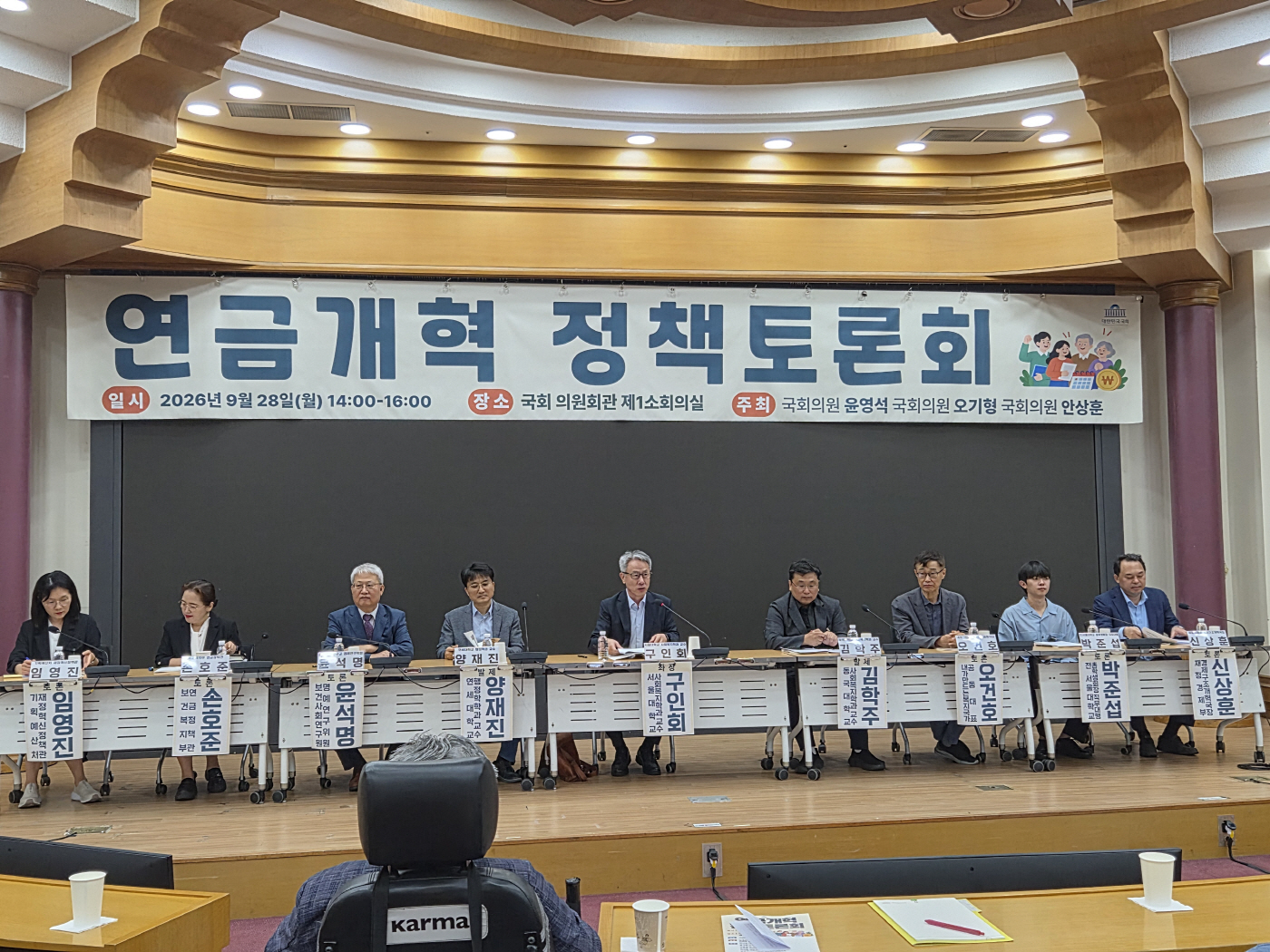
At a policy debate held at 2:00 p.m. on the 28th at the National Assembly Members' Office Building, co-hosted by Representative Yoon Young-seok of the People Power Party, Chairman of the Special Committee on Pension Reform, and the committee's secretaries, Representative Oh Ki-hyung of the Democratic Party of Korea and Representative Ahn Sang-hoon of the People Power Party,
structural reform measures were discussed intensively to ease this fiscal burden on the younger generation while at the same time underpinning old-age income security and securing the long-term sustainability of the system.
Professor Kim Hak-ju of Dongguk University, who gave the presentation that day, sharply criticized the amendment to the National Pension Act passed in 2025 (income replacement rate 43%, contribution rate 13%), stating, "It is a statistical illusion that pushed back the date of depletion through arbitrarily optimistic assumptions about fund investment returns, and in reality a deterioration that passes unfunded pension liability on to future generations."
According to Professor Kim's analysis, if the amendment is maintained and the mandatory contribution age is extended to 64 in step with a higher retirement age, the National Pension's PAYG cost rate will soar to as much as 41.2% in 2081.
In particular, it was estimated that young people aged 19 and under as of 2024 will face a serious crisis in 2078, when pension expenditure peaks, bearing a cost rate of as much as 43.2% of their own income.
Park Jun-seop, former acting president of the Seoul National University student council, who took part in the debate, pointed to the anxiety and distrust over fund depletion that pervade the younger generation.
He stressed that young people want not only the expected effects of the system but also its limitations and the conditions for achieving them to be disclosed transparently, and that on this basis the reform must be backed by a productive deliberative process that takes intergenerational equity into account, including the separation of old and new pensions and guaranteed participation for young people.
◇ Experts: "Inject national treasury funds in advance and increase fund returns" VS "Cannot leave the old-age security of citizens to exogenous variables"
At this debate, a tense clash of opinions continued between Professor Yang Jae-jin of Yonsei University and Professor Kim Hak-ju of Dongguk University over specific structural reform methods and fund injection plans for pension fiscal stabilization.
Professor Yang Jae-jin warned of the looming crisis of the PAYG system and urged a transition to a 'Partially Funded Defined Benefit (DB)' system, which uses an accumulated fund of overwhelming size to generate investment returns that finance benefits.
Professor Yang argued, "Before the fund is depleted, the excess tax revenue generated by the semiconductor boom and other factors (approximately 100 trillion won over the first two years) must be injected preemptively and intensively to maintain the capital stock and maximize the compounding effect."
He stated that if structural reform fails and the fund is depleted in 2065, 39.2% of income will be collected in 2079, or a massive amount of taxes—up to 6.3% of GDP annually—will be injected, causing the tax burden on future generations to explode.
Furthermore, he added that targeting should be strengthened by narrowing the Basic Pension eligibility from the bottom 70% of income to '100% of median income or below,' and a 'Future Fund' using excess tax revenue should be created to prevent a future explosion in expenditure.
However, some also point out that variables such as swings in economic conditions are far from negligible.
In particular, there was also a rebuttal that injecting national treasury funds amounts to collecting taxes to support the pensions of the wealthy and is, if anything, regressive.
Professor Kim Hak-ju diagnosed that the essence of the crisis lies not in the external environment of low fertility, but in the actuarial imbalance of 'low-contribution, high-benefit' that has persisted since the system was introduced.
Instead of relying on fund returns or the national treasury, Professor Kim proposed the introduction of a 'Korean-style hybrid fiscal stabilization mechanism' as the solution.
He argued that as a first stage, a 'Finnish-style life-expectancy coefficient' that adjusts the pension amount as life expectancy increases should be introduced immediately,
and as a second stage, the system should be restructured into a purely earnings-related system based on contributions, followed by the full application of a 'Swedish-style automatic balancing mechanism.'
He also stressed that the Basic Pension should abolish its uniform payment to the bottom 70% and shift to a 'more for the lower, less for the upper' (下厚上薄) structure that concentrates support on vulnerable older people exposed to absolute poverty.
◇ Pension solutions must not be one-size-fits-all—the current debate on income replacement and contribution rates applies only to 'high-income, stable workers'
It was also pointed out that solutions for the National Pension should not be put forward on the assumption that the elderly poor form a single group.
Professor Kim Hak-ju pointed out, "While the elderly poverty rate for those born in the late 1930s is 56.3%, it is 18.7% for those born in the late 1950s, falling sharply with each more recent generation," adding,
"For those born in the 1930s and 40s who have already retired and have no history of pension participation, current discussions on the income replacement rate or contribution increases provide no practical help."
He went on to add, "For the oldest generation, the National Basic Living Security System (NBLSS) must be strengthened, and for the new middle-aged generation, solutions suited to their generation's circumstances, such as promoting the Housing Pension and supporting re-employment after retirement, must be pursued in parallel."
Some also raised concerns about a 'poverty trap,' in which people with bad credit or low incomes stay in informal work to avoid having their wages garnished, and about the risk that a uniform expansion of pension coverage could produce a crowding-out (substitution) effect involving foreign workers in sectors such as platform labor.
Regarding this, Yun Suk-myung, Research Fellow Emeritus at the Korea Institute for Health and Social Affairs (KIHASA), suggested, "Rather than unconditionally injecting taxes just because a group is vulnerable, we should link Korea's excellent IT technology with the platform market to formalize income, and the state should provide support on the premise that the individual contributes a certain portion."
He then said, "The uniform increase in the income replacement rate and the generous arrears-payment system now under discussion are structures that channel benefits to those who have long held good jobs or who have lump sums of money,"
adding, "A 'restrain the strong, support the weak' (抑强扶弱) reform must be pursued in parallel, overhauling the pension system into one that pays out only what one has paid in and channeling the savings to the truly vulnerable, such as multiple jobholders and platform workers."
Research Fellow Yun also pointed out that the seniority-based pay system should be overhauled into a job-based pay system and that, at the same time, labor market reforms such as re-employment after retirement must follow.
Meanwhile, Chairman Yoon Young-seok of the National Assembly Special Committee on Pension Reform stated that discussions regarding the retirement pension, one of the core pillars of establishing a multi-tiered pension system, remain at a standstill.
Chairman Yoon said, "To make the retirement pension a genuine public pension, mandatory participation must be extended to small and medium-sized workplaces, but strong opposition from owners of very small businesses who lack the financial capacity is a foregone conclusion," adding,
"There needs to be a strong will for implementation at the government level, but currently, an integrated plan is absent."
Reporter Lee Jung-yeon [email protected]