(Newsis Report on the Debate Hosted by the 22nd National Assembly Special Committee on Pension Reform) "Pension Reform Is Unfavorable to Those in Their 20s — A Realistic Automatic Adjustment Mechanism Must Be Introduced" (Posted September 28, 2026)
Claims have been raised that the current National Pension may be unfavorable to young people because of demographic change, the imbalance between contributions and benefits, and other factors, and that an automatic adjustment mechanism, among other measures, needs to be introduced to enhance its sustainability.
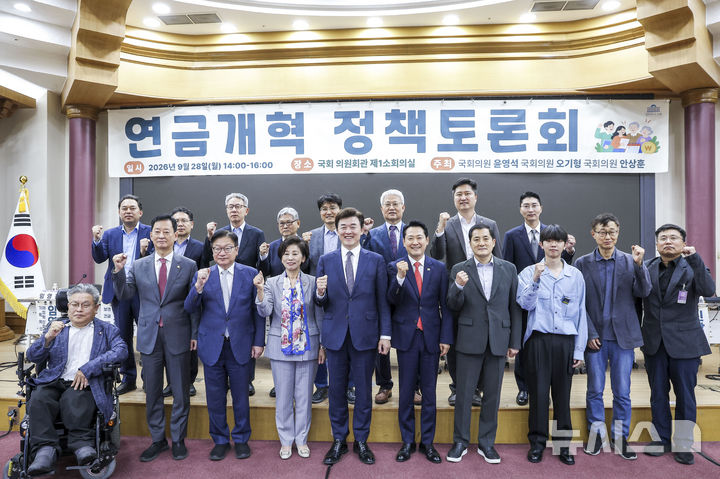
On the afternoon of the 28th, a policy debate on pension reform was held at the National Assembly, jointly hosted by Representative Yoon Young-seok of the People Power Party, Chairman of the Special Committee on Pension Reform, and by the Committee's secretaries, Representative Oh Ki-hyung of the Democratic Party of Korea and Representative Ahn Sang-hoon of the People Power Party.
In his opening remarks, Representative Yoon stated that he would pursue structural reform centered on four goals: ▲a pension that does not pass an unbearable burden onto future generations; ▲a pension that makes the public's old-age income safety net its top priority and is operated based on principles and expertise; ▲a multi-tiered old-age income security system encompassing not only the National Pension but also the Basic Pension and retirement pensions; and ▲a pension system where people can work without an income cliff and where burdens and benefits are fair. He added, "The Special Committee on Pension Reform will also fulfill its responsibility in creating a sustainable and fair pension system based on sufficient discussion and social consensus."
Professor Kim Hak-ju of the Department of Social Welfare at Dongguk University, who delivered the presentation, said, "The root cause of the current National Pension crisis lies, in essence, not in the external environment of low fertility and aging but in the low-contribution, high-benefit actuarial imbalance that has persisted since the system was first introduced."
According to Professor Kim, to pay the income replacement rate of 43% set through parametric reform, the contribution rate required for a balance between contributions and benefits reaches 21.2%, but the contribution rate was set at 13%.
He argued, "While the increase in the income replacement rate is applied immediately starting from 2026, the increase in contributions proceeds gradually over eight years; thus, those currently in their 50s and older are the biggest beneficiaries, while those in their 20s and younger are the biggest victims." Professor Kim set out four directions for reform: ▲introduction of a fiscal stabilization mechanism, ▲separation of pension policy from social policy, ▲restructuring of the Basic Pension, and ▲labor market reform. He proposed pursuing, as a first stage, a Finnish-style approach that delays the pension eligibility age in step with rising life expectancy, and then introducing a Swedish-style automatic balancing mechanism that, once liabilities exceed assets, cuts future benefits until the budget is back in balance.
Professor Yang Jae-jin of the Department of Public Administration at Yonsei University projected that by 2070 the share of the working-age population aged 15–64 would fall to 46.1%, while the older population aged 65 and over would rise to 46.4%. He also expected that by 2072 the structure would be reversed, with the older population requiring support outnumbering the working-age population.
Professor Yang emphasized a partially funded defined benefit (DB) pension, which is financed by adding the investment returns of a large reserve fund to the traditional approach of levying contributions and paying defined benefits. For this, however, he said the fund must not be allowed to become depleted but must be maintained permanently to generate returns.
According to Professor Yang, the Canada Pension Plan (CPP), which, like Korea's National Pension, operates a large fund, has turned that fund from a buffer to be drawn down until depletion into a permanent return-generating asset and manages it as such. Ireland established the Future Ireland Fund in 2024 to accumulate excess tax revenues and other funds for the long term, prohibiting withdrawals until 2041, and Germany is pursuing a plan to raise approximately 200 billion euros by the mid-2030s for long-term investment in capital markets.
Korea already possesses a large pension fund amounting to 1,800 trillion won; Professor Yang suggested ▲advance national treasury injections, ▲improving investment returns, and ▲raising the pension eligibility age as available fiscal stabilization measures, with the goal of maintaining a reserve ratio of five times or more even in 2096, 70 years from now.
Accordingly, scenarios were derived: Option A, which keeps the pension eligibility age at the current 65 and investment returns at 5.5% while injecting 0.6% of gross domestic product (GDP) from the national treasury annually, results in a reserve ratio of 8.5 times after 70 years; Option B, which raises the eligibility age to 68 and injects, through the Future Response Fund and other sources, 100 trillion won for the first two years and then 0.25% of GDP annually thereafter, results in a reserve ratio of 9.5 times; and Option C, which raises the eligibility age to 68 and investment returns to 6%, results in a reserve ratio of 11.8 times.
If advance national treasury injections are impossible, he proposed adjusting the contribution rate up to 15% and the income replacement rate down to 30%, raising the pension eligibility age to 68, and extending the contribution period until the start of pension benefits.
Regarding the Basic Pension, he suggested shifting the eligibility from the bottom 70% to those below 100% of the median income, citing examples of 450,000 won for those below 50% of the median income, 300,000 won for 50–75%, and 200,000 won for 75–100%. He also stated that adopting a price indexation mechanism could prevent a future explosion in fiscal expenditures.
In the ensuing debate, Yun Suk-myung, Research Fellow Emeritus at the Korea Institute for Health and Social Affairs (KIHASA), said, "The pension system is currently overloaded because it includes all sorts of social policy requirements," and added, "An automatic adjustment mechanism suited to the reality of Korea must be introduced."
Jung Eun-kyeong, Minister of Health and Welfare, stated in her congratulatory remarks, "Pension reform is a difficult task that must balance securing old-age security, enhancing fiscal sustainability, and intergenerational equity," and added, "The government will continue to provide active support to ensure that discussions for structural reform and increasing fiscal sustainability proceed smoothly."