(Economist, Citing the Pension Future Forum Future Generations Network) Basic Pension Reform Has Failed — What If Semiconductor Tax Revenue Turns Down? [Lee Byung-hee's Alchemist] (September 4, 2026)
(This is an article in the Economist
citing the Future Generations Network
of the Pension Future Forum.)
“More for the Lower, Less for the Upper” Disappears,
Increase for Low-Income Recipients Stops at 30,000 Won
“Only the Tax Burden on Future Generations Grows Heavier”
Criticism is mounting that the Basic Pension overhaul plan recently announced by the government is a “failed reform” that has offloaded the cost burden onto future generations.
With none of the “more for the lower, less for the upper” change that President Lee Jae-myung had originally emphasized, and with the plan instead including an extra 30,000 won for low-income recipients alone, voices of concern are growing louder that the result will be nothing but a heavier tax burden.
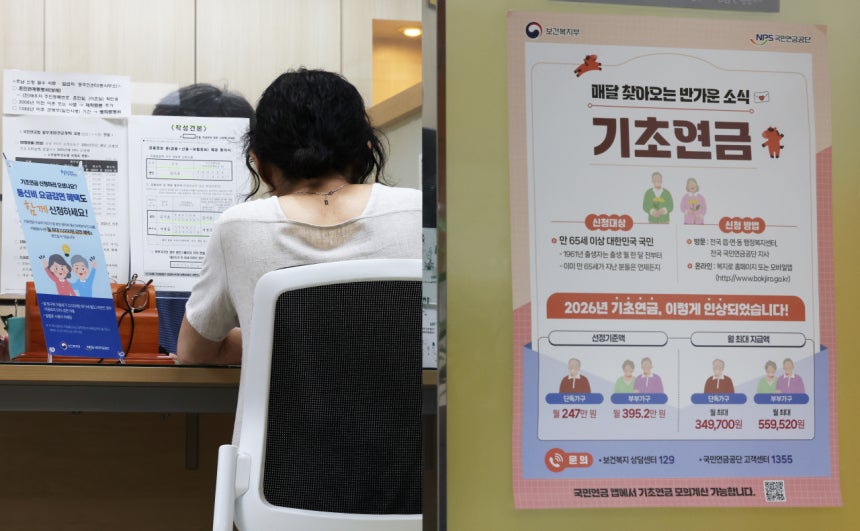
The Basic Pension refers to a pension through which the Ministry of Health and Welfare provides older people with a stable income base and thereby helps secure their livelihoods.
Anyone aged 65 or over whose recognized income places them within the bottom 70% of the older population is eligible. The maximum benefit is 349,700 won for a single household (as of 2026) and 559,520 won for a couple household (as of 2026).
But as benefits have been paid out mechanically according to the “recognized income in the bottom 70%” standard, critics have repeatedly noted that even older people of some means end up receiving the Basic Pension, driving up the fiscal burden.
According to two papers published this past February and in 2023 by Kim Man-soo, Associate Research Fellow at the National Pension Research Institute, of the 10,097 participants in the government's 2020 Survey on the Living Conditions of the Elderly, 6,465 older people were receiving the Basic Pension, and 64.3% of them (4,155 people) had incomes at or above 50% of the median income of all older people.
In other words, older people who are not poor, amounting to more than 40% of the entire older population, are drawing the Basic Pension.
As concern over the fiscal burden grew louder, the Ministry of Health and Welfare announced its Basic Pension overhaul plan on the 1st, together with the 2027 budget bill.
The overhaul plan had been expected to pay more to low-income recipients and to withhold or reduce payments for those with substantial assets, but what the government included instead was roughly 30,000 won more for recipients in the bottom 0–30% of older people.
Benefits for the bottom 45–70% were frozen. The concept of “more for the lower, less for the upper” has vanished, and the only thing to have grown is the scale of pension spending.
The problem is that the further society ages, the more government spending is bound to grow. As early as next year, 25.7 trillion won will be needed for the Basic Pension, a budget roughly 600 billion won larger than this year's.
Korea has already entered a super-aged society, in which older people account for more than 20% of the total population.
According to a demographic brief released last October by the National Assembly Futures Institute, the share of older people in the population is projected to reach 36.9% by 2045.
There is also a reading that by 2050 the older population will exceed 40% of the total and that, if the Basic Pension system is maintained as it is, 3 out of every 10 people in the country could end up drawing the Basic Pension.
In about 25 years, the Basic Pension the government has to pay out could reach twice its current level (50 trillion won).
A financial industry official said, “Unlike the National Pension, which manages reserves built up from a set amount the insured pay in every month, the Basic Pension is financed by the taxes the public pays,”
adding, “If Basic Pension payments rise, the tax burden rises with them, and that is very likely to come back as a burden on working people and the younger generation.”
In a statement on the 1st, the Pension Future Forum's Future Generations Network said,
“Young people have been made to shoulder an increase in National Pension contributions and the fiscal burden of the Basic Pension at the same time,”
pointing out that the plan shifts costs onto future generations without any substantive structural reform.
For the moment, there is also a reading that the boom in the semiconductor industry has sharply increased corporate tax revenue, giving the government greater room for fiscal expansion.
Indeed, the corporate tax paid this year by Samsung Electronics and SK Hynix alone has been found to exceed 11 trillion won. Corporate tax in the first half of the year is levied on the basis of the previous year's earnings.
There are also projections that, helped by improving semiconductor earnings, total corporate tax revenue will rise above 200 trillion won next year.
Ryu Duk-hyun, Advisor for Fiscal Planning at the presidential office, said on CBS Radio on the 2nd, “We expect more than 200 trillion won in corporate tax to come in next year thanks to the semiconductor windfall.”
On the other hand, there are also concerns about whether all this could be sustained if the semiconductor cycle turns down.
A business-sector official said, “Many analyses hold that the semiconductor industry is at the very start of a super-cycle right now, but we have to prepare for a slump in which demand falls once a certain period has passed,”
adding, “If a full-blown downcycle arrives 4 to 5 years from now with government spending at its maximum, we will need to be prepared to withstand the shock when it comes.”