Basic Pension Reform Is Back in the National Assembly's Hands (September 3, 2026)
Government to make differentiated payments of 350,000–380,000 won next year
Implementation requires amending the relevant law
Wide disagreement in the political sphere over 'more for the lower, less for the upper' reform
With the government's push for a 'more for the lower, less for the upper (下厚上薄; thick at the bottom, thin at the top)' style of Basic Pension reform now halted, the ball on pension reform has passed to the National Assembly. The government has written into the budget a plan to pay the Basic Pension at different rates by income tier, but implementation requires amending the relevant law, so the outcome rests in the National Assembly's hands. Attention now turns to whether the Assembly can produce a solution that answers both the concerns over public finances and the policy goal of securing income for poor older people.
According to next year's budget bill that the government submitted to the National Assembly on the 3rd, the government has decided to maintain the current eligibility rule under which the Basic Pension is paid to the bottom 70% by income among older people aged 65 and over. President Lee Jae-myung had earlier instructed that an approach paying a larger Basic Pension to low-income older people be reviewed. In response, the Ministry of Health and Welfare was reported to have examined a plan that would lower eligibility in stages to '80% or less of the standard median income' by 2030 while strengthening support for those at the bottom of the income distribution, but that plan was ultimately shelved. The dominant reading is that the decision reflected concern over a public backlash.
The 'More for the Lower, Less for the Upper' Plan the Government Had in Mind
This year's Basic Pension eligibility threshold for a single person is 2.47 million won, whereas 80% of the standard median income is about 2.05 million won. The two cannot be compared directly, because they are compiled differently: the current scheme sets the eligibility threshold by reference to the older population alone, whereas the standard median income covers the entire population, which puts older people, whose incomes are relatively low, at a disadvantage. According to figures presented by Representative Jeon Jong-deok of the Progressive Party at the National Assembly Special Committee on Pension Reform, the current pension threshold corresponds to 96% of the standard median income. Had the reform gone ahead as the government originally envisioned, a gradual narrowing of eligibility would have been unavoidable.
The Basic Pension Plan the Government Is Actually Pursuing
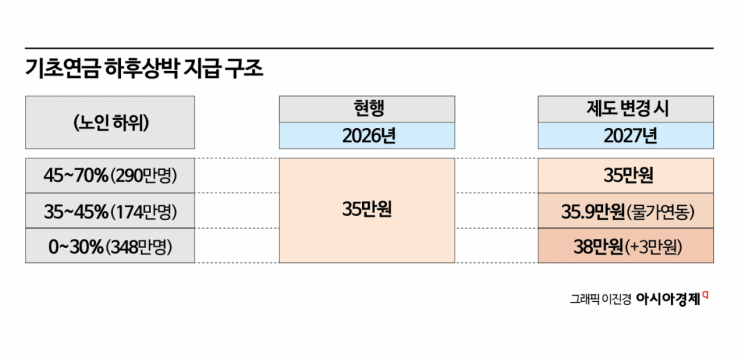
In the end, under pressure from a backlash in the political sphere and public opinion more broadly, eligibility will keep the bottom-70%-by-income framework exactly as it stands. The government has, however, settled on a course of dividing beneficiaries into three tiers and paying the pension at differentiated rates. The 2.9 million people with relatively higher incomes (the 45–70% band by income) will receive 350,000 won, the same as this year, while the 1.74 million people in the 30–45% band by income will receive 359,000 won, raised by 9,000 won through price indexation. And the 3.48 million people with the lowest incomes (the 0–30% band by income) will be paid 380,000 won, an increase of 30,000 won.

View originalThis departs from the method for calculating the Basic Pension amount under the current Basic Pension Act. The Act requires the amount to be announced by applying the rate of change in consumer prices to the previous year's Basic Pension amount. For the 45–70% band alone, that price-indexation principle has been set aside and the amount frozen. Instead, the approach is to make additional payments to the lower income bands and other groups. On this point, the Ministry has promised to complete the legislation within the year.
The Ministry has also decided to overhaul the scheme so that, for those in the current 0–45% band by income alone (2.34 million people), the 20% couples’ reduction is narrowed to 10%, and so that beneficiaries and spouses of the special occupational pension schemes become eligible for the Basic Pension where they fall into the low-income group.
Basic Pension Reform Passes Back to the National Assembly
The ball has thus passed back to the National Assembly. On the 21st of last month, the Assembly's Special Committee on Pension Reform heard a report on the activities of its Private Advisory Committee, and differing views on the Basic Pension were confirmed.
Park Myung-ho, Professor in the Department of Economics at Hongik University and co-chair of the advisory committee, argued that "ultimately we must make the National Pension a sustainable system that pays out only what one has paid in and, while narrowing the Basic Pension's eligibility, protect the genuinely hard-pressed older people far more generously, and at the same time build a labor market and a pension system that allow people to work and to prepare for longer."
The other co-chair, Joo Eun-sun, Professor in the Department of Social Welfare at Kyonggi University, said by contrast that "(as a result of the deliberations) from the standpoint of strengthening benefit adequacy, views on the direction of Basic Pension reform did not converge into one," adding,
"The Basic Pension is a scheme whose very character is so heavily contested, and whose scale is so large, that changing the logic by which it operates is not easy. That is why we discussed the need to move quickly to introduce a supplementary income guarantee that provides additional protection to low-income older people, ahead of any conversion of the Basic Pension itself."
In other words, no agreement was reached on the direction of Basic Pension reform even within the advisory committee. Professor Joo also took the position that Basic Pension reform will require separate supplementary measures.
On the same issue, Nam In-soon, Deputy Speaker of the National Assembly (Democratic Party), told the Special Committee on Pension Reform this past March that "(under a 'more for the lower, less for the upper' overhaul) the National Pension is not yet mature, so among upper-middle-income older people who depend heavily on it—those in roughly the fourth to sixth deciles—the number eligible for the Basic Pension could fall," adding,
"I think we need scenarios for the direction and the pace of the Basic Pension overhaul, tied to how mature the National Pension is."
At the same session, Deputy Speaker Nam also cited the report of the Private Advisory Committee of the pension special committee in the 21st National Assembly, noting that "a proposal was once put forward to preserve the quasi-universal character of the Basic Pension in the short term and then, when the benchmark is set, to set it at 100% of the standard median income while paying differentiated benefits according to income tier."
Within the National Assembly, however, opinion on Basic Pension reform is divided even within a single party.
Representative Woo Jae-jun of the People Power Party, for instance, told the Special Committee this past March that "it is interpreted as meaning that even someone who owns a single unit in the Eunma Apartments becomes eligible for the Basic Pension," pointing out that "even older people who are not poor are receiving it."
Representative Ahn Cheol-soo, of the same party, by contrast criticized the move on social media on the 28th of last month, writing that "what the Lee Jae-myung administration has done is to tell people in their 50s and 60s, who have worked diligently and paid their taxes honestly all their lives, that 'you do not even deserve the 350,000-won Basic Pension.'"
So where does the discussion go from here?
An official of the Special Committee on Pension Reform said, "The ball on Basic Pension reform has passed back to the National Assembly," adding, "I think we will have to link the Basic Pension, the National Pension and even the Basic Living Security system together and work out better ways to improve them."