
(MBC TV Report, May 27, 2024) To Protect the "Golden Opportunity" Before the Pension Fund Runs Out — "Start With What Both Sides Already Agree On" (Posted September 4, 2026)
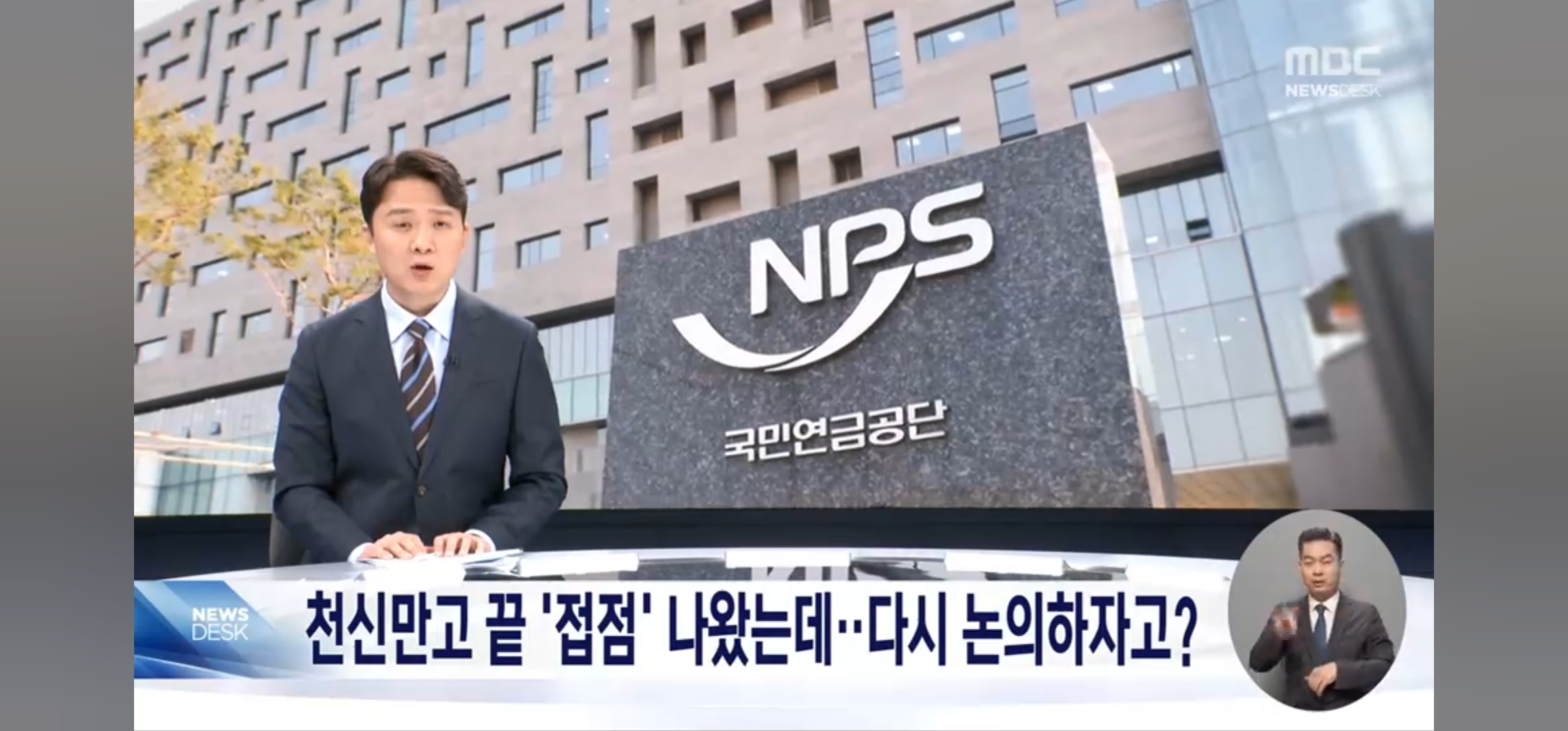
Anchor
So why is it that even within the People Power Party there is now talk of accepting the Democratic Party's proposal?
It is because, for all the talk that the pension fund will be depleted, the core numbers—how much more we pay in and how much more we receive—have gone unchanged for years.
Presumably, then, there is at least a consensus that the first step has to be taken now if the "golden opportunity" is not to be missed.
Reporter Yoo Seo-young reports.
Report
Last month the 500 citizen representatives who took part in the pension reform public deliberation chose the "pay more, receive more" option.
The idea is to raise the National Pension contribution rate deducted from monthly income from the current 9% to 13%, and in exchange to raise the "income replacement rate"—the ratio of the money received to average monthly income over the contribution period—by 10 percentage points, to 50%.
Apart from the "13% contribution rate," the ruling and opposition parties had been unable to narrow the gap on the income replacement rate, before common ground was ultimately found at 44%.
Even that comes with an obvious limit: it merely pushes the projected date of fund depletion back by about 10 years, to 2064.
[Yun Suk-myung / Research Fellow Emeritus, Korea Institute for Health and Social Affairs]
"Didn't (pension reform) start out from the aim of leaving future generations somewhat less pension debt than at present, or of doing away with it? This is not reform but deterioration…"
Even so, the "parameters"—the core variables, that is, the contribution rate and the income replacement rate—are being adjusted for the first time in fully 26 and 17 years, respectively.
That is why the argument that the parameters should be tackled first—in the sense of opening the channels of reform before it is too late—is gaining ground.
[Kim Yeon-myeong / Professor, Department of Social Welfare, Chung-Ang University]
"This strengthens the function of the public pension system in old age, so the direction itself is not wrong. It will obviously benefit the public as a whole. In (that) respect, it carries quite a lot of significance right now."
As for the process of setting out how the National Pension relates to other pension schemes such as the Basic Pension and the Government Employees Pension—that is, "structural reform"—prolonged wrangling appears unavoidable.
[Jeong Se-eun / Professor, Department of Economics, Chungnam National University]
"We debated 'structural reform or parametric reform' for a long time, and this public deliberation went ahead under a general agreement that 'this time it is right to do parametric reform.'"
Civil society groups including the Citizens’ Coalition for Economic Justice criticized the government, saying, "Now that the option the government wanted was not the one chosen, it is invoking 'structural reform' and distorting the essence of the matter."
This has been Yoo Seo-young, MBC News.
https://imnews.imbc.com/replay/2024/nwdesk/article/6602290_36515.html


