
(SBS TV Live Broadcast, May 12, 2015) [Issue Inside] What Is It About a 50% Income Replacement Rate? — 'Fear Marketing vs. Intergenerational Theft' (Posted September 4, 2026)
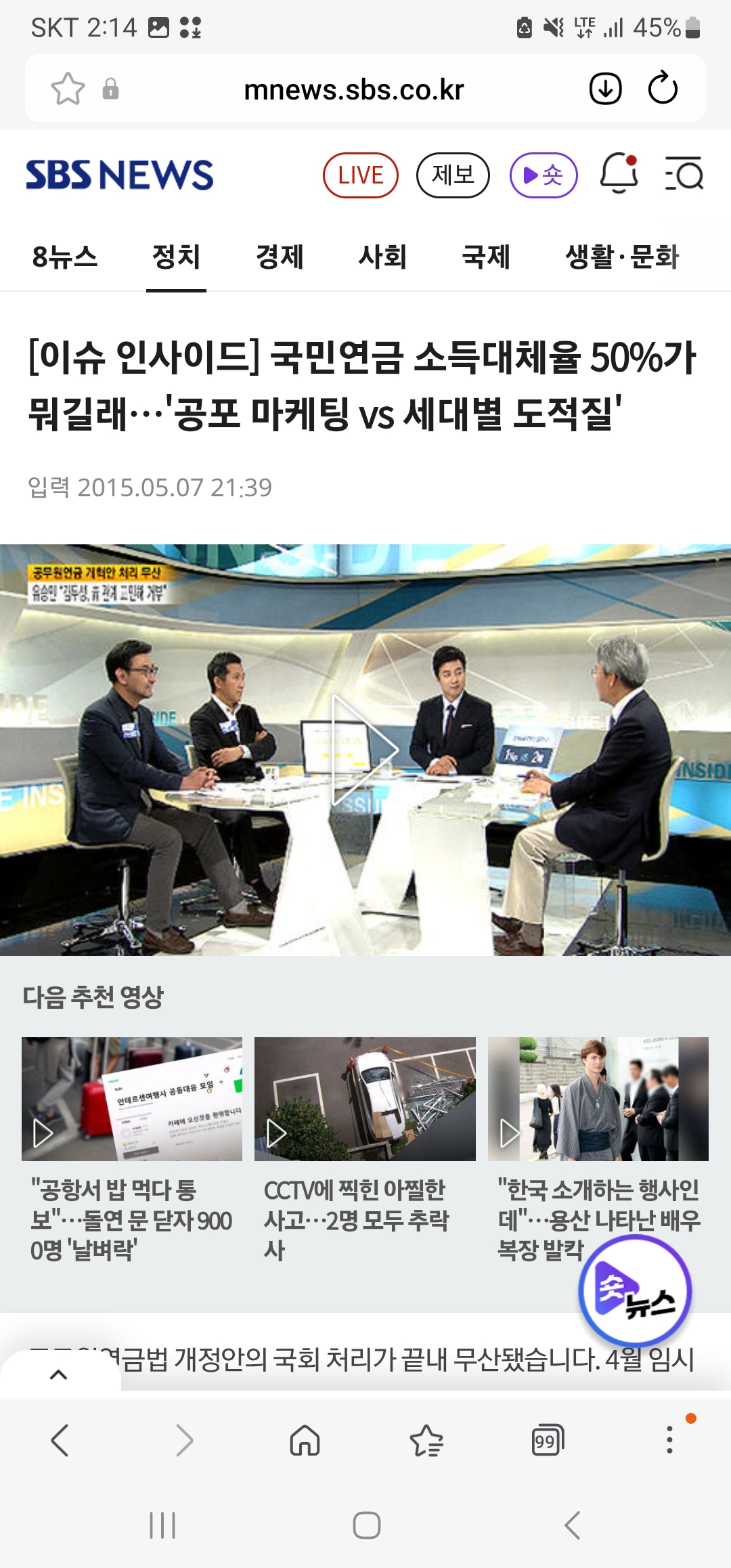
(Professor Kim Yeon-myeong of Chung-Ang University
wants the National Pension's income replacement rate
raised to 50%;
Yun Suk-myung, Research Fellow at
the Korea Institute for Health and Social Affairs (KIHASA),
says that raising it to 50%
is intergenerational theft.
This is a live debate.
Professor Kim Yeon-myeong is pressing
Committee Member Yun Suk-myung,
demanding to know whether he will take responsibility
for what he has said.
This can be seen
at around the four-minute mark
of the attached video.)
Passage of the amendment to the Government Employees Pension Act in the National Assembly has ultimately fallen through. Yesterday, the last day of the April extraordinary session of the National Assembly, the agreement by the ruling and opposition parties to pass the amendment evaporated, and all that continues is a "your fault" war of words.
The ruling and opposition parties were divided over whether, in connection with Government Employees Pension reform, to raise the National Pension's income replacement rate (the ratio of the pension benefit received to lifetime average earnings).
The opposition party argued that the working group's agreement, which specified raising the National Pension's income replacement rate to 50%, should be attached to the National Assembly's rules as an annexed document, while the ruling party countered that the figure was no more than a target and could not be given legal binding force.
What, then, is the significance of the increase in the National Pension's income replacement rate to 50%—the issue that held up the Government Employees Pension reform bill?
The Ministry of Health and Welfare released materials arguing that raising the National Pension's income replacement rate to 50% would require contributions to be raised to as much as double. National Pension contributors, it says, would be hit with a contribution bomb.
Moon Hyung-pyo, the Minister of Health and Welfare, went so far as to call it "intergenerational theft," on the grounds that if this leads to fund depletion, future generations will have no choice but to shoulder the burden.
The New Politics Democratic Union, by contrast, argued that even if the income replacement rate were raised to 50%, the contributions paid in would need to rise by only 1 percentage point, and that the controversy had been amplified because the Ministry of Health and Welfare gave an exaggerated account of the contribution increase.
So who is right?
Appearing on the April 7 episode "What Is It About the 'National Pension's 50% Income Replacement Rate'?"
Professor Kim Yeon-myeong of the Department of Social Welfare at Chung-Ang University argued: "The public is anxious about the depletion of the National Pension fund, but the National Pension was created in the first place on the projection that the fund would be depleted in 2060.
On the premise of fund depletion in 2060, as at present, raising the income replacement rate to 50% requires raising the contribution rate by only 1 percentage point." He went on: "The claim that contributions would double comes from a calculation that assumes contributions should be stockpiled in the fund through 2100.
In a situation where we cannot even project 2060, how are we supposed to project what things will look like in 2100? To say that this becomes a contribution bomb and a heavy burden on future generations is a work of fiction and fear marketing."
Yun Suk-myung, Research Fellow at the Korea Institute for Health and Social Affairs, who appeared on the program with him, argued: "There is no country on earth that has achieved economic growth as rapid as ours. Nor is there any country where the older population is growing as fast as ours. What this means is that unless we look ahead to later generations and prepare, older people could become a back-breaker for future generations.
If the National Pension fund is depleted in 2060, the size of the pension bill my children's and grandchildren's generations must shoulder will grow larger. Our generation would be committing a sin.
That is why we project out to 2083, and why either pensions must be cut or more must be paid in contributions."
Source: SBS News
Original link: https://news.sbs.co.kr/news/endPage.do?news_id=N1002965739&plink=COPYPASTE&cooper=SBSNEWSMOBEND


