
National Assembly Forum on the Problems and Reform Plans of the Current Basic Pension System Concludes Successfully (2026-01-29)
2026.02.01
- #연금특위
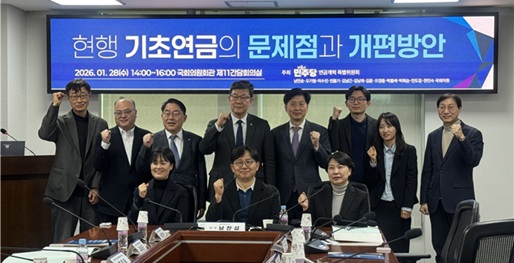
The National Assembly forum "Problems and Reform Plans of the Current Basic Pension System," hosted by Democratic Party of Korea Assemblywoman Nam In-soon (Health and Welfare Committee; Seoul Songpa-byeong) on the 28th at Meeting Room No. 11 of the National Assembly Members' Office Building, concluded successfully.
This forum was organized to examine the current state and problems of the Basic Pension system amid rapid population aging and to explore reform plans, hosted by the Democratic Party's Special Committee on Pension Reform.
(Excerpt omitted)
Rep. Nam, who hosted the forum, stressed that "the Basic Pension must achieve its original purpose of alleviating elderly poverty and supplementing coverage gaps in the National Pension," and that "together with precise simulations reflecting demographic change, we need to set a genuine short- and long-term operating direction that goes beyond simple budget cuts."
Rep. Oh Ki-hyung said, "I will do my utmost to communicate with the Ministry of Economy and Finance, the Ministry of Health and Welfare, the National Pension Service and others, and to work out alternatives, focusing on the sustainability of the Basic Pension eligibility threshold and the efficiency of its linkage with the National Pension."
Rep. Kim Nam-geun stressed, "Twenty years have passed since the Basic Pension was introduced, and the times have changed — including the polarization of elderly poverty — so I will actively participate in a system overhaul that properly reflects the Basic Pension's social role in addressing the changed environment and the problem of elderly poverty."
Rep. Park Hee-seung said, "To resolve elderly poverty in an aging society, I will take the lead in reviewing the current system and redesigning and improving a mid- to long-term, multi-pillar old-age income security system that considers fiscal sustainability and compatibility with other systems."
Kim Sung-joo, Chairman of the National Pension Service, stressed the need for a Basic Pension system overhaul, saying, "This is a point at which the scope of Basic Pension payments needs to be reexamined to reflect changed realities such as the growing number of National Pension beneficiaries," and that "we need to consider using the funds saved through the system overhaul for genuinely preventing old-age poverty across the population and closing coverage gaps in the pension system."
Kim Tae-wan, Senior Research Fellow at the Korea Institute for Health and Social Affairs (KIHASA), who gave the presentation, said, "The elderly poverty rate is in a serious state due to population aging and the rise in one-person households, so a customized strategy reflecting the characteristics of each income group is more urgent than uniform support," adding that "available measures — such as adjusting the Basic Pension's eligibility scope and expanding elderly jobs — should be concentrated to bring the poverty rate down to the high 20% range within the current administration, and the Basic Pension needs to be converted into a minimum income guarantee scheme that provides more generous support to low-income people."
Choi Ok-geum, Senior Research Fellow at the National Pension Research Institute, pointed out that "the current system, without clear grounds, is blurring the nature of the Basic Pension by applying the 'bottom 70%' standard," and stressed that "it needs to be restructured into a system that provides more generous support to low-income older people in the coverage gaps of the National Pension, and ultimately, the National Basic Living Security System and the Basic Pension need to be integrated to build a minimum income guarantee as public assistance for older people."
Seok Jae-eun, Professor in the Department of Social Welfare at Hallym University, who participated as a discussant, said, "The Basic Pension needs to move beyond its original purpose of closing coverage gaps in the National Pension and focus on alleviating elderly poverty by converting into a minimum income guarantee scheme," adding that "institutional support must proceed in parallel to lower reliance on the Basic Pension and to strengthen the National Pension's 'one person, one pension' framework."
Kim Do-heon, Associate Research Fellow at the Korea Development Institute (KDI), stressed that "the Basic Pension should be converted into a minimum income guarantee scheme linked to the standard median income of the entire population, instead of the rigid 'bottom 70%' standard," and that "the self-sustaining capacity of old-age income needs to be raised by expanding National Pension enrollment periods, and fiscal sustainability must be secured through a precise linkage between the Basic Pension and elderly job programs."
Dr. Oh Gun-ho, Co-representative of Welfare State I Make, said, "the Basic Pension needs to move beyond the rigid structure of '70% receipt' and convert into a supplementary minimum income guarantee that provides generous support to the poor," adding that "we need to respond precisely to the conflict discourse claiming that strengthening the Basic Pension encourages avoidance of National Pension enrollment, and build social consensus."


