
The Basic Old-Age Pension Is a Defective Knockoff of the Basic Pension (2006. 11. 6)
- #연금특위
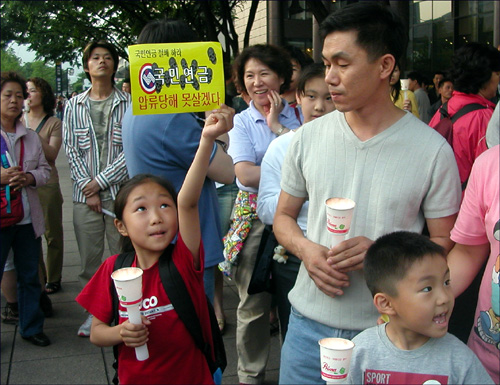
(The Democratic Party of Korea's Pension Reform Committee recently held a forum on the direction of the Basic Pension overhaul. The Basic Pension traces its origin to the Basic Old-Age Pension, enacted in April 2007. At the time, there was considerable political turmoil surrounding the introduction of the Basic Old-Age Pension.
Five months before the Basic Old-Age Pension was introduced, OhmyNews commissioned expert columns supporting the opposition's plan and the government's plan; we are posting them on the Pension Future Forum website as a historical record. This is Professor Kim Yong-ha of Soonchunhyang University's column supporting the position of the Grand National Party, then the opposition.)
In this respect, the Basic Pension system of 'one pension per person' can be described as a system that enhances the fairness of income transfers across generations.
The Basic Pension therefore carries a significance that goes beyond a simple pension system: it transforms the burden of supporting parents, formerly borne at the level of the individual family, into a social system in which the working generation jointly supports the older generation.
What is pointed to as a problem with the Basic Pension is the excessive burden it places on future generations. This is because the Basic Pension is operated on a pay-as-you-go (PAYG) basis, and is therefore directly affected by population aging. the share of the population aged 65 and over stands at around 9% as of 2006 but will rise to around 37% by 2050, so the burden on the working generation will increase by that much.
However, the increase in the Basic Pension's burden is not a problem of the system itself, but merely reflects the increased burden that future generations will face as they confront an aging society.
(Excerpt omitted)
The Basic Old-Age Pension recently put forward by the government and the Uri Party is a proposal to pay a pension of 70,000–100,000 won, funded by taxes, to 60% of people aged 65 and over.
This proposal appears at first glance to resemble the Basic Pension, but it is nothing more than a 'defective knockoff.' To begin with, the purpose behind introducing the Basic Pension lies in maximizing the effect of national integration by providing universal minimum income security to all older people.
(Excerpt omitted)
If a welfare state is defined as a state in which the problems of life are not left entirely to the individual, but the minimum problems necessary for a life of human dignity are solved together by all citizens, then the Basic Pension system is meant to build the framework of a welfare state by having citizens jointly confront social risks such as old age or disability.
(Excerpt omitted)
Because the current public pension is a set of rules created, without any procedure of social consensus, in an era when the policymaking process was government-led, a new national consensus must now be drawn out at this point in time, when ordinary citizens too have come to understand what the pension system is.
https://m.ohmynews.com/NWS_Web/Mobile/at_pg.aspx?CNTN_CD=A0000371357&CMPT_CD=SEARCH#cb

