
(Pension Future Forum Commentary) “The Basic Pension Affects 8 Million People… It Must Not Be Pushed Through in Haste” (2026.08.25.)
(On what grounds do they say
it is being pushed through in haste!
Ever since the 22nd National Assembly Special Committee on Pension Reform was formed,
for a year and a half,
what group kept proper discussion
from even taking place
and engineered
all that wasted time!
If they are confident
in their own claims,
then why!
Why did they oppose
the live YouTube broadcast of the Advisory Committee
to the 22nd National Assembly Special Committee on Pension Reform!
Because it was a venue for discussing
the structural reform of the pension system,
including the Basic Pension,
it should have been
broadcast live on YouTube,
if only to safeguard
the public’s
right to know!
And after they finally turned it
into a closed meeting,
did they not, on the contrary, argue for
expanding the number of Basic Pension recipients still further,
or for newly introducing
a supplementary pension scheme!
Do they believe that such claims
accord with the global standard of pension reform!
According to the article below,
Dr. Joo Su-jeong of the Department of Social Welfare at Chung-Ang University explained that a “more for the lower, less for the upper” benefit structure is no more than a shell game of pulling out the top stone to prop up the bottom one.
Dr. Joo criticized it, saying that “an approach that holds back price indexation for the upper band and raises only the lower band
is merely a cost-saving measure that cuts the real benefits of older people at the top end without putting in any additional funding.”
What Dr. Joo criticizes is precisely what the OECD has consistently recommended over the years, including in 2018, on the overhaul of Korea’s Basic Pension.
Do they think that, in taking a position that criticizes
even the recommendations of an international organization,
they are speaking with a proper understanding of the latest pension-reform trends
among OECD member countries!
If that is what they think,
let them state their position
forthrightly and in public.
That is our request!)
The Public Pension Strengthening People’s Action Holds a Basic Pension Briefing
“Pulling Out the Top Stone to Prop Up the Bottom One… It Only Deepens Conflicts over Fairness”
Criticism has been voiced that the “more for the lower, less for the upper” Basic Pension overhaul being pursued by the Lee Jae-myung administration lacks procedural legitimacy and effectiveness.
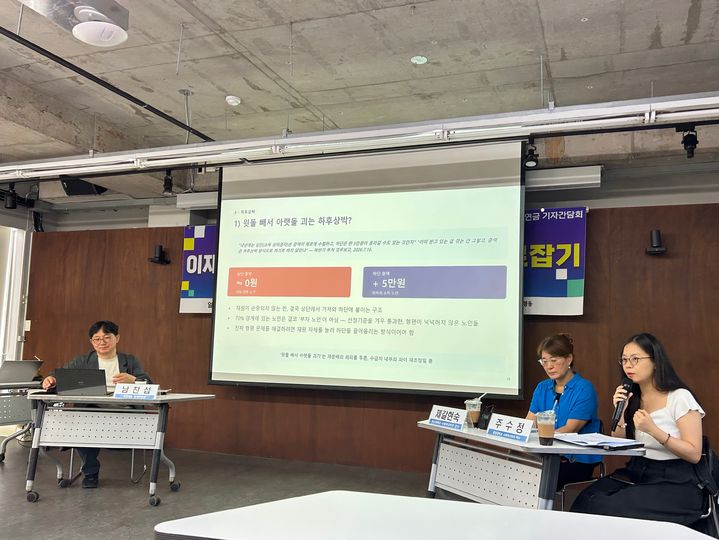
On the afternoon of the 25th, the Public Pension Strengthening People’s Action held a press briefing at the People’s Solidarity for Participatory Democracy meeting room in Jongno-gu, Seoul, on the theme “Setting Right the Debate on the Lee Jae-myung Administration’s Basic Pension Overhaul.”
At present the Basic Pension is paid uniformly to older people in the bottom 70% by income, and the government is pursuing an overhaul that would provide more generous protection to low-income groups. Among the measures under discussion are changing the basis of eligibility from the bottom 70% by income to the standard median income, and differentiating the annual increase indexed to inflation according to income level.
The experts who attended the briefing agreed that the Basic Pension overhaul is being pushed through under government leadership without sufficient public deliberation or consultation with those directly affected.
Nam Chan-seop, Professor of Social Welfare at Dong-A University, argued that “concrete figures and target levels of protection have gone missing from the Lee Jae-myung administration’s overhaul plan,” adding that “since this is a major program affecting some 7.7 million to 8 million beneficiaries, there is a serious problem with pushing legislation through in haste within the year.”
It was also pointed out that the detailed terms are unclear — at what ratio the eligibility threshold is to be linked to the standard median income, and what the criteria are for the top and bottom ends in a “more for the lower, less for the upper” design.
Jegal Hyeon-suk, Lecturer in the Department of Social Welfare at Hanshin University, stressed the flaws in the government’s proposed linkage to the standard median income. Jegal judged that changing the current target take-up rate method — which sets the eligibility threshold so that 70% of all older people receive the Basic Pension — to a method linked to 100% of the standard median income could slightly increase the number of beneficiaries in the short term, but that if the 90%-of-median-income option reported in the press were adopted, there would be a risk of the number of beneficiaries falling in the future.
Jegal said that “the original purpose of the Basic Pension is to compensate for coverage gaps in the National Pension and to establish a minimum baseline for older people’s lives,” adding that “it must not be confined to means-tested support aimed at low-income groups.”
Dr. Joo Su-jeong of the Department of Social Welfare at Chung-Ang University explained that a “more for the lower, less for the upper” benefit structure is no more than a shell game of pulling out the top stone to prop up the bottom one.
Dr. Joo said that “an approach that holds back price indexation for the upper band and raises only the lower band is merely a cost-saving measure that cuts the real benefits of older people at the top end without putting in any additional funding,” and added,
“In particular, because income bands are tightly packed at the lower end, raising only certain lower bands will, through the compounding effect, do nothing but widen the gap between the top and bottom ends and deepen conflicts over fairness.”
The experts pointed out that overhauling the Basic Pension from within is not the only way to achieve a “more for the lower, less for the upper” outcome. They suggested that it is worth looking at approaches that deliver it through a separate supplementary scheme, as in Canada, Denmark, New Zealand, and other cases abroad.
Lee Joo-ha, Chair of the Social Welfare Committee at People’s Solidarity for Participatory Democracy, said that “we must not turn away from the world’s highest rates of elderly poverty and suicide,” adding that “we must break out of a pattern of fiscal savings driven by the fiscal authorities.”
The experts said that once the Ministry of Health and Welfare’s Basic Pension overhaul plan is officially announced, they plan to continue further analysis and discussion on the basis of that government plan.
![(연금연구회 성명서 보도. 노컷뉴스) [칼럼] 연기금 카지노 책임론?…'쉬운길' 선택의 결과일 수 있다 (2026.10.20.)](/_next/image?url=%2Fuploads%2Feditor%2F2026%2F10%2Fc6f13b0799b440d0874a9f72413c6f58-0004200449_003_20261020063615439-1.jpg&w=128&q=75)

![(연금연구회 성명서 보도. 중앙일보) [취재일기] 국민 노후보다 코스피를 지킨 국민연금 (2026.10.19. )](/_next/image?url=%2Fuploads%2Feditor%2F2026%2F10%2F7e92f70b0ec843bbb869a4cf46b01f72-0003558751_001_20261019052229249.jpg&w=128&q=75)