
The Ministry of Strategy and Finance Changes Its Tune: “The National Pension Is a Debt” (2013.05.08)
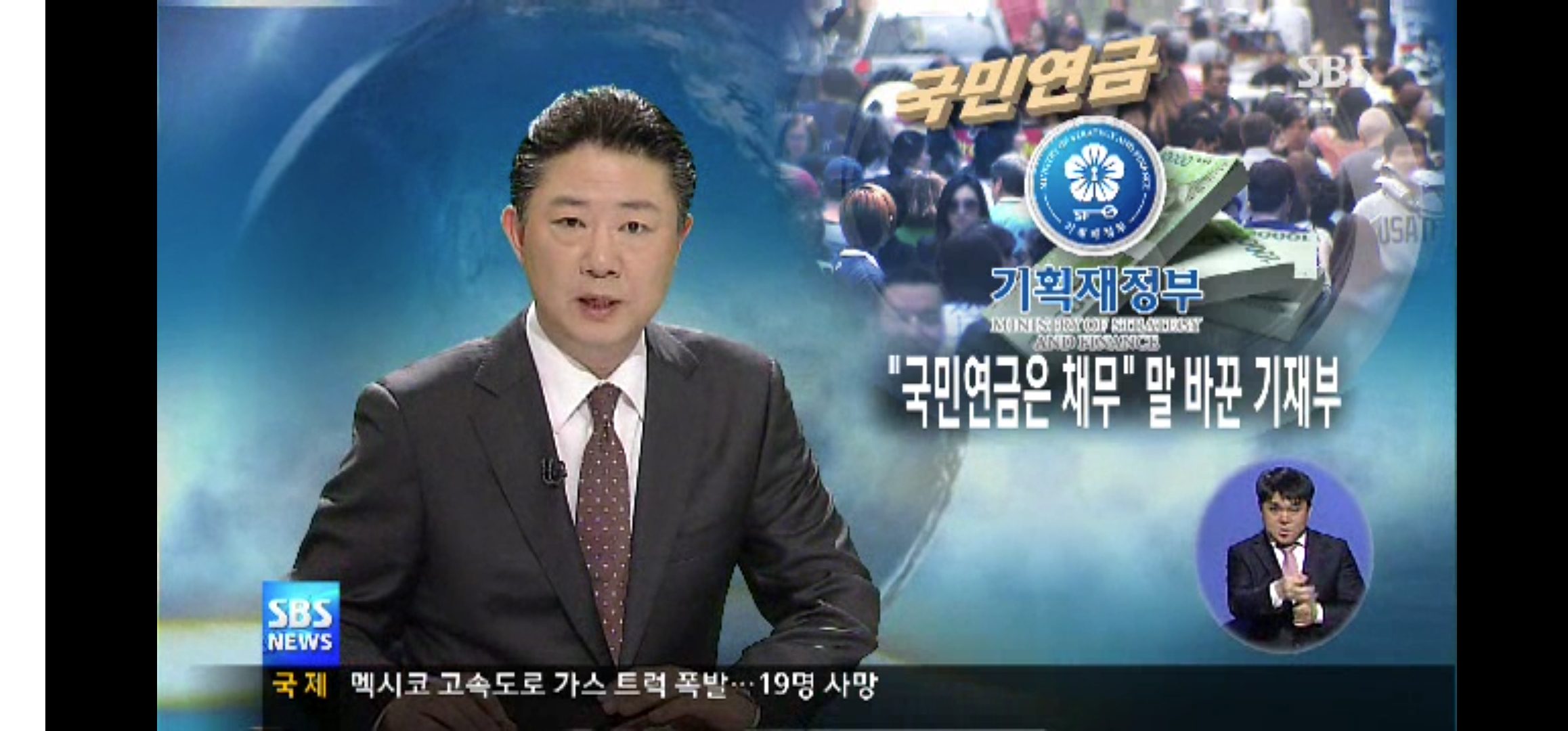
[At the time of the fierce debate
over the Basic Pension in 2013,
this is the content of a press report (SBS TV)
concerning the provision
on the State’s guarantee
of National Pension payments.
The 2013 Korea Economic Daily
head-to-head debate
(between National Assembly member Nam Yun In-soon and
Yun Suk-myung, head of the Pension Research Center
at the Korea Institute for Health and Social Affairs)
was grounded in this
position of the government at the time.]
<Anchor> A bill under which the State would guarantee National Pension payments has fallen through in the face of resistance from the Ministry of Strategy and Finance. The Ministry has reversed its previous position. Reporter Kim Tae-hoon has the story.
<Reporter> The failure to process the amendment to the National Pension Act guaranteeing State payment of the National Pension was due to the opposition of the Ministry of Strategy and Finance.
The Ministry gave as its reason that “if the State guarantees payment, the money that must be set aside to pay pensions — the provision — will be counted as national debt, and fiscal soundness will deteriorate.”
Until last year, however, the Ministry had been making precisely the opposite argument.
In a press release last June it stated that “the pension provision is an uncertain amount that depends on various assumptions such as the inflation rate and mortality, and so cannot constitute a burden on the public — that is, a debt.”
Three years ago it announced the same position, citing even the international standards of the IMF and the OECD.
[Won Jong-hyun / Investigator, National Assembly Research Service: No one knows what inflation will do, and there are so many assumed values that it cannot be captured in the accounts. That is why there is no country in the world that captures it in its accounts.]
On the change of position, the Ministry explained that although it is not officially counted as national debt, it could give foreign credit rating agencies a pretext for lowering the country’s credit rating.
Democratic Party lawmakers urged the government and the ruling party to cooperate so that the bill can pass in its original form at the extraordinary session of the National Assembly in June.
![(연금연구회 성명서 보도. 노컷뉴스) [칼럼] 연기금 카지노 책임론?…'쉬운길' 선택의 결과일 수 있다 (2026.10.20.)](/_next/image?url=%2Fuploads%2Feditor%2F2026%2F10%2Fc6f13b0799b440d0874a9f72413c6f58-0004200449_003_20261020063615439-1.jpg&w=128&q=75)
![(연금연구회 성명서 보도. 중앙일보) [취재일기] 국민 노후보다 코스피를 지킨 국민연금 (2026.10.19. )](/_next/image?url=%2Fuploads%2Feditor%2F2026%2F10%2F7e92f70b0ec843bbb869a4cf46b01f72-0003558751_001_20261019052229249.jpg&w=128&q=75)