Older People Receive 8 Trillion Won in Pensions Each Month… “We Must Discuss Introducing an Automatic Adjustment Mechanism for the National Pension” (2026.08.05.)
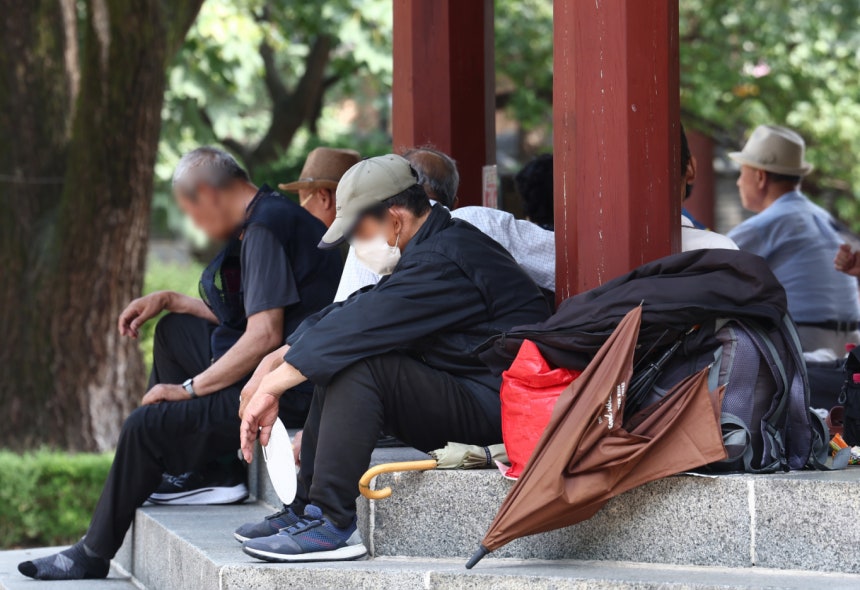
“May 2026 Supplementary Survey of Older Persons”…
8.97 million pension beneficiaries aged 55–79
Total pension receipts of 7.9 trillion won a month…
the National Pension accounts for half
A “warning light” for sustainability
“Further pension reform, including the introduction
of an automatic adjustment mechanism, is needed”…
Some also argue that “the contribution rate must be raised”
The total monthly pension receipts of older people have been found to reach 7.89 trillion won. The National Pension, which accounts for roughly half of that, still faces concerns about the depletion of its finances despite the recent reform. The point is made that discussion is needed of further reform to secure the National Pension’s sustainability, including the introduction of an automatic adjustment mechanism.
According to the “Results of the May 2026 Supplementary Survey of Older Persons in the Economically Active Population Survey,” released by the National Data Office on the 5th, 8,969,000 people aged 55 to 79 were pension beneficiaries, accounting for 52.7% of the total.
The average monthly amount received per older pension beneficiary was tallied at 880,000 won. That yields a calculation of roughly 7.89 trillion won in total monthly pension receipts for the older population as a whole.
This is the sum of the National Pension, the Basic Pension, occupational pensions such as those for government employees, the military and private school teachers, and personal pensions.
Comparing this with the National Pension Service’s statistics by benefit type and age, National Pension benefit payments to those aged 55–79 are estimated to account for roughly half (about 49.5%) of the total.
Pension receipts by older people are rising rapidly each year. An analysis of the National Data Office’s microdata shows that total receipts have grown by an average of 11.2% a year over the past decade.
Total receipts, which stood at 3.03 trillion won in 2017, passed 4.21 trillion won in 2020 and jumped to ▲5.13 trillion won in 2022, ▲5.82 trillion won in 2023, ▲6.7 trillion won in 2024 and ▲7.32 trillion won in 2025.
Behind this surge in pension receipts lies steep population aging. On a resident registration basis, Korea entered a super-aged society (a population aged 65 and over of 20% or more) at the end of 2024. It took only seven years and four months after entering an aged society (a population aged 65 and over of 14% or more) in 2017.
That is an overwhelmingly faster pace than Japan’s, which took 12 years to move from an aged society to a super-aged one.
On top of this, the retirement of 7.2 million “baby boomers” born between 1955 and 1963, concentrated in the years 2020–2028, also affects the surge in receipts.
The problem is the funding. Last year, by bipartisan agreement, a National Pension reform bill raising the contribution rate in stages from 9% to 13% for the first time in 18 years passed the National Assembly, but the point of fund depletion was pushed back only about ten years, from 2056 to 2065.
The rapid rise of the KOSPI this year has also had the effect of deferring fund depletion, but it is hard to say that stability has fundamentally improved. After hitting a record high in June, the index has shown extreme volatility, plunging more than 33% over the single month of July.
Experts point out that “further pension reform is needed” to raise the National Pension’s sustainability. Specifically, they suggest that it is necessary either to introduce an “automatic adjustment mechanism” that would manage the finances independently of stock market performance, or to adjust the contribution rate further.
An automatic adjustment mechanism is a system that automatically adjusts benefit amounts or contributions in line with demographic and economic indicators such as life expectancy and changes in the number of insured persons. According to the Ministry of Health and Welfare, 24 of the 38 OECD (Organisation for Economic Co-operation and Development) member countries already operate such a mechanism. Korea also considered introducing one during last year’s reform discussions, but it was dropped from the final proposal because of opposition from the ruling party.
Yun Suk-myung, Research Fellow Emeritus at the Korea Institute for Health and Social Affairs, stressed at a Pension Future Forum seminar held last month that “the National Assembly must keep its promise to the public that it would constitute a special committee on pensions and carry out structural reform,” and that “the core of structural reform is the introduction of an automatic adjustment mechanism and the mandating of retirement pensions.”
There are also arguments that the National Pension’s contribution rate should be raised further. In its report “An Analysis of Changes to the National Pension System with Social Welfare in View,” published in June, the National Pension Research Institute picked as the most desirable alternative a plan to raise the contribution rate by a further 2 percentage points, to 15%, by 2040.
The researchers who wrote the report — Yoon Byung-wook, Kim Hyung-soo and Oh Yu-jin — explained that “an analysis of three additional reform scenarios found that this is the only improvement which, although its effect in extending the life of the fund is limited to around five years, does not blunt the will to work and in fact raises economic efficiency by 2%.”