“Samjeon-nix” Leverage — My Account Is at –40%… Asset Managers and Brokerages Hit the Fee Jackpot (2026.07.26.)
(Since this is an article that the members
of the Pension Future Forum are treating as a problem,
we place it under the Forum’s
“Statements and Commentary”
category —
here is the article!
In the content of the article below,
“the Governor of the Financial Supervisory Service, who put financial institutions’ fees at as much as 10 trillion won,
and
the Chairman of the Korea Financial Investment Association, who countered that they came to 50 billion won —
of these two statements,
whose is the factual one?”
That must be established without delay!
Although the scale of the losses is said to have narrowed with the recent surge in the KOSPI index,
it should be noted that 62% of the securities accounts subject to forced liquidation belonged to young people aged 35 or under.
In some quarters
the objection is raised: “Who pushed anyone into investing!
Is investment not one’s own responsibility!”
Yet
if one recalls the mood of our society
since the second half of last year,
and in particular the conduct of politicians,
the matter cannot be pushed off
entirely onto the investors alone, and so
it must be acknowledged that a considerable part of the public
is angry!
Rather than rushing to shift the blame,
and above all
rather than persisting in feigning ignorance,
follow-up measures capable of satisfying
the angry parties concerned
must be taken
as a matter of urgency!)
“Devastating”: 16 Leveraged ETFs Show an Average Cumulative Return of –39%
Asset Managers and Brokerages Earn Tens of Billions of Won in Fees
Financial Authorities Raise the Deposit Requirement to 30 Million Won from the 31st
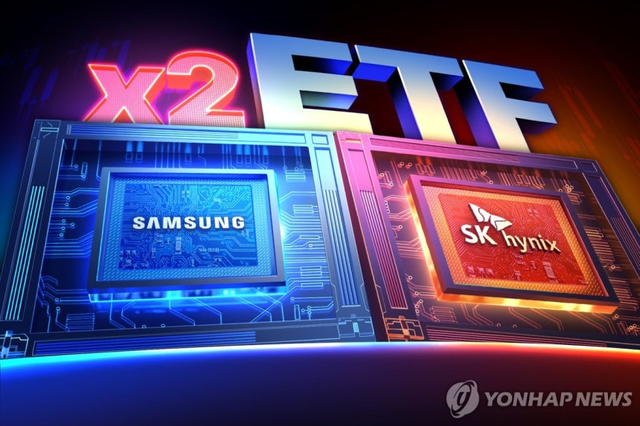
Losses among retail investors who put money into single-stock leveraged ETFs on Samsung Electronics and SK Hynix are snowballing. As losses swell through the “negative compounding effect,” single-stock leveraged accounts show an average valuation loss of minus 40%. With the recovery of principal a distant prospect, asset managers and brokerages have earned considerable fee income from inflows and increased trading, and investors’ complaints are growing louder that “they have simply thrown a results party with retail investors’ money.”
(abridged)
According to the financial information provider FnGuide on the 26th, the 16 single-stock leveraged ETFs (including two inverse products) recorded an average cumulative return of –39.4% from their listing date of May 27 through the 23rd of this month. Over the some 50 days since listing, single-stock leverage has instead seen losses swell through the “negative compounding effect.”
(abridged)
According to the Korea Exchange, from the listing of the single-stock leveraged products through the 23rd of this month, the intraday volatility of SK Hynix and Samsung Electronics stood at 8.4% and 6.9% respectively — volatility of a record order. Intraday volatility is the difference between the high and the low divided by the average; the greater the volatility during the session, the higher the figure.
The biggest problem is that, by the nature of leveraged products, the negative compounding effect is maximized in periods of sharp rises and falls. A leveraged ETF tracks twice the “daily return,” not the cumulative return over a given period. When share prices rise steadily, the compounding effect enlarges gains; but when prices swing sharply, the repeated cycle of loss and recovery erodes principal through the negative compounding effect, which can damage the cumulative return.
In fact, over this period SK Hynix’s share price fell 14.5%, from 2,243,000 won to 1,919,000 won. The theoretical loss rate from simply doubling the decline in the underlying asset is 29%, but the SK Hynix single-stock leveraged product plunged more than 44%, so that the actual loss was 15 percentage points greater.
Bae Jae-kyu, CEO of Korea Investment Management and known as “the father of the ETF,” recently wrote on Facebook that “if the volatility of the underlying stock is as great as it is now, it is a structure in which losses accumulate daily,” and that “even if the underlying stock returns to its original level as time passes, there is a high probability that the ETF price will not,” bluntly advising against investing in single-stock leverage.
With Recovery of Principal Distant, Asset Managers and Brokerages Pocket Ample Fees
While retail investors’ losses snowball, asset managers and brokerages are understood to have earned considerable fee income from inflows and increased trading.
According to the financial investment industry, as of the 23rd of this month the assets under management (AUM) of the 16 single-stock leveraged products stood at 10.813 trillion won.
Applying, on a simple basis, the management fees of the eight asset managers that launched single-stock leveraged products yields about 20.3 billion won in annual management fees. Based on the 25th of last month, when AUM reached 17.6 trillion won, annual management fees came to about 34 billion won. Asset managers receive management fees in proportion to the net assets of the ETF.
Brokerages, too, are estimated to have earned considerable trading fee income, given that the average daily turnover ratio of single-stock leveraged products exceeds 100%. The turnover ratio is the number of shares traded divided by the total number of listed shares; a figure of 100% means every share changed hands once. Brokerages earn a brokerage commission each time an investor trades, so they benefit as trading increases.
On the 25th of last month, Lee Chan-jin, Governor of the Financial Supervisory Service, said that “brokerage trading fees related to single-stock leveraged products are estimated at as much as 10 trillion won,” conveying concern that the brokerages alone were profiting.
In response, Hwang Sung-yeop, Chairman of the Korea Financial Investment Association, countered that “trading fee income since listing is on the order of 50 billion won.”