Amid Questions of Fitness, Every Remark Draws Controversy… Chairman Kim Sung-joo Stokes the Fire of “Pension Socialism” (2025.12.22.)

(The head of the body that manages the National Pension,
which was introduced for the sake of the public’s old age,
must be appointed without political considerations!)
With Kim Sung-joo, a former lawmaker of the Democratic Party of Korea, appointed as the new chairman of the National Pension Service, controversy over how the pension fund is managed and what role it should play is reigniting.
In the government and among politicians, the level of rhetoric is being raised day after day, stressing a role for the National Pension in achieving a KOSPI of 5,000 and in stabilizing the won–dollar exchange rate. As they in effect set about stoking the fire of “pension socialism,” Chairman Kim has issued a string of remarks that appear to go along with it. Concern is already rife that the government and the ruling party may use the National Pension’s exercise of voting rights — it is the largest shareholder in a considerable number of companies with dispersed ownership — as a lever for open interference in management.
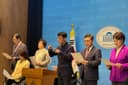
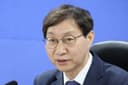
Kim Sung-joo, appointed chairman of the National Pension Service amid questions over fitness for the post, worked through a breathless schedule: the Fund Management Committee on December 15, the presidential policy briefing on the 16th, and the inauguration ceremony on the 17th. Having served as the 16th chairman from November 2017 to January 2020, Kim now leads the National Pension for a second time.
In the market, many are tilting their heads at Kim’s appointment. The chairmanship of the National Pension Service is a post responsible for the old age of 22 million insured persons. As of the end of August, the National Pension’s reserves reached 1,322 trillion won. That is why a high degree of expertise and a sense of responsibility are demanded of the chairman.
Yet after losing in the 2016 general election, Kim was appointed chairman of the National Pension Service at the end of 2017 amid controversy over a “parachute” appointment. Then, in 2020, with ten months of the term remaining, Kim resigned midway, saying, “I will run in the general election.” Kim’s constituency is Jeonju B, where the National Pension Fund headquarters is located. At the time, there was talk in the region that “the chairmanship is being used for personal politics.” After 2020, Kim ran again in last year’s general election but was eliminated after losing the party primary. Even so, Kim has returned as chairman of the National Pension Service after five years. An official in the fund management industry said, “Even during the last term there was much criticism that the Fund Management Office was being used as a political asset. It is hard to accept that such a person has been appointed chairman once again.”
Remarks Kim made at the inauguration ceremony also drew controversy. At the ceremony on December 17, Kim said, “The National Pension must answer the question of why, while it invests in overseas real estate, it does not invest a single won to solve Korea’s housing problem,” adding, “Through investment in public housing we will promote marriage and childbirth, overcome the demographic cliff, and lay the groundwork for expanding the number of insured persons.”
Of these remarks, criticism arose among pension experts that “the chairman cannot even distinguish between what should be done through the public finances and the role of a public pension.” The chairman of the National Pension Service has no authority over fund investment decisions. That belongs to the Fund Management Committee, chaired by the Minister of Health and Welfare.
From Domestic Equities to Defending the Exchange Rate
The Government and the Ruling Party Press the National Pension
What is worrying is that various roles are being demanded of the National Pension in the open. Broadly, they are: ▲ expanding the allocation to domestic equities; ▲ defending the exchange rate; and ▲ actively exercising voting rights through an overhaul of the stewardship code (the principles of fiduciary responsibility for institutional investors). As the government and the ruling party issue high-intensity remarks from the sidelines day after day, criticism is boiling over that the autonomy of the Fund Management Committee’s decision-making may be damaged.
At a recent policy briefing Chairman Kim said that a plan to increase the National Pension’s allocation to domestic equities would be pursued. It is a step taken in response to President Lee Jae-myung’s request that thought be given to pension fund management, at a time when the won–dollar exchange rate is running high.
On December 16, President Lee Jae-myung received the Ministry of Health and Welfare’s policy briefing at the Government Complex Sejong and instructed that expanding the National Pension’s allocation to domestic equities be examined.
President Lee said, “It is clear that the Korean stock market has been undervalued. People say, ‘We cannot trust Korean shares,’ ‘Normal trading is not possible’ — so should we not simply normalize this?” The President added, “It is delicate and risky to speak about the stock market, but the National Pension too will need to give the matter a great deal of thought”
. In response, Chairman Kim replied, “It is impossible to predict whether the domestic stock market will be this strong next year, but in order to respond swiftly to conditions we intend to change the standards in the investment guidelines.”
Accordingly, changes are expected in the fund’s management strategy as well. With the KOSPI surging this year, the National Pension’s allocation to domestic equities had risen to 15.6% as of the end of the third quarter, above the year-end target of 14.9%.
Each May the National Pension sets a five-year medium-term strategy, taking account of medium-term prospects for the real economy and financial markets. It sets a target return and a risk limit for five years ahead and also determines target allocations by asset class. This year’s target for domestic equities is set at 14.9% under the “2025–2029 Five-Year Medium-Term Asset Allocation Strategy.” If the allocation exceeds 17.9%, the limit of the permitted strategic asset allocation (SAA) range (±3 percentage points), the National Pension may resort to “mechanical selling.” The market expects that the National Pension may use tactical asset allocation (TAA; permitted range ±2 percentage points), which is discretionary, to adjust the domestic equity allocation.
Lee Kyoung-min, an analyst at Daishin Securities, said, “The President instructed that expanding the National Pension’s allocation to domestic equities be examined, and Chairman Kim Sung-joo of the National Pension Service said he plans to change the investment guidelines at next year’s Fund Management Committee,” adding that “this suggests a flexible management policy for coping with volatility.”
Many take the view, however, that adjusting the investment strategy with an eye to short-term market conditions will harm the National Pension’s medium- and long-term profitability. Within the National Pension the dominant view is that the trend of reducing domestic equities should continue. To minimize the impact on domestic equities in the future period when the fund shrinks, the allocation must be adjusted strategically from now. In terms of returns, too, it is advantageous to increase overseas and alternative assets.
The National Pension is also being asked to play a role in the foreign exchange market. With the won–dollar exchange rate recently passing 1,470 won, the foreign exchange authorities are pressing the National Pension in public. From reducing the scale of overseas investment to permanent currency hedging, the pressure on the National Pension is fierce. At the end of November a “four-party consultative body for stabilizing the foreign exchange market” was set in motion, made up of the foreign exchange authorities — the Ministry of Economy and Finance and the Bank of Korea — together with the National Pension and its supervising ministry, the Ministry of Health and Welfare.
Concern over pension socialism is also a hot potato. Since the launch of the Lee Jae-myung government, the ruling camp and the government have begun in earnest to discuss institutional changes that could exert direct or indirect influence over the exercise of voting rights through the National Pension. When Lee Chan-jin, Governor of the Financial Supervisory Service, recently referred to diversifying the routes for recommending outside directors of financial holding companies and used the phrase “an institution recommended by the people,” talk went around the financial sector that “this must mean using outside directors recommended by the National Pension.” That is why concern has been raised that the government is seeking to strengthen its indirect control over financial holding companies through the National Pension.
Business circles and the market are also on edge over the overhaul of the stewardship code. At the Ministry of Health and Welfare’s policy briefing, President Lee said, “The National Pension Service, which holds the public’s shares, must exercise its voting rights properly,” and instructed that the stewardship code, the guideline for exercising voting rights, be strengthened. Given that Chairman Kim was the figure who led the introduction of the stewardship code, many regard the President’s remark as anything but ordinary.
Hyun Jung-hwan, Professor in the Department of International Trade at Dongguk University, expressed concern that “if the National Pension is instrumentalized for purposes such as foreign exchange policy, both profitability and stability will be damaged, and the point of depletion could well be brought forward.”
https://n.news.naver.com/article/024/0000102254?sid=102