
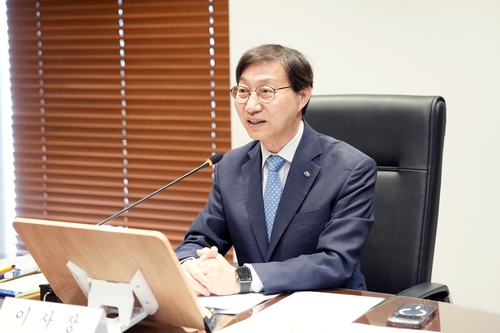
Kim Sung-joo, Chairman of the National Pension Service: “We Will Judge at the End of This Year Whether to Raise the Domestic Equity Allocation Further” (2026.06.23)
(Current and former officers and staff of the National Pension Service
have a tendency, in newspaper contributions
and similar venues,
to state things
that are contrary to fact!
In the Yonhap Infomax article that follows,
Chairman Kim Sung-joo is quoted as saying,
“As for the idea of splitting the scheme into an old pension and a new pension,
there is not one such case
anywhere abroad.”
As to that remark,
if one recalls that Sweden,
through its 1999 pension reform, applied by year of birth
an old pension and a new pension
on a differentiated basis, then it is clear
that the interview was given with content
contrary to fact.
In particular, the remark that “we will consider raising the domestic equity allocation further at the end of this year” appears to be a statement by the chairman of the National Pension Service — a body that is no more than a policy-executing agency —
that goes beyond the powers of that office,
and may well be assessed as such!)
“Domestic Equity Rebalancing Guided by the Principle of Minimizing Market Shock… Private Engagement with Starbucks Under Way”
(Seoul = Yonhap Infomax) Reporter Song Ha-rin = Kim Sung-joo, Chairman of the National Pension Service, stated a plan to judge once again at the end of this year whether to raise the target allocation to domestic equities further.
◇“Will Consider Raising the Domestic Equity Allocation Further at the End of This Year… Private Engagement with Starbucks Under Way”
At an online press briefing on the 23rd, Chairman Kim said the background to the decision to raise the domestic equity allocation was that “we judged the change in the domestic stock market to be a structural change in which the constitution of the Korean market has improved, rather than a temporary market factor.”
On the possibility of raising the target allocation to domestic equities further in future, Chairman Kim said, “We will judge again at the end of this year,” adding, “That said, at the Fund Management Committee last May it was decided that from next year we would go back to reducing the domestic equity allocation by 0.5 percentage point each year, as originally planned.”
On this point the National Pension Service issued a correction, stating, “The Fund Management Committee decided to maintain the domestic equity allocation at 20.8% through next year, and the allocation from the year after next will be discussed again in the medium-term asset allocation in the first half of next year,” and that “it is not the case that a reduction of 0.5% each year was decided.”
As for the fallout from the end of the moratorium on domestic equity rebalancing, Chairman Kim said it was “strictly undisclosed,” explaining, “The National Pension accounts for 6% of the Korean stock market as a whole, but because its holdings are concentrated in large-cap stocks, its effect on the market is large.”
Chairman Kim added, however, that “there is a principle of public purpose, which is to minimize market shock,” and that “a private investor whose only aim is to make money would dump large volumes or buy at the bottom, but the National Pension acts with great prudence.”
To criticism that the minutes are not disclosed, Chairman Kim explained, “Those who take part in the Fund Management Committee may make decisions that differ from the interests of the group to which they belong,” and “there is a need to respect that independent judgment, which is why they are not disclosed.”
On the direction of structural reform of the National Pension, Chairman Kim said, “I have continued to stress that if the State adds support — subsidizing contributions for low-income groups, funding credits at the point at which they arise, and so on — we can build a scheme with no fear of fund depletion through the end of the twenty-first century.”
Of the idea of splitting the scheme into an old pension and a new pension, Chairman Kim was pointed: “There is not one such case anywhere abroad,” and “to advocate a policy instrument that cannot be used in reality, such as bearing the sunk costs, is an extremely dangerous attempt.”
https://news.einfomax.co.kr/news/articleView.html?idxno=4421430
![(Report on the Pension Future Forum Statement, Nocut News) [Column] Holding the 'Pension Fund Casino' to Account?… It May Be the Result of Choosing the 'Easy Way' (October 20, 2026)](/_next/image?url=%2Fuploads%2Feditor%2F2026%2F10%2Fc6f13b0799b440d0874a9f72413c6f58-0004200449_003_20261020063615439-1.jpg&w=128&q=75)
![(Report on the Pension Future Forum Statement, JoongAng Ilbo) [Reporting Diary] The National Pension Protected the KOSPI Rather Than the Public's Retirement (October 19, 2026)](/_next/image?url=%2Fuploads%2Feditor%2F2026%2F10%2F7e92f70b0ec843bbb869a4cf46b01f72-0003558751_001_20261019052229249.jpg&w=128&q=75)