
The Advisory Committee of the Special Committee on Pension Reform, Nearing the Conclusion of Its Term — Will This Time Be Different? (2026-05-23)
- #연금특위
(If certain claims have been advanced persistently up to this point, ought not the veracity of those claims and their real-world validity be established through an exhaustive debate that settles the matter once and for all!
If segments of the political sphere and a majority of the media were subjected to gaslighting by those claims,
causing a change that constitutes deterioration to be passed off as "reform," and a statutory amendment was thereby enacted,
why! should those who advanced such claims not forthwith explain, openly and without reservation, why they did so!
Failing even to attend the meeting sessions, or walking out mid-session — this!
The preparation of detailed meeting minutes, which certain parties fought strenuously to prevent,
and the prospect of their own remarks being preserved in those detailed minutes — is it not to avoid precisely this that such conduct is being exhibited!
If that is not the case, the members concerned should attend the sessions and speak to the very end;
and, given that the National Assembly Special Committee still has seven months remaining in its mandate, taking that schedule into account, should not the term of the advisory committee be extended accordingly!
This is the position held by the Pension Future Forum.)
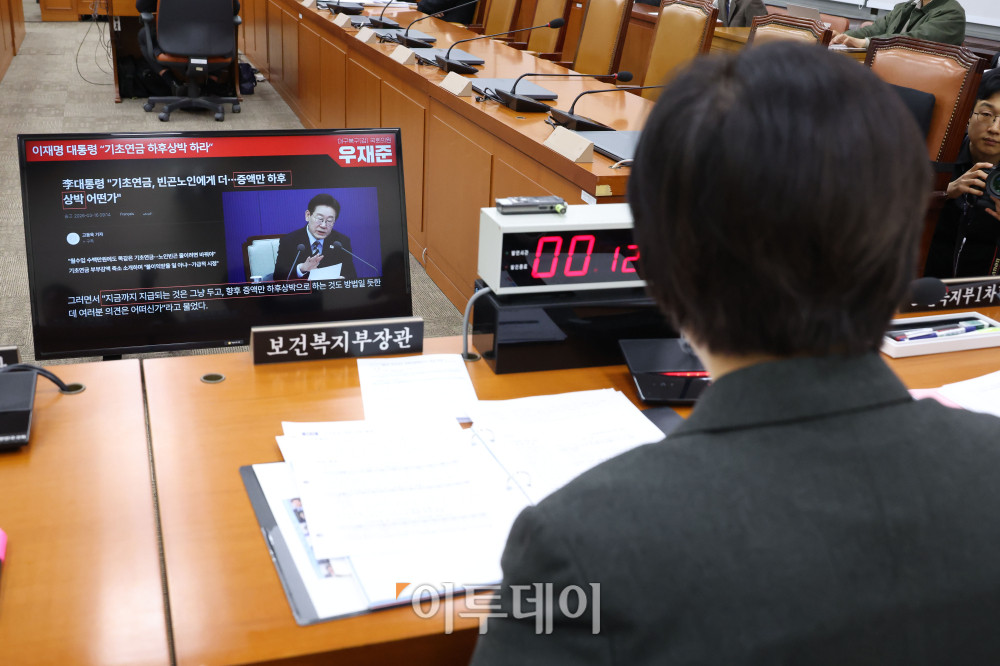
The private advisory committee established under the National Assembly Special Committee on Pension Reform (the Special Pension Committee) is set to conclude its activities with its 10th meeting on the 29th.
However, there are indications that reaching a consensus "recommendation" is, in practice, unlikely.
According to the National Assembly and the Special Pension Committee as of the 23rd, the advisory committee is scheduled to hold a plenary session on the 29th to compile the conclusions of its deliberations.
The advisory committee was established last March as a follow-up measure to the parametric reform of the National Pension (the amendment to the National Pension Act), with the purpose of devising a comprehensive structural reform proposal encompassing the pension system as a whole.
Yet through its ninth meeting, the advisory committee has failed to reach agreement on any point.
Divisions have persisted over contested issues including the injection of general tax revenues into the National Pension and the introduction of an automatic adjustment mechanism.
In the final stages, it is reported that substantive debate was not even properly conducted, as experts advocating for enhanced income security boycotted sessions or departed immediately after presenting their papers.
During discussions of President Lee Jae-myung's proposed Basic Pension restructuring along a "more for the lower-income, less for the upper-income" principle, the divergence of views among advisory committee members was once again confirmed.
From the outset, the advisory committee was structured in a manner that made consensus difficult. The ruling Democratic Party of Korea nominated members primarily from the social welfare field, while the People Power Party nominated members from the economic and fiscal fields; as a result, the advisory committee became divided between advocates of enhanced income security and advocates of financial sustainability.
At a fundamental level, the two sides held incompatible views on the fiscal position of the National Pension.
Those on the income-security side denied the existence of a fiscal crisis, and discussions of individual agenda items devolved into heated exchanges and mutual recrimination.
A "dramatic consensus" is also unlikely to emerge from the remaining 10th meeting. In all probability, rather than a formal recommendation, a "report" summarizing the proceedings of the advisory committee — including presentation papers and discussion records — will be submitted. The advisory committee of the 21st National Assembly's Special Pension Committee, which had a similar structure, likewise failed to reach agreement; in that instance, the co-chairs, Professors Kim Yeon-myung and Kim Yong-ha, each submitted separate recommendations embodying their respective positions directly to the Special Committee, without consulting the other advisory committee members.
https://m.etoday.co.kr/news/view/2587267
![(Pension Future Forum Position Statement, JoongAng Ilbo, October 14, 2026) [Exclusive] As Chairman Kim Sung-joo Returns… National Pension Service Revives '7 Million Won a Month' Team Leader Post](/_next/image?url=%2Fuploads%2Feditor%2F2026%2F10%2F2204b9fa7b7945b39feda2bfbfea1fe9-0003557760_001_20261014052215751.jpg&w=128&q=75)