
Did the President and the Vice Minister of Health and Welfare Diverge on the National Pension Fund Depletion Year? Both Are Correct (May 21, 2026)
- #연금특위
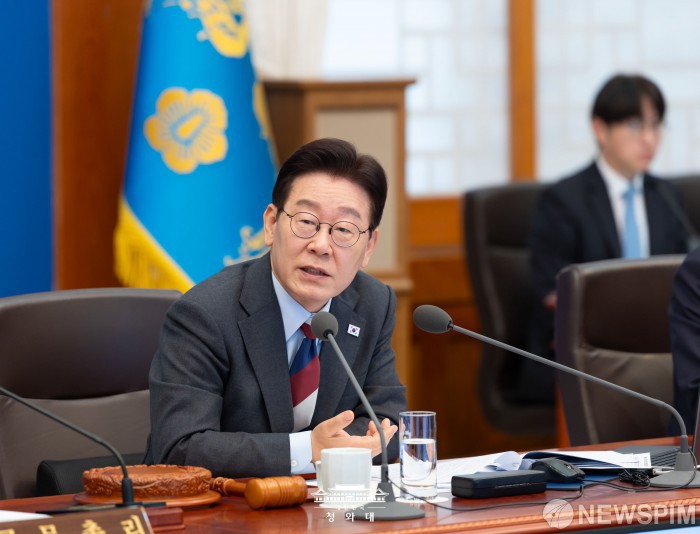
President Lee Jae-myung and Vice Minister of Health and Welfare Hyun Su-yeop diverged on the projected year of National Pension Fund depletion during the Cabinet meeting held on the 20th; the discrepancy has since been found to stem from differing assumptions about the fund investment return rate.
According to reporting by <Newspim> on May 21, the fund depletion year cited by President Lee was based on a scenario assuming a fund investment return rate of 6.5%, whereas
Vice Minister Hyun's response reflected the financial projection result incorporating a fund investment return rate of 5.5%.
◆ President and Vice Minister of Health and Welfare Diverge on "Extension of National Pension Depletion Timeline"…"7 Years vs. 30 Years"
At the Cabinet meeting held on the 20th, President Lee asked Vice Minister Hyun: "The National Pension Fund's return on investment varies from year to year — what is the currently projected year of fund depletion?"
Vice Minister Hyun replied, "In the previous financial projection, it was 2071." He added, "That was the original figure (2071), but because strong returns were generated this time around, we would need to carry out a precise projection, though on a preliminary basis the timeline has been pushed back by approximately seven years."
Upon hearing this response, President Lee expressed skepticism, asking, "Is that all the extension we get?"
He pressed further, saying, "Stock prices rose last year, and including this year, the fund has grown by 300 trillion won — and yet the extension is only seven years?"
He continued, "I had heard from media reports that the depletion date had been pushed back by 20 to 30 years — does the Vice Minister stand behind what he said? It seems there may be a basis for that; please look into this at a later stage."
The divergence between President Lee and Vice Minister Hyun has generated confusion among the public as well.
One citizen stated, "I had heard it would be pushed past 2100." Another said, "I understood it had been delayed to around 2090." Yet another noted, "When I asked an artificial intelligence (AI) system, it said the National Pension depletion date had been extended by up to 33 years."
(omitted)
A Ministry of Health and Welfare official stated in response, "The government has never once calculated using a fund investment return rate assumption of 5.5% or higher," indicating that the figure in question does not represent an official financial projection result.
The financial projection conducted by the government pursuant to the National Pension Act is carried out every five years; the next (sixth) financial projection is scheduled to be completed in 2028.
It is highly likely that both President Lee and the general public encountered a scenario premised on the assumption of sustained high long-term fund investment returns, leading them to perceive fund depletion as having been deferred by several decades.
Although recent stock market gains have boosted the National Pension's fund investment return rate, it must also be recognized that, over the longer term, the scale of annual benefit expenditures payable by the National Pension will grow astronomically as population aging intensifies.
It is further necessary to take into account that the government's financial projection is calculated with a forward-looking horizon of 70 years of pension finances.
To push the fund depletion date back by 30 or more years, the decisive factor is not immediate returns but rather sustaining a fund investment return rate of 6.5% every year.
If future returns are projected with undue optimism at an elevated level, and actual returns subsequently fall short of that target, the system's capacity to respond will be diminished — leaving future generations to bear the full brunt of the consequences.
Experts advise that, given the fund depletion year can shift by several decades depending on the fund investment return rate assumed, the government should enhance public confidence in the pension system by transparently disclosing both optimistic and pessimistic scenarios.
Yun Suk-myung, Emeritus Research Fellow at the Korea Institute for Health and Social Affairs (KIHASA), had previously noted — when the government, during last year's National Pension reform process, raised the fund investment return assumption from 4.5% to 5.5% to highlight its achievements — that the results of multiple scenarios, such as return rates of 3.5%, 4.5%, and 5.5%, should be communicated to the public.
Regarding this matter, Professor Yun stated, "No one knows what will happen over the course of 70 years,"
adding, "Since no one can know how circumstances will change, the government should assume and publicly disclose multiple scenarios for the fund investment return rate — such as 3.5%, 4.5%, 5.5%, and 6.5% — so that the public is not misled."
https://m.newspim.com/news/view/20260521000988![(Report on the Pension Future Forum Statement, Nocut News) [Column] Holding the 'Pension Fund Casino' to Account?… It May Be the Result of Choosing the 'Easy Way' (October 20, 2026)](/_next/image?url=%2Fuploads%2Feditor%2F2026%2F10%2Fc6f13b0799b440d0874a9f72413c6f58-0004200449_003_20261020063615439-1.jpg&w=128&q=75)
![(Report on the Pension Future Forum Statement, JoongAng Ilbo) [Reporting Diary] The National Pension Protected the KOSPI Rather Than the Public's Retirement (October 19, 2026)](/_next/image?url=%2Fuploads%2Feditor%2F2026%2F10%2F7e92f70b0ec843bbb869a4cf46b01f72-0003558751_001_20261019052229249.jpg&w=128&q=75)