
"More for Vulnerable Older Adults" — Proposal to Narrow Basic Pension Eligibility Threshold from 2.47 Million Won to 1.23 Million Won (March 17, 2026)
- #연금특위
As the government is reviewing a shift from the current Basic Pension system—which provides a uniform benefit amount to the bottom 70% of income earners aged 65 and above—to an income-differentiated tiered benefit structure,
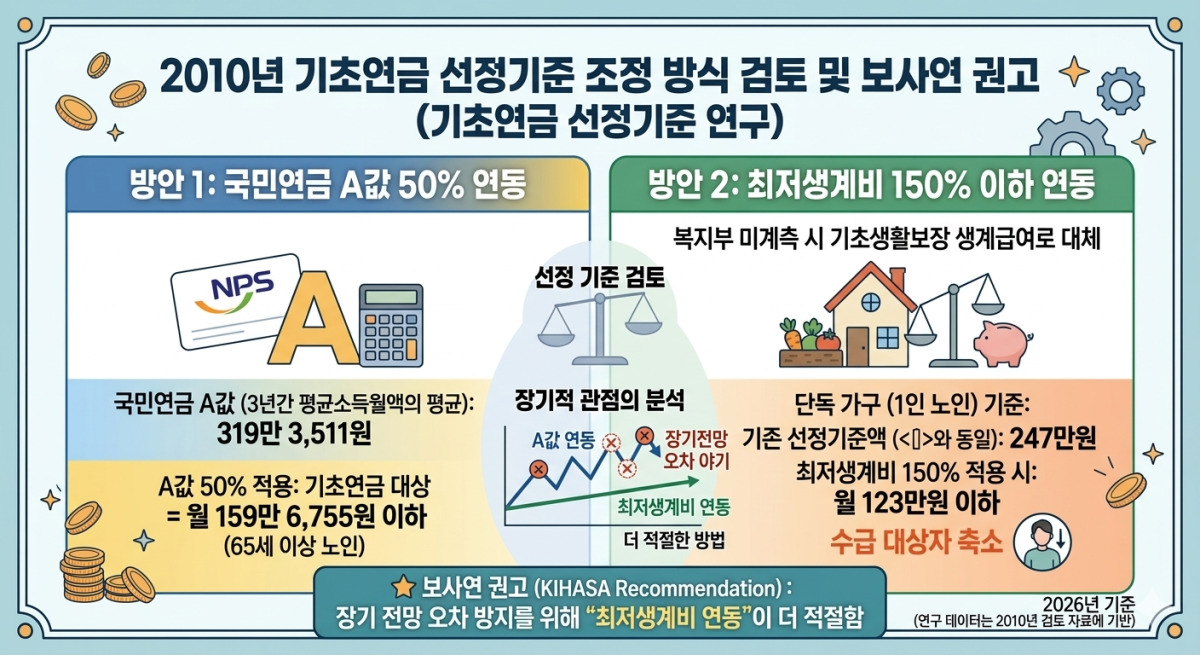
a proposal has emerged to provide the Basic Pension exclusively to elderly individuals with monthly incomes at or below 1.23 million won, based on a threshold of 150% of the minimum living cost.
According to the Ministry of Health and Welfare on the 17th, the Lee Jae-myung administration is reviewing a plan to shift from the current uniform-benefit Basic Pension for the bottom 70% of income earners aged 65 and above to an income-differentiated tiered benefit structure.
The Pension Future Forum, a private research organization engaged in discussions on pension reform, expressed agreement that a restructuring of the Basic Pension is necessary, noting that the government's direction is consistent with the policy recommendations of the Organisation for Economic Co-operation and Development (OECD) Secretariat.
(Excerpt)
◆ KIHASA: 150% of Minimum Living Cost Is the Appropriate Standard — Basic Pension Eligibility Threshold to Be Reduced from 2.47 Million Won to 1.23 Million Won
According to the "Study on Selection Criteria for the Basic Old-Age Pension" conducted by the Ministry of Health and Welfare and the Korea Institute for Health and Social Affairs (KIHASA),
the Ministry of Health and Welfare examined, in 2010, two approaches for adjusting the Basic Pension selection criteria: one involving indexation to 50% of the National Pension's A value (the A value being the economy-wide average of insured earnings, calculated as the monthly average of all National Pension contributors' earnings over the three years prior to the commencement of benefit receipt), and another involving provision of benefits to individuals with incomes below 150% of the minimum living cost.
The National Pension's A value for this year is 3,193,511 won. Applying 50% of the A value, the Basic Pension would cover elderly persons aged 65 and above with monthly incomes at or below 1,596,755 won.
When applying the minimum living cost standard, the Ministry of Health and Welfare does not directly measure the minimum living cost — taking into account social disparities and other factors — and therefore substitutes the livelihood benefit under the National Basic Livelihood Security System as the basis for calculation.
For the current year, the Basic Pension selection threshold for a single elderly person aged 65 and above without a spouse is 2.47 million won; applying the 150% minimum living cost standard would reduce the eligible recipient pool to those with monthly incomes at or below 1.23 million won.
KIHASA concluded that indexing the Basic Pension selection criteria to the National Pension's A value could introduce errors in long-term projections, and that indexation to the minimum living cost is therefore the more appropriate approach.
Yun Suk-myung, Honorary Research Fellow at KIHASA and the researcher who conducted the study, stated that "adopting the livelihood benefit concept under the National Basic Livelihood Security System as the reference standard
offers the advantage of enabling a more direct link between the Basic Pension and elderly poverty, which remains the highest among OECD member countries." He further explained that
"reducing the number of eligible recipients would create additional fiscal capacity to provide greater benefits to the most vulnerable elderly."
https://m.newspim.com/news/view/20260317000909![(Report on the Pension Future Forum Statement, Nocut News) [Column] Holding the 'Pension Fund Casino' to Account?… It May Be the Result of Choosing the 'Easy Way' (October 20, 2026)](/_next/image?url=%2Fuploads%2Feditor%2F2026%2F10%2Fc6f13b0799b440d0874a9f72413c6f58-0004200449_003_20261020063615439-1.jpg&w=128&q=75)

![(Report on the Pension Future Forum Statement, JoongAng Ilbo) [Reporting Diary] The National Pension Protected the KOSPI Rather Than the Public's Retirement (October 19, 2026)](/_next/image?url=%2Fuploads%2Feditor%2F2026%2F10%2F7e92f70b0ec843bbb869a4cf46b01f72-0003558751_001_20261019052229249.jpg&w=128&q=75)