
The Rationale That Raising Pension Contributions by 1 Percentage Point Would Enable a 50% Income Replacement Rate for the National Pension (May 6, 2015)
- #연금특위
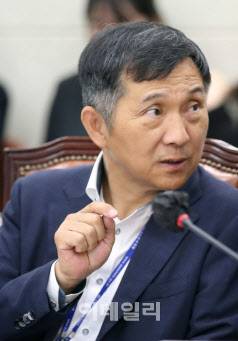
(The following reproduces the rationale then advanced by the Democratic Party—circa 2015—that raising National Pension contributions by a mere 1 percentage point would make a 50% income replacement rate achievable.)
Kim Yeon-myeong:
That is the view held by those who believe the functions of the National Pension should not be expanded—only one side of the argument. Take, for instance, the decision reached this time to raise the National Pension's income replacement rate to 50%. Is that not the most contentious point? The figure of a 50% income replacement rate was, in fact, already the subject of broad expert consensus as the optimal target during the 2007 reform process. It would be incorrect to suggest that a handful of working-level legislators who participated in that process simply woke up one morning and inserted "50%" without any deliberation. The members of our working-level body incorporated that figure only after thoroughly debating and persuading the representatives of both major parties—the Saenuri Party and the New Politics Democratic Union—on the question of pension reform. Within the Government Employees Pension Special Committee as well, there were three subcommittees, one of which was the Subcommittee on Old-Age Income Security. The government side, the Ministry of Health and Welfare, the Ministry of Strategy and Finance, and members from both the ruling and opposition parties all participated in the discussion. To speak of this decision as though it fell from the sky suggests an unfamiliarity with the processes that had taken place up to that point.
Ko Seong-guk: Yes. Committee Member Yun Suk-myung, would you like to offer a rebuttal?Yun Suk-myung:
Indeed. If the deliberations had been as transparent as described, I doubt the Ministry of Health and Welfare—the ministry responsible for National Pension policy—would have reacted as strongly as it did, going so far as to issue a press release. Viewed from the other direction, that reaction speaks for itself. It is true that the Director-General of the Ministry attended the proceedings. However, he attended only up to the preceding stage. The Ministry's responsible official was absent from the final working-level responsible committee meeting at which the National Pension's income replacement rate was determined. That point needs to be made clearly. Furthermore, regarding the assertion that consensus was reached in 2007: we had originally submitted a proposed amendment to the National Pension Act to the National Assembly in October 2003, based on the results of the first financial projection for the National Pension. At that time, the government proposal argued that lowering the rate to 40% would be too severe and that it would be preferable to maintain approximately 50%, provided that contributions were raised to approximately 15.88%–16%. However, the political establishment of the day held that raising contributions to 16% was not feasible and that, painful as it would be, the benefit rate should be cut further—and so 40% was decided upon. There is a precedent for that. The fact that such a decision is now being made abruptly, with those circumstances entirely disregarded, appears to be why many stakeholders and the media are leveling very sharp criticism.
Ko Seong-guk: Ah, Committee Member Yun—did you state at the time as well that a 50% rate would require a contribution burden of 16%?
Yun Suk-myung: To be precise, 15.88%, which is close to 16%.
Ko Seong-guk: Yes. And at that time, on the grounds that the burden was too great, the benefit rate was lowered to 40%—what contribution rate resulted from that?
Yun Suk-myung: When the rate was lowered to 40%, the proposal was to raise contributions to 12.9%—call it 13%—but even that was deemed too burdensome, and the National Assembly ultimately rejected it, leaving only the benefit rate reduced. So the government's position at the time was that 50% was preferable to 40%, but only on the condition that the contribution burden be increased accordingly. None of those conditions were accepted.
https://m.tbs.seoul.kr/news/newsView.do?seq_800=10086275&idx_800=2101187&typ_800=11&grd_800=null
![(Report on the Pension Future Forum Statement, Nocut News) [Column] Holding the 'Pension Fund Casino' to Account?… It May Be the Result of Choosing the 'Easy Way' (October 20, 2026)](/_next/image?url=%2Fuploads%2Feditor%2F2026%2F10%2Fc6f13b0799b440d0874a9f72413c6f58-0004200449_003_20261020063615439-1.jpg&w=128&q=75)

![(Report on the Pension Future Forum Statement, JoongAng Ilbo) [Reporting Diary] The National Pension Protected the KOSPI Rather Than the Public's Retirement (October 19, 2026)](/_next/image?url=%2Fuploads%2Feditor%2F2026%2F10%2F7e92f70b0ec843bbb869a4cf46b01f72-0003558751_001_20261019052229249.jpg&w=128&q=75)