
Pension Future Forum Calls on Acting President to Exercise Veto over the Regressive National Pension Amendment (March 24, 2025)
- #연금특위
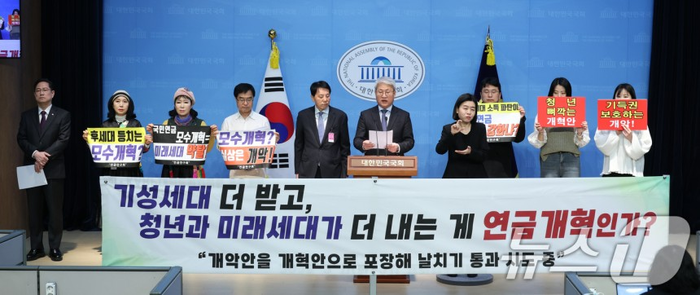
(After the National Pension Act amendment passed on March 20, 2025—demonstrating that its content constituted a change for the worse masquerading as reform—the Pension Future Forum held a press conference at the National Assembly Communication Hall on March 24, 2025.
The press conference, in which the Forum demanded that the Acting President exercise a veto over the regressive amendment, was subsequently covered by the media.
This is a matter that must be preserved as a record for history.)
The Pension Future Forum—led by Lee Geun-myeon, former Commissioner of the Ministry of Personnel Management who spearheaded Government Employees Pension reform, and Honorary Research Fellow Yun Suk-myung of Korea Institute for Health and Social Affairs (KIHASA)—called on the Acting President to exercise the right to request reconsideration of the "National Pension deterioration bill."
In a statement issued on March 24, the Pension Future Forum declared that "the fury of the younger generation has reached the breaking point since the passage of the National Pension amendment," criticizing the bill for "deepening intergenerational inequity and making the system even less sustainable—a change for the worse."
The Forum leveled pointed criticisms with specific examples. The first issue it raised was the statutory codification of the government's guarantee of pension payments. The Forum stated that "the intent is to reassure the younger generation that they need not worry about receiving their pension because the state guarantees payment," but added that "the crux of the problem lies in who will bear responsibility for that guarantee." It went on to argue that "if a legal provision is enacted yet, when the time actually comes for the younger generation to receive their pensions, there is no money to pay them, the practical effect is to deceive the younger generation yet again."
The Forum also stated that the younger generation's anger stems from the reform package abusing the payment guarantee provision as a means of further entrenching the pension entitlements of those aged 50 and above.
The second point was that age-differentiated contribution burdens were not incorporated. The problem, the Forum argued, is the omission of the automatic adjustment mechanism included in the government's proposal and the "age-differentiated contribution burden scheme" that could have addressed the dissatisfaction of younger cohorts. In its statement, the Forum emphasized: "These two measures are indispensable for reducing intergenerational inequality and enhancing sustainability. The Ministry of Health and Welfare, which participated in the ruling-opposition-government consultations, ultimately failed to protect the core measures of the government's proposal," and stressed that "further deliberation is unavoidable."
The third point was that the younger generation was effectively excluded from the pension reform discussions. In its statement, the Forum noted that "this pension reform package suffers from the fatal flaw that the views of the younger generation—the stakeholders with the greatest interest—were thoroughly disregarded," and
criticized that "political and fiscal sustainability can only be secured if the content of the pension reform is something the younger generation can genuinely accept."
https://www.mk.co.kr/news/economy/11272419![(Report on the Pension Future Forum Statement, Nocut News) [Column] Holding the 'Pension Fund Casino' to Account?… It May Be the Result of Choosing the 'Easy Way' (October 20, 2026)](/_next/image?url=%2Fuploads%2Feditor%2F2026%2F10%2Fc6f13b0799b440d0874a9f72413c6f58-0004200449_003_20261020063615439-1.jpg&w=128&q=75)

![(Report on the Pension Future Forum Statement, JoongAng Ilbo) [Reporting Diary] The National Pension Protected the KOSPI Rather Than the Public's Retirement (October 19, 2026)](/_next/image?url=%2Fuploads%2Feditor%2F2026%2F10%2F7e92f70b0ec843bbb869a4cf46b01f72-0003558751_001_20261019052229249.jpg&w=128&q=75)