
Propping Up KOSDAQ with 1,400 Trillion Won in Pension Funds? KOSDAQ Index to Be Added to Benchmarks, and Bonus Points Established for Exchange-Rate Management (January 29, 2026)
- #국민연금법
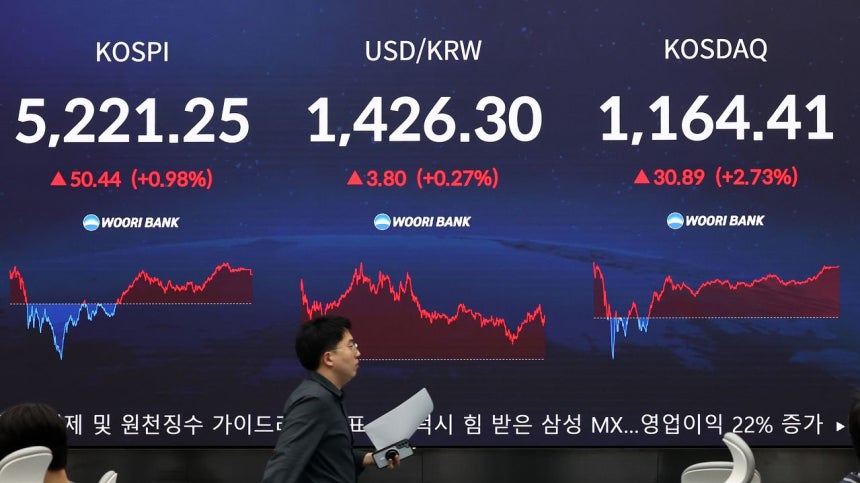
The government has issued guidelines directing pension funds—amounting to approximately 1,400 trillion won—to increase their investments in KOSDAQ. Having achieved the "KOSPI 5000" target, the ruling government and its party have set "KOSDAQ 3000" as the next objective, with the intention of supporting that goal through pension fund deployment. The evaluation of pension fund performance is also to take into account the degree to which funds comply with government policy.
On the 29th, the Ministry of Planning and Budget convened a meeting of the Fund Asset Management Policy Committee and resolved the "2026 Basic Direction for Fund Asset Management" and the "Draft Amendment to the 2026 Fiscal Year Fund Management Evaluation Guidelines," both of which contain the measures described above.
(omitted)
According to the basic direction, pension funds are required to take government policy into account when formulating investment strategies. The relevant policies include promotion of domestic venture investment, the People's Growth Fund, and measures to strengthen confidence in the KOSDAQ market. In particular, the government has focused on inducing pension fund investment into KOSDAQ.
(omitted)
The fund evaluation guidelines are also to be revised. It was decided to incorporate a 5% weighting of the KOSDAQ index into the benchmark return rate for domestic equity assessments of both large and small-to-medium-sized funds. Currently, only the KOSPI is reflected in the benchmark. In fund evaluations scored out of 100 points, the allocation for bonus-point items covering innovation-growth investments such as venture investment has been raised from 1 point to 2 points.
The government will also strengthen exchange-rate management through pension funds. As an initial step, a new evaluation item has been established to assess the risk of asset-value fluctuation arising from exchange-rate changes, including currency hedging (i.e., shielding asset values from exchange-rate exposure). Late last year, when the won–dollar exchange rate surged sharply (i.e., when the value of the won fell sharply), the government utilized the National Pension's currency hedging as an instrument of exchange-rate defense.
The clause evaluating investment diversification by funds will also delete "overseas investment." The removal of overseas investment from this criterion is the first such change since 2009. This is attributed to the fact that overseas investment by pension funds has already matured, with the overseas investment share rising from 7.7% in 2009 to 43.6% in 2024. The measure is interpreted as a constraint on large-scale overseas investment by pension funds—investment that could increase demand for the U.S. dollar and thereby contribute to exchange-rate appreciation.
(omitted)
There are also voices of concern regarding the government's "pension fund mobilization order" aimed at boosting KOSDAQ. The worry is that increasing the investment share in the highly volatile KOSDAQ market could undermine the stability of the pension funds.
Yun Suk-myung, an Honorary Research Fellow at the Korea Institute for Health and Social Affairs (KIHASA), stated: "KOSDAQ has weak fundamentals and high volatility. Changing the institutional framework to direct pension funds to invest in it at this point in time could amount to an artificial stimulus measure."
Kim Sung-joo, President of the National Pension Service (NPS), also remarked at a press briefing held the same day, regarding the prospect of expanded KOSDAQ investment: "From the perspective of risk management in response to high volatility, we invest relatively little in KOSDAQ, yet there are cases where returns are comparatively high—so it is a dilemma."
With respect to the establishment of new evaluation items related to exchange-rate management, a representative of the asset management industry noted: "When investing in advanced markets such as the United States, maintaining an open currency position (i.e., exposure to exchange-rate fluctuation) is the standard structure," adding that "awarding bonus points based on whether currency hedging is employed amounts to nothing more than a policy instrument driven by the government's need for foreign exchange management."
https://n.news.naver.com/article/025/0003499992?sid=101![(연금연구회 성명서 보도. 노컷뉴스) [칼럼] 연기금 카지노 책임론?…'쉬운길' 선택의 결과일 수 있다 (2026.10.20.)](/_next/image?url=%2Fuploads%2Feditor%2F2026%2F10%2Fc6f13b0799b440d0874a9f72413c6f58-0004200449_003_20261020063615439-1.jpg&w=128&q=75)

![(연금연구회 성명서 보도. 중앙일보) [취재일기] 국민 노후보다 코스피를 지킨 국민연금 (2026.10.19. )](/_next/image?url=%2Fuploads%2Feditor%2F2026%2F10%2F7e92f70b0ec843bbb869a4cf46b01f72-0003558751_001_20261019052229249.jpg&w=128&q=75)