(KBS TV, Coverage File K) Free Rides at a Crossroads (August 6, 2017)
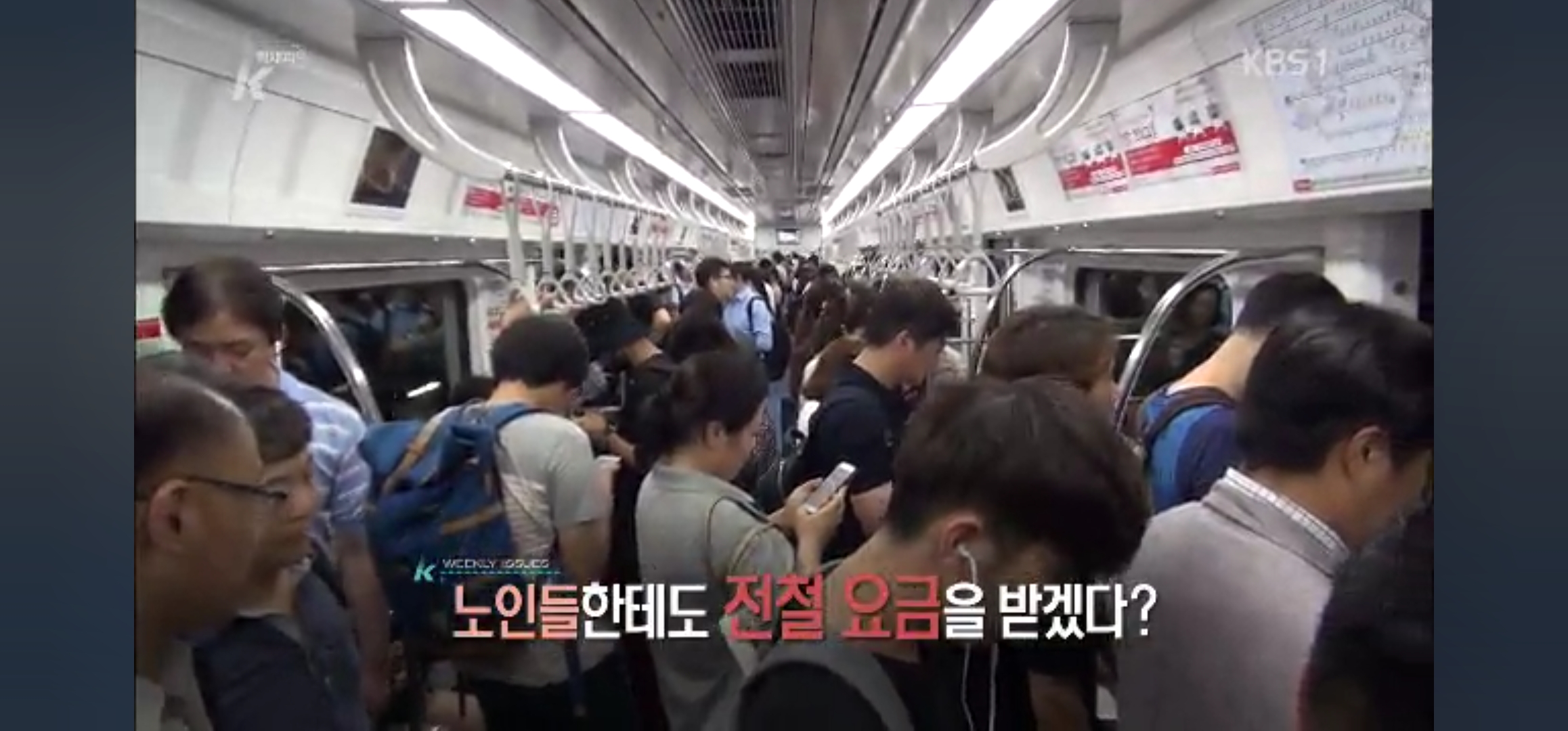
“We are going to charge older people fares, too.”
<Recording> “We have to pay—what else can we do? They say it is running a deficit. But I wish they would raise it to 70. The age...”
<Recording> “Why pin the deficit on older people, I ask you... Everyone keeps blaming only older people like that...”
The Shinbundang Line, a privately financed subway line, is moving to introduce fares, saying it will charge older people as well.
Its deficit is so severe that it can no longer hold out, it says, and the debate over this is intensifying.
With the older population growing steadily, calls are mounting that the free-ride program for those aged 65 and over needs to be overhauled one way or another.
We looked into the free subway ride program for older people, now at a crossroads.
On the Shinbundang Line, which connects Gangnam in Seoul with Bundang, many older people feel quite uneasy these days.
<Recording> “I read the papers too, so I know. They do say it is running a big deficit. But these days there really are too many old folks over there. I am an old one myself. You know. Well, it is a bit awkward.”
The operator’s position is that, six years after opening, its cumulative deficit is approaching 400 billion won and it can hardly hold out any longer.
It has asked the Ministry of Land, Infrastructure and Transport for approval to charge fares to older people and people with disabilities as well.
<Interview> Nam Sang-wook (person with a brain lesion disability): “I-I-I have to pay utility bills too, and so it is still a bit of a burden...”
<Recording> Older man: “Even if older people ride, it is not as if other passengers cannot get on—you know. And from the standpoint of welfare, of letting older people get around in good health, what is wrong with that? Being so stingy... You have to weigh what is worth weighing... You know.”
It is not a problem of the Shinbundang Line alone.
Add up the annual deficits of the subways in the country’s six major cities, including Seoul and Busan, and the total easily exceeds 700 billion won.
The operators calculate that if older people and people with disabilities had paid their fares in full, the deficits would have been cut by more than 70%.
Where do older people go on the subway, and what do they do there?
At the subway station said to have the highest share of older passengers in the country, a red light at the ticket gate signals an older passenger riding free.
An endless procession of red lights!
During the daytime about 90% are older people, and even counting rush hours, older passengers make up more than half.
<Interview> Park Mi-jeong (77): “(Do you use the subway often?) Yes. I often come out here to shop at the traditional market. It is free. (Is it better than your neighborhood?) Yes, it is better. Much better. (How big is the difference?) Maybe not 50%, but it is a lot cheaper. It helps a lot with living expenses.”
<Interview> Ko Ok-yeo (85): “It is good exercise, you know. Just because you are old, you cannot just sit still. You have to get enough exercise. You have to do it according to your strength.”
We followed an older woman wearing unusually heavy makeup.
As the music grows louder, a colatec dance hall comes into view.
An older man in white shoes, just finished with lunch, also goes into the colatec.
<Interview> Lim Chun-sik (Professor Emeritus, Department of Social Welfare, Hannam University):
“In our country, people are typically very negative about dancing, whether young or old. Older people who take part in such niche activities enjoy themselves, heal their minds, and meet good friends.... And the cost, they say, is 2,000 won. The admission fee—I have been there myself. But if you go to senior centers, there are many older people who cannot go because they do not have that 2,000 won.”
At Tapgol Park, an older man who says he retired ten years ago speaks of his loneliness.
<Interview> “I retired suddenly, so I had nowhere to go. Trying to get through the long hours of a day is hell. In a word. Hell, I tell you. Getting through each day is dull, and sometimes it is depressing. If I stay home, just as the old gentleman said a moment ago, I just stare at the ceiling.”
Even with nothing in particular to do, the time passes quickly.
<Interview> “Nothing special—we just laugh and talk, that kind of thing. It is a way to kill time.”
That older people can gather at Tapgol Park like this is also owed in large part to the free subway.
A bus fare of 1,200 won is a burdensome amount for older people.
<Interview> “(What did you take to get here?) The subway, of course. (Do you take the subway often?) I have no money, so I have to take the subway—what else would I take? For the bus, someone would have to give me the money.”
Older people getting off at Onyangoncheon Station.
There is quite a lot one can do because the subway is free.
Kim Eung-jung, who came to Onyangoncheon Station by subway, walks only a short way before his regular bathhouse comes into view.
For just 3,000 won, he can enjoy a hot-spring bath.
Even including lunch, 10,000 won is enough.
<Interview> Kim Eung-jung (80): “This is really good for your health. (Do you feel that?) I do. I am 80 now, but I have no wrinkles on my face, see? And the subway is cool, too. Rather than staying at home in the heat, you have to come out and keep moving. When you get old. So I come on purpose.”
Korea’s level of welfare for older people remains near the bottom among OECD countries.
It is true that free subway rides have served, at least in part, to make up for inadequate welfare for older people.
<Interview> Yun Suk-myung (Center Director, Korea Institute for Health and Social Affairs):
“In a country like ours, where the metropolitan-area commuter rail system has been built so effectively, free public transportation can be seen as an enormous benefit, to a degree that is hard to compare.”
<Recording> Daehan News (1984): “With the completion and opening of Seoul Subway Line 2, the full-fledged subway era has begun.”
Free subway rides for older people began in 1984, when Seoul Subway Line 2 opened.
It was an era when a single word from the President could make anything happen.
<Recording> Daehan News (1984): “On the President’s instructions, the Seoul Metropolitan Government has allowed older people aged 65 and over to use the subway free of charge.”
Word has it that Lee Kyu-dong, the President’s father-in-law, who had served as president and adviser of the Korea Senior Citizens Association, exerted his influence.
At the time, those aged 65 and over made up around 4% of the population, and subways existed only in Seoul.
Today, however, those aged 65 and over make up about 14% of the population, more than 7 million people.
Some argue that since the central government started the program as an act of benevolence in the first place, the government should cover the deficit with national treasury subsidies.
Their point is that 500 billion won a year is a lot of money, but given the size of the overall welfare budget for older people, it is not an unmanageable burden.
<Interview> Lim Chun-sik (Professor Emeritus, Hannam University):
“It is 500 billion a year—if the central government supports it, that settles it. But what I am unhappy about is the central government’s attitude toward covering the losses.”
Others suggest cutting the discount in half if a national treasury subsidy is difficult.
<Interview> Ko Ok-yeo: “I have often felt sorry. I used to think it would be good if they charged at least half. Because we ride around completely free...”
There is also a proposal to raise the starting age of eligibility from the current 65 to 70.
<Interview> Kang Cheon-su (72): “I am 72 now myself and I ride this for free, but there are just too many people riding it for free. From now on they should raise the age, up to about 70 and over...”
Experts point out that in that case a gradual approach is needed so that the older people who now receive the benefit are not disadvantaged.
<Interview> Yun Suk-myung (Center Director, Korea Institute for Health and Social Affairs):
“For people newly turning 65, I think an approach that raises the age somewhat from where it is now, focused on new entrants—by raising it by one year each year or by various other methods—may be the approach that can minimize the backlash.”
There are also strong calls that even if the free-ride benefit is overhauled, consideration must be given to older people who are not financially well off.
Kim Deung, 77 this year, gets around almost entirely by subway.
He walks the two bus stops’ distance from his home to the subway station.
<Interview> Kim Deung (77): “When I was young, about 10 minutes... 5 minutes was plenty to get here, but now 30 minutes? It takes 30 minutes. I do not take the bus much...”
There are times when he has to take the bus, but even then he deliberately uses a paper bill instead of a transit card.
<Interview> Kim Deung (77): “Even though I have a transit card, I deliberately pay 1,000 won to ride. It is actually cheaper. You are supposed to pay 1,200 won... but if you tell the driver you only have 1,000 won, you can pay 1,000 won and ride.”
Some argue that rather than giving the free benefit to all older people as now, it should be given only to older people in need.
Their point is that because the integrated social welfare management network has already been built, it is easy to identify who needs the free benefit.
<Interview> Yun Suk-myung (Center Director, Korea Institute for Health and Social Affairs):
“Welfare programs are run separately by each government ministry, and in the past they were all walled off from one another, so if it was Hong Gil-dong, we did not know exactly what benefits this Hong Gil-dong was receiving. But now a system called Haengbok-eum, in which all information on welfare programs is operated in an integrated way, has been built.”
The free subway ride program, introduced at a time when even the concept of welfare for older people was scarcely known, has taken root as a welfare policy for older people.
Amid the growth of the older population, it now stands at a crossroads.
Attachments
- Screenshot_20261121_190102_Samsung Browser.jpg(502.6 KB)ViewDownload
- Screenshot_20261121_190111_Samsung Browser.jpg(476.5 KB)ViewDownload
- Screenshot_20261121_185452_Samsung Browser.jpg(525.0 KB)ViewDownload
- Screenshot_20261121_185607_Samsung Browser.jpg(530.1 KB)ViewDownload
- Screenshot_20261121_190309_Samsung Browser.jpg(504.2 KB)ViewDownload
- Screenshot_20261121_185745_Samsung Browser.jpg(484.7 KB)ViewDownload
- Screenshot_20261121_185749_Samsung Browser.jpg(486.1 KB)ViewDownload