
(Monthly JoongAng) Social Issues | Behind the Government Employees Pension Reform — Is “Coexistence” Giving Way to a Race Toward “Mutual Ruin”? (November 20, 2014)
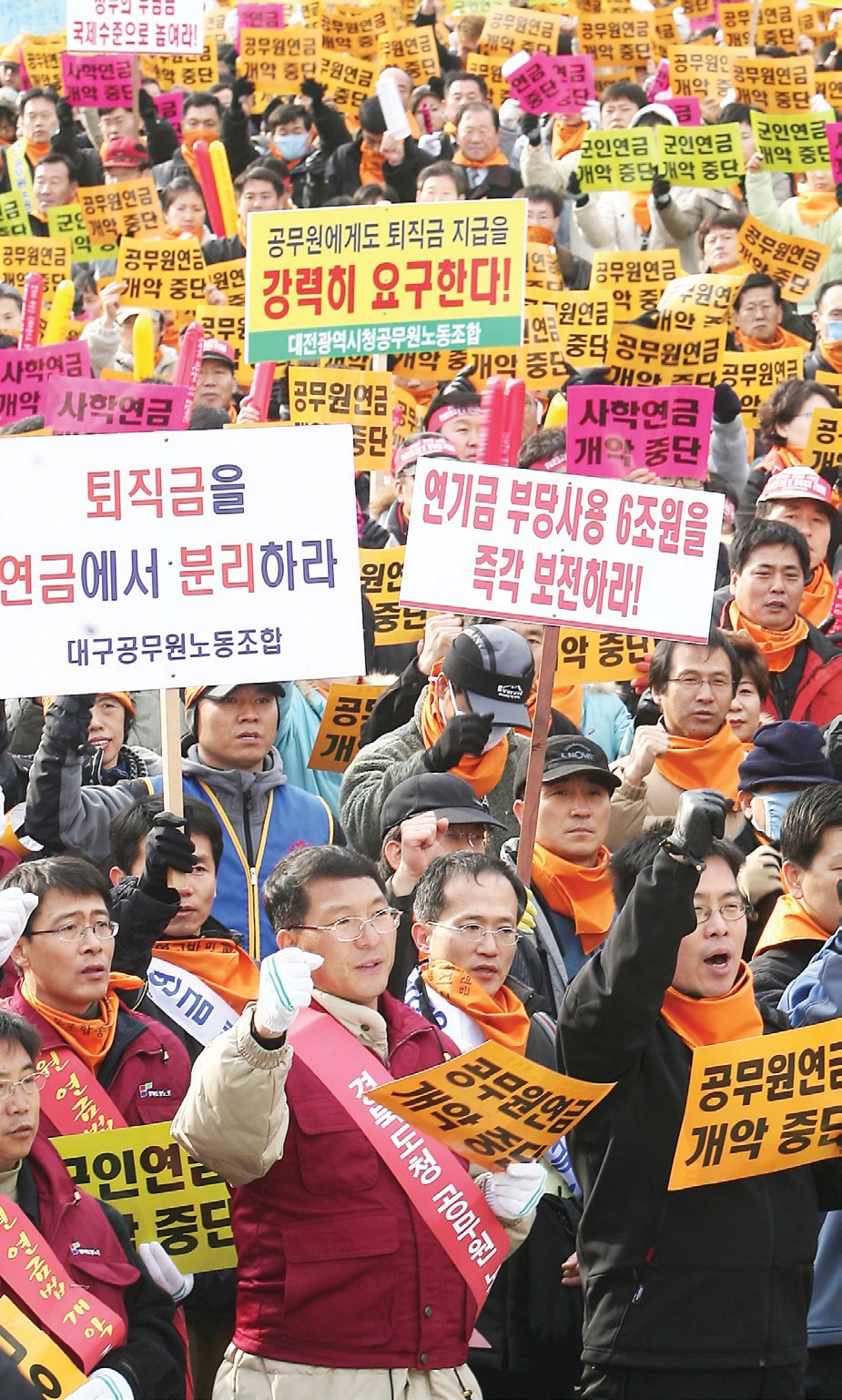
A severe imbalance with the National Pension,
broad consensus on reform…
The government’s “more for the lower, less for the upper” policy
raises concerns about leveling public pensions down and shrinking their role
3 million won versus 320,000 won. These are the monthly pension amounts received by two groups of Korean citizens. The former are civil servants; the latter, ordinary citizens. It is a stark illustration of the gap between the Government Employees Pension and the National Pension. The Government Employees Pension’s funding shortfall is a problem that began long ago, but it has now reached a level that public sentiment can no longer tolerate. That is why the government has drawn its sword on Government Employees Pension reform.
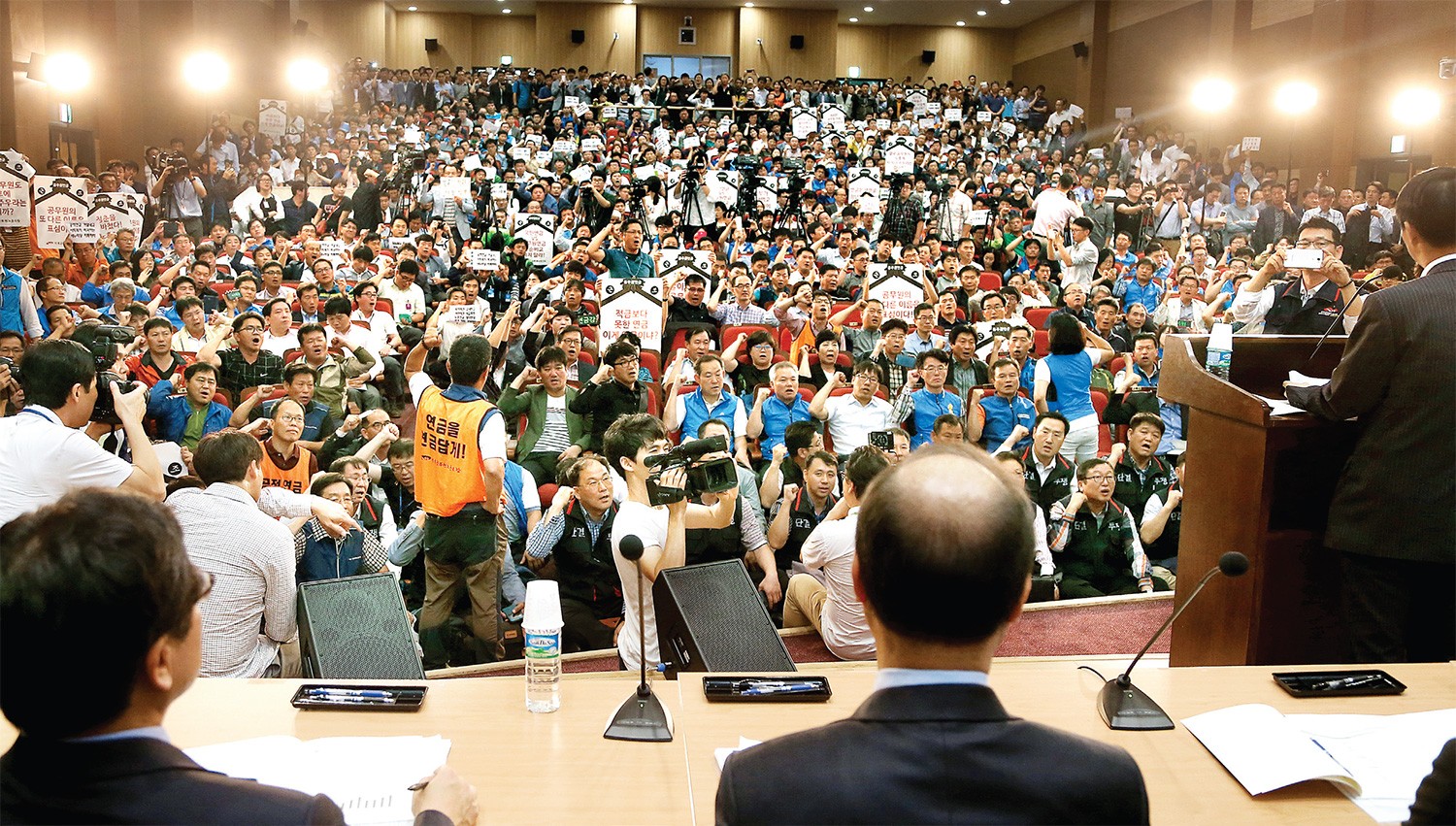
At the “Policy Debate on Government Employees Pension Reform” hosted by the Korean Pension Association at the National Assembly Members’ Office Building on September 22, members of the Korean Government Employees’ Union chant slogans against pension reform. The government has decided to overhaul the Government Employees Pension system substantially along “more for the lower, less for the upper” lines. / Photo: JoongAng Photo
The crisis of the Government Employees Pension is closely tied to rapid population aging. According to the Ministry of Security and Public Administration’s statistics on Government Employees Pension benefits, released by Representative Cho Won-jin (Saenuri Party) of the National Assembly’s Security and Public Administration Committee, as of the end of August, 75,036 people, or 22.2% of all Government Employees Pension recipients, receive 3 million won or more a month. At the end of 2012, recipients of 3 million won or more numbered 56,205, or 18.4% of the total, meaning that 18,831 more were added in one year and eight months. At this pace, the number receiving 3 million won or more is expected to approach 79,000 by the end of this year.
Recipients of 4 million won or more also rose by as much as 170% in 20 months, from 859 at the end of 2012 to 2,326 at the end of August this year. By contrast, the share receiving less than 2 million won fell from 43.2% to 37.9%. The rising size of Government Employees Pension benefits is a phenomenon that has emerged as those who joined the civil service during its major expansion in the 1970s and 1980s reach retirement. Designing the pension with a “high-benefit” structure, as compensation for civil servants’ poor working conditions, is now proving to be a heavy burden.
When the Government Employees Pension system was introduced, the benefit ratio was not as high as it is today. In the 1960s, the Government Employees Pension’s income replacement rate was 40%. The income replacement rate was then raised step by step until the mid-1980s, reaching as high as 90%.
Yun Suk-myung, Research Fellow at the Korea Institute for Health and Social Affairs (KIHASA), said, “Because the country had no money at the time, there was an element of deferred wages—a promise to compensate civil servants with pensions later, once the economy had grown.”
Benefits almost unchanged even after the 2009 reform
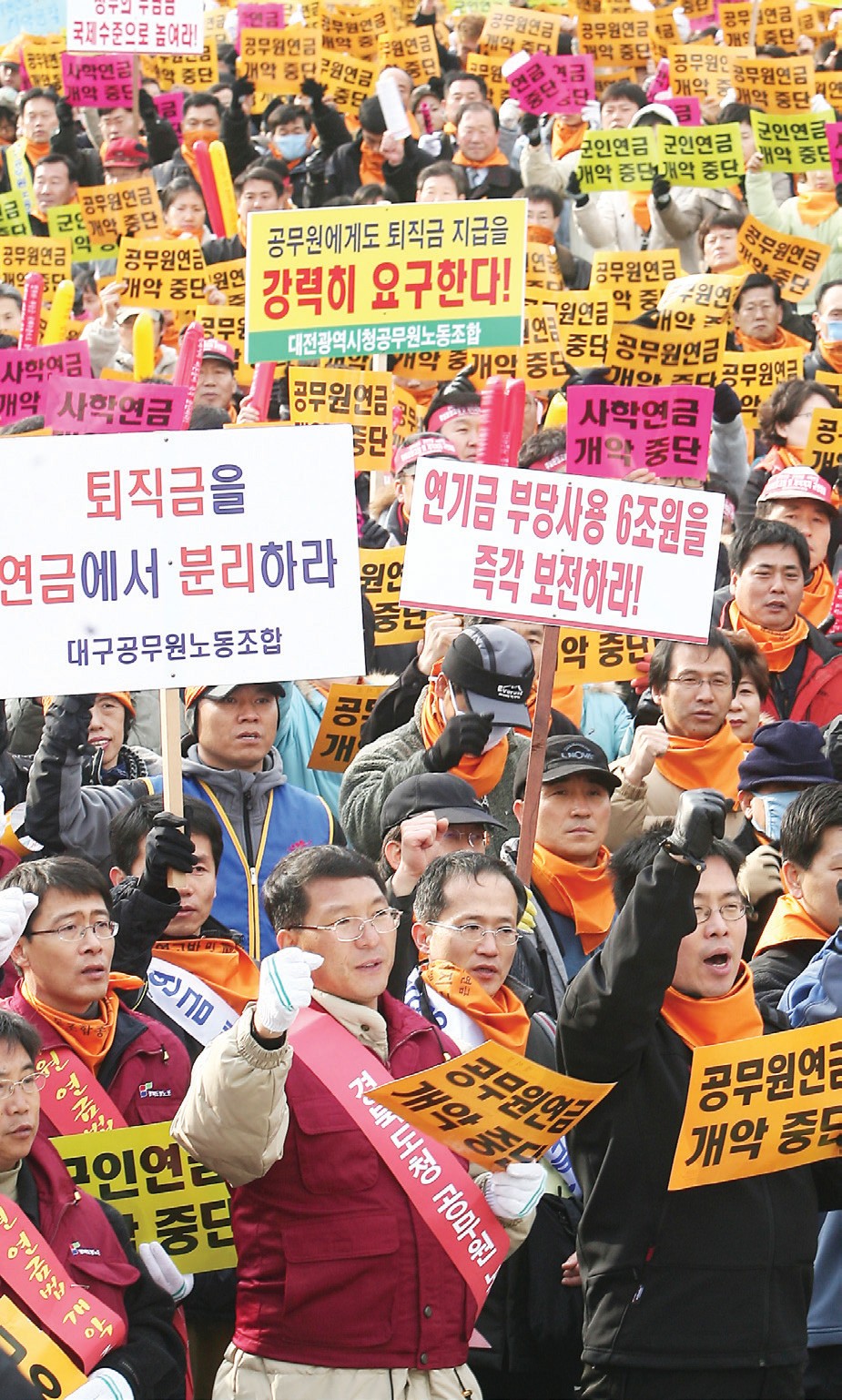
When the government pushed ahead with reform of the Government Employees, Military, and Private School Teachers Pensions in 2007, current and former public servants, including civil servants, teachers, and military personnel, hold a protest rally in front of Gwanghwamun in Seoul. / Photo: JoongAng Photo
Introduced in 1960, the Government Employees Pension sailed smoothly until the 1990s, when it was hit by several rounds of reform. The first reform came in 1993, when the Government Employees Pension went into deficit. At the time, pension expenditure exceeded contribution revenue, and calls for pension reform were raised for the first time. The government of the day chose to cover the deficit by raising the contribution rate paid by individual civil servants. In 1995, it then introduced a pension eligibility age, under which a pension could be received only from age 60.
When the foreign exchange crisis broke out, a wave of large-scale restructuring swept the public sector as well. With its depleted finances, the government had no capacity to pay severance to the flood of retirees. As a stopgap, it chose to take 4.7169 trillion won out of the Government Employees Pension fund to pay retirement benefits. As a result, the Government Employees Pension fund shrank from 6 trillion won in 1999 to some 1.7 trillion won a year later. This led to the third reform. The contribution rate was raised to 8.5%, and the indexation method, which had followed civil-service pay, was changed to track inflation, as in the National Pension. The following year, government subsidies began to be injected to cover the pension deficit, setting off a vicious cycle.
For some time thereafter, no measure worthy of the name reform was forthcoming, until a reform was carried out in 2009. For civil servants appointed from 2010 onward, the pension eligibility age was pushed back to 65. The annual accrual rate was cut from 2.1% to 1.9%, and the pay base for calculating pensions was changed from the average monthly pay of the last three years before retirement to average earnings over the entire period of service.
Yet those measures did little to stabilize the Government Employees Pension. The state’s deficit subsidy to the Government Employees Pension (1.9748 trillion won) in 2009 dipped briefly to 1.3071 trillion won the following year but soon resumed its rise. Last year it returned to its pre-reform level, at 1.8963 trillion won. This year the Government Employees Pension’s state deficit subsidy is 2.4854 trillion won, and it is projected to reach the 3 trillion won range next year. An official at the Government Employees Pension Service said, “It is expected to exceed 4 trillion won in 2017.”
The reason the reform plan of that time proved useless is that a trick was hidden in the calculation method. That trick is clearly shown in explanatory material distributed at the time by the Federation of Korean Government Employees’ Unions. According to this material, pensions would not decrease at all for those with ten or more years of service, remaining at current levels, while for staff from nine years of service (-0.9%) down to new hires (-8.4%), pension amounts would decrease only “slightly.”
It is true that pension amounts fell because the eligibility age was raised and the annual accrual rate lowered. However, changing the pay base in the benefit formula from “average pay over the last three years” to “average reference earnings over the entire period of service” actually had the opposite effect of increasing pensions. The Federation of Korean Government Employees’ Unions analyzed: “With the switch to average reference earnings over the entire period of service, the retirement pension of a civil servant with 30 years of service falls by about 30%. But because the reference pay was changed from ‘monthly pay’ to ‘taxable income,’ the retirement pension actually increases.”
For example, if a civil servant appointed in 1989 retires in 2017, the contributions paid to the Service will total 172.51 million won. The total pension this civil servant will receive exceeds 700 million won: 635.27 million won in pension plus a retirement allowance of 65.1 million won. After retirement, the civil servant will receive 2.48 million won a month in pension. Total retirement income is 43.69 million won less than before the reform, but the monthly benefit turned out to be the same.
The same holds for civil servants appointed after the reform took effect in 2009.
Assuming 30 years of service, total contributions paid come to 194.2 million won, 26% more than before the reform; the total pension is 474.64 million won (25.13% less than before the reform), but the monthly pension of 2,247,000 won is only 8.25% lower than before the reform took effect (2.45 million won). It is precisely because of such tricks that the reform, pushed through over the strong opposition of civil servants at the time, produced no significant effect afterward.
Paid less than the private sector? Not in reality!
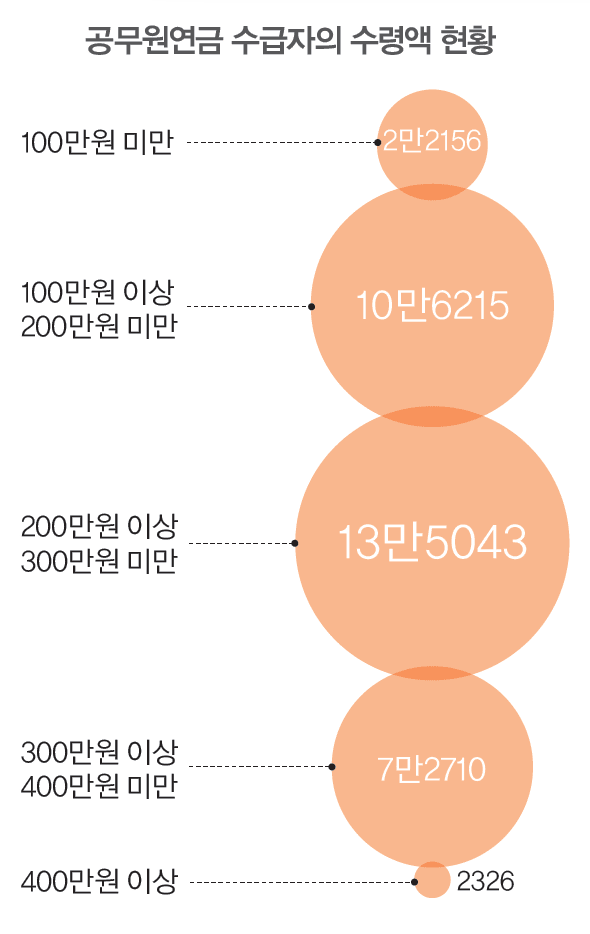
(Unit: persons) ※As of August 2014 <Source: Ministry of Security and Public Administration>
Civil servants’ organizations argue that their pensions must be generous because civil servants’ pay is meager compared with the private sector and they face many restrictions, such as being excluded from employment insurance.
Yet few citizens seem readily persuaded by these circumstances. According to the National Pension Service, as of the end of August this year, the highest National Pension benefit received was 1.68 million won—far short even of the average Government Employees Pension benefit.
First, the difference from the National Pension shows up in the numbers. The National Pension’s annual contribution rate is 9%, and its income replacement rate is 40% (based on a 40-year contribution period). The Government Employees Pension, by contrast, has an annual contribution rate of 14% and an income replacement rate of 62.7% (33-year contribution period). In amounts paid in, the Government Employees Pension exceeds the National Pension, but once the contribution period and income replacement rate are taken into account, the picture is reversed.
Taking 1988, when the National Pension was first implemented, as the baseline, there was little difference between the National Pension and the Government Employees Pension. A worker with average monthly earnings of 1.8 million won who joined the National Pension in 1988 and contributed for 33 years would receive 860,000 won a month, an income replacement rate of about 48%. Including severance pay, this rises to 1.02 million won a month, an income replacement rate of 62.5%.
By comparison, a civil servant enrolled in the Government Employees Pension with the same earnings and period would receive a monthly benefit of 900,000 won, slightly more than the National Pension member, but including severance pay it comes to 990,000 won, actually less. The benefit-to-contribution ratios of the National Pension and the Government Employees Pension were 3.25% and 2.61%, respectively.
By 2010, however, the situation had reversed. The National Pension member’s monthly benefit fell by more than 200,000 won to 630,000 won (930,000 won including severance pay), whereas the Government Employees Pension’s monthly benefit rose to 1.16 million won (1.27 million won including severance pay), widening the gap considerably. The income replacement rate, too, fell from 48% to 35.1% for the National Pension but rose from 50.4% to 64.9% for the Government Employees Pension.
The claim that civil servants are treated worse than employees of ordinary companies is also close to fiction. According to the Ministry of Security and Public Administration’s survey of civil-service pay, as of June last year civil servants’ pay stood at 77.6% of the average wage at businesses with 100 or more employees. In other words, if a private-company employee earned 1 million won a month, a civil servant received 776,000 won. Civil servants’ retirement allowances, too, are on the low side, at 6.5% to 39% of the private-sector level depending on length of service. Looking at the statistics alone, the claim seems quite plausible at first glance.
What is missing, however, is the difference in length of service. According to figures released at the end of July by CEO Score, a corporate evaluation firm, Korea’s 500 largest companies
have an average tenure of 9.4 years. Their average annual salary is around 60 million won. By contrast, the average tenure of employees at 12 public corporations was 15.4 years, longer than in private companies. For civil servants, who are guaranteed employment until the retirement age, it is longer still: one appointed at age 30 is guaranteed more than 30 years of employment unless disciplined or resigning voluntarily.
The path to re-employment after retirement is also comparatively wider for civil servants than for ordinary citizens. Retired civil servants are stationed everywhere—in associations and organizations of every kind, in public corporations such as government agencies, and in private bodies alike. The posts that retired civil servants take are mostly predetermined, and it has become customary to guarantee them employment for about two to three years after retirement. Senior officials are given posts as heads of institutions or organizations or as director-level executives, while mid- and low-ranking officials are given working-level managerial posts such as team leader—positions commensurate with their rank at retirement. This practice prevails across the whole of Korea, not only in bodies linked to government ministries but also in organizations and institutions linked to local governments. The civil servants’ organizations’ claim that “after retirement we lack suitable experience or skills for re-employment” is therefore close to a lie that deliberately conceals an obvious fact.
Reform plan likely to follow “more for the lower, less for the upper”
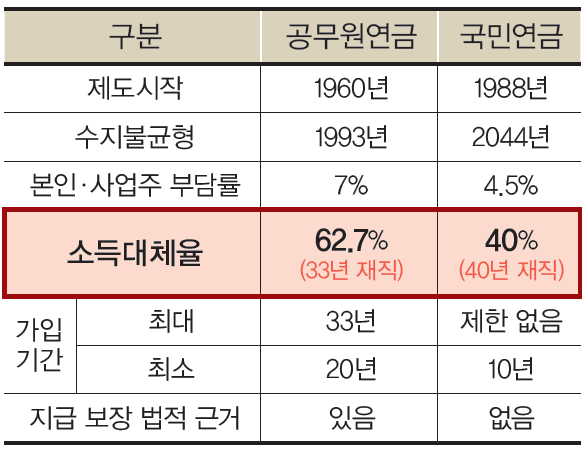
<Table 1> Comparison of the Features of the Government Employees Pension and the National Pension
There is no disagreement that the Government Employees Pension must be overhauled; the only difference lies in the method. The plan recently put forward by the Ministry of Security and Public Administration through party-government consultation follows the “more for the lower, less for the upper (下厚上薄)” approach: pensions for lower-ranking officials are touched less, while those of senior officials are cut more. If this approach is adopted, the current “proportional pension,” in which benefits rise with rank and length of service, will become a “progressive pension.”
Specifically, one option under discussion is to lower the benefit rate, currently a uniform 1.9% regardless of rank, to 1.25% by 2026.
Under this approach, senior officials’ pension benefits in 2026 would be 34% lower than now. Introducing differentiated income replacement rates is a proposal that reflects the reality that Grade 5 civil servants take home some 500 million to 700 million won more in income than civil servants who entered through the Grade 7 and Grade 9 open examinations. High-pension recipients are mostly senior officials who started at Grade 5. The rate for those hired through open examinations at Grade 6 or below was adjusted to 1.6%, and for those hired through the Grade 5 open examination to 1.42%, while the contribution period was extended from 33 to 35 years. Under this arrangement, the income replacement rate would be 56% for those hired through the Grade 7 and Grade 9 open examinations and 50% for those hired through the Grade 5 open examination. Another option under discussion is to lower the earnings ceiling for pension purposes (8.05 million won a month) to the National Pension’s level (4.08 million won) to reduce the number of high-pension recipients. This would level pension benefits down and save the pension contributions that the government shares one-to-one, lowering the burden on the national treasury.
The approach to Government Employees Pension reform taken by Germany and Austria, which President Park Geun-hye mentioned, is also under review. It can be summed up as “pay more and receive later.” In 1998, Germany extended the contribution period of its civil servants’ pension from 35 to 40 years. In 2005, Austria changed it from 40 to 50 years. Korea’s maximum contribution period, at 33 years, is shorter. This approach can be expected to stabilize finances by delaying the start of pension payments and lengthening the period over which serving civil servants build up reserves. But concerns are also raised that the fiscal burden could grow heavier once payments fall due.
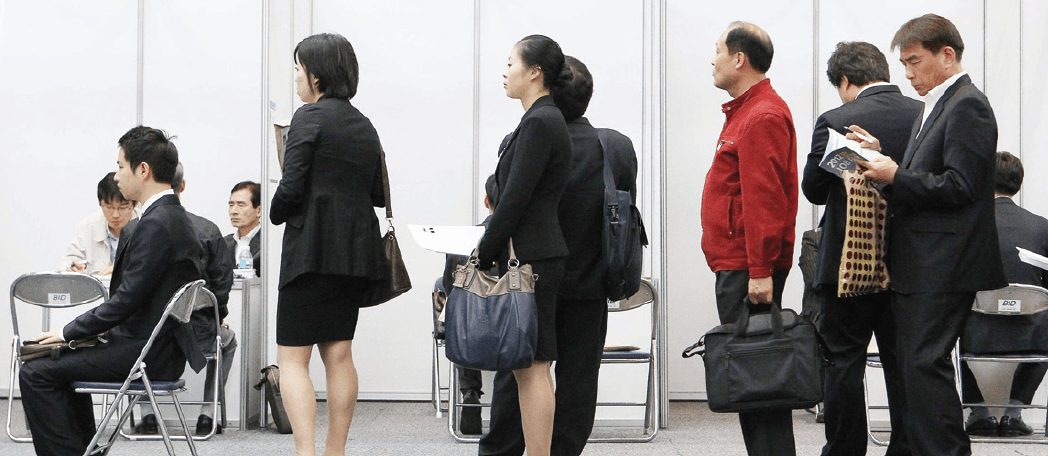
The average tenure at Korea’s 500 largest companies is 9.4 years, far shorter than that of civil servants, who are guaranteed employment until the retirement age. Middle-aged men wait their turn for interviews at a job fair. / Photo: Newsis
The backlash from civil servants’ organizations is fierce. When the government and the ruling party decided to gather the views of the unions and the opposition party separately, the organizations called it an attempt to exclude them from the negotiating table and declared that they would not shrink even from collective action. Oh Seong-taek, Chair of the Pension Committee of the Federation of Korean Government Employees’ Unions, said, “There can be no pension roundtable with the minister without the government employees’ unions,” and argued, “As the opposition party proposes, a social consultative body should be formed to discuss public pensions as a whole.” A large-scale rally is also being prepared at Yeouido Park on November 1.
According to a survey by the Ministry of Security and Public Administration, seven in ten citizens agree that Government Employees Pension reform is necessary. With public opinion behind it, the government appears ready to push the reform through. Yet voices of concern are being raised about the rapid pace of the Government Employees Pension reform debate—voices warning that it could lead to the collapse of the public pension funds.
In a commentary on September 22, the People’s Solidarity for Participatory Democracy criticized it, saying, “The Government Employees Pension reform plan put forward by the Saenuri Party uses the fiscal burden as a pretext
to shrink public pensions.” The Saenuri Party reform plan that the People’s Solidarity for Participatory Democracy criticized was designed by the Korean Pension Association. It raises serving civil servants’ contributions by 43% from the current level and cuts benefits by 34%. It also proposed applying the same burdens and benefits as the National Pension to civil servants hired from 2016 onward and cutting benefits by up to 3% even for retirees already drawing the Government Employees Pension. Critics note that this approach of leveling pensions down might quiet public discontent but would reduce the practical benefit of public pensions overall.
Private insurers smile at the Government Employees Pension reform debate
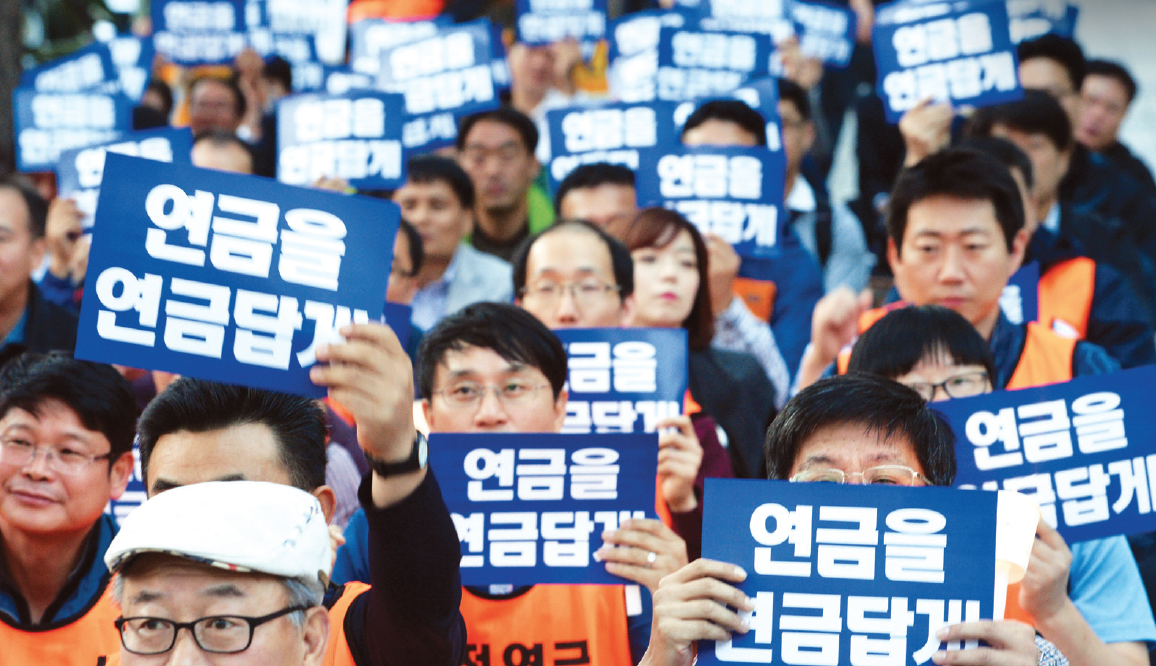
As the government signals a tough Government Employees Pension reform, civil servants’ backlash is growing steadily fiercer. On October 6, court employees stage a demonstration against Government Employees Pension reform in front of the Seoul Central District Court. / Photo: Newsis
The People’s Solidarity for Participatory Democracy pointed out, “It considers only the government’s fiscal burden, and stable old-age income security, the very purpose of a pension system, is completely excluded.” An official of the People’s Solidarity for Participatory Democracy said, “It is hard to accept the Pension Association’s announcement that the accrued pension liability of the Government Employees Pension still to be paid will approach 500 trillion won,” adding, “In fact, as of 2007, the government’s expenditure burden for the Government Employees Pension was 0.6%, which may not be excessive compared with the OECD average of 1.5%.” The point is that the Korean Pension Association is excluding comprehensive information and stoking fear about the Government Employees Pension’s fiscal burden.
Civic groups claim that “the biggest beneficiaries of this Government Employees Pension reform plan are private pension providers.” They see it as of a piece with the “Measures to Revitalize Private Pensions” announced by the Park Geun-hye administration. The core of the private pension revitalization measures announced by the government on August 27 is to widen mandatory enrollment in retirement pensions and to ease investment regulations.
Specifically, all companies will be required to introduce a retirement pension plan by 2022. Small and medium-sized enterprises are to introduce fund-type retirement pension plans to raise the efficiency of asset management. The measures also include tax support, such as tax credits, and fiscal support to expand retirement pension enrollment. The government expects that once the system takes hold, retirement pensions will extend even to workplaces with fewer than ten employees by 2022, bringing 5.3 million people into retirement pensions—more than half of all workers.
This plan for a full expansion of the retirement pension system rests on the premise that public pensions such as the National Pension and the Basic Pension are currently insufficient to secure old-age income. It shifts functions that public pensions should perform onto private pensions. Lee Kwon-neung, Full-Time Research Fellow at the Welfare State Society, analyzed, “Acknowledging the inadequacy of public pensions while offering no plan to improve them and promising only to revitalize private pensions reveals an intention to turn our pension system into one centered on private pensions.”
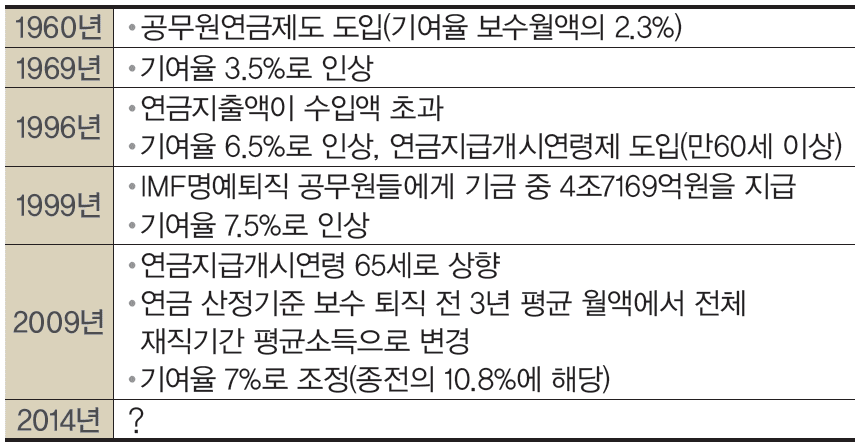
<Table 2> History of the Government Employees Pension
According to Research Fellow Lee, the principle underlying private pensions is the self-help principle that “each person is responsible for his or her own old age.” This is in the same vein as the overarching premise of privatization of every kind. If private pensions are revitalized, a phase emerges in which they compete with the public pension system, which is also the part most worrying from a progressive perspective. Research Fellow Lee argued, “If the managers of private pensions are concentrated in financial institutions under large conglomerates, there is a high likelihood of a reversal between public and private pensions,” adding, “The reason the advanced European countries other than the United States and the United Kingdom were able to achieve some success in revitalizing private pensions is that their public pension systems had a foundation strong enough to play the central role.” Private pensions, in other words, should be a supplementary instrument to public pensions.
There is also a forecast that if Government Employees Pension reform takes the form of leveling down, public trust in and reliance on public pensions will weaken. Analysts say that if this sentiment spreads, reliance on private pensions will grow, and the gains will flow to a financial market centered on large conglomerates. This argument is bolstered by the criticism that the Korean Pension Association and the experts who designed the Government Employees Pension reform plan lean toward capital.
If it weakens public pensions, a national consensus will be hard to reach
There are concerns that if Government Employees Pension reform takes the form of leveling down, the adequacy of public pensions will weaken and the private pension market will grow. / Photo: JoongAng Photo
When the Ministry of Security and Public Administration convened an expert meeting on Government Employees Pension reform on October 2, it drew criticism for not disclosing the identities of the participants. Beyond the fact that there were seven participants in all, including five professors in public pensions and personnel administration and researchers from government-funded research institutes, the ministry released no other information. Suspicions were then raised that graduates of Sungkyunkwan University—Korean Pension Association President Kim Yong-ha, Senior Presidential Secretary for Economic Affairs Ahn Jong-bum, Senior Presidential Secretary for State Affairs Planning Yoo Min-bong, and Government Employees Pension Service Chairman Choi Jae-sik—were steering the reform plan in a direction that represented the interests of the financial and insurance companies of large conglomerates.
Indeed, the character of the Pension Association that put forward the reform plan makes these suspicions understandable to a degree. Over the past four years, through seven policy debates, the Pension Association has argued that “government spending on public pensions such as the National Pension and the Government Employees Pension should be reduced, and individuals should be encouraged to prepare for their own old age through the private pension market.” Its stance is also in line with the private pension revitalization measures announced by the government.
President Park’s statement that she would draw on the experience of Europe’s advanced welfare states for Government Employees Pension reform is regarded as having set a desirable benchmark for the current reform debate, divided as it is between conservatives and progressives. But referring only to the arithmetic visible on the surface will make it hard to unite public opinion. The European countries that President Park cited as models carried out their reforms on a foundation of state responsibility for old-age security. If Government Employees Pension reform drifts into being merely a means of reducing the government’s fiscal burden, it cannot bring about a national consensus. A plan for how to redistribute the state funds saved through Government Employees Pension reform must be presented alongside it.
Copyright © Monthly JoongAng. Unauthorized reproduction and redistribution prohibited.
https://www.m-joongang.com/news/articleView.html?idxno=303696

![(KBS TV. 이슈&뉴스] 공무원 연금, '세금 먹는 하마'?...'사회적 합의' 절실 (2013년 10월 23일)](/_next/image?url=%2Fuploads%2Feditor%2F2026%2F11%2Fcfe4824d207e450c8cad3a7c73e2fb04-Screenshot_20261122_221550_Samsung-Browser.jpg&w=128&q=75)