(Maeil Shinmun) A “Pension Deterioration” Worse Than Doing Nothing — Yun Suk-myung: “Accept It and You Become a Historical Accomplice” [News Cabinet] (May 28, 2024)

“Conservative media hammering Yongsan… they are committing a historic sin,
and in a few years they will beat the ground in regret”
“A 13% contribution rate?…
At least 20% must be collected to avoid passing debt on to later generations”
“Unfunded pension liability to grow 3.5-fold in 27 years…
not reform but deterioration”
“Reform as soon as possible? A leaders’ summit?…
They must be put before the judgment of history”
“The golden opportunity has already passed…
pension reform should have been done under the Moon Jae-in administration”
“A generation of 200,000 births
supporting a generation of 700,000 births”
“Cut the cumulative deficit by 3,000 trillion won,
and we can shout hurrah for pension reform?”
“The National Pension public deliberation committee
chose to shift even more of the burden onto future generations”
“My own grandchildren are as precious as gold…
but other people’s children get a debt bomb”
“The unfunded pension liability:
disclose it transparently, like a status board”
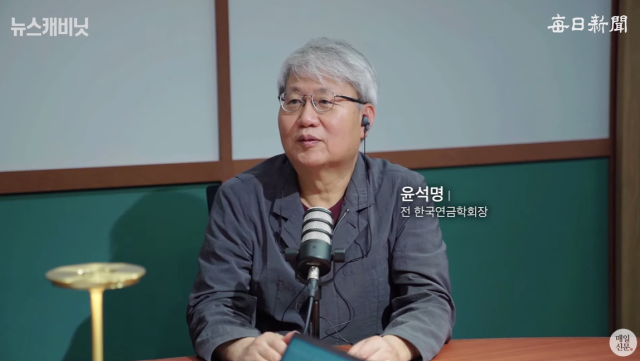
Yun Suk-myung, former President of the Korean Pension Association. Source: Maeil Shinmun YouTube, ‘Lee Dong-jae’s News Cabinet’
- Broadcast: Maeil Shinmun YouTube 〈Lee Dong-jae’s News Cabinet〉 (weekdays, 18:30–19:30)
- Host: Lee Dong-jae, Guest Editorial Writer, Maeil Shinmun
- Guest: Yun Suk-myung, former President of the Korean Pension Association
▷Lee Dong-jae, Guest Editorial Writer (hereafter Lee Dong-jae):
We now begin Part 2 of News Cabinet.
Today we pay 9% of our income in National Pension contributions. Paying contributions this way, the state promises to guarantee 40% of our income in old age. But if things go on as they are, from 2055 people aged 65 and over will be unable to receive their pensions. When people of the 2030 generation like me—in international age I am still in my 30s—reach old age, the finances will have run dry and we will be in a situation where we can hardly receive anything at all. The realistic outlook is that the generation being born today will have to spend nearly half of its income paying for the pensions—paying off the pension debt—of the generations above it. The ruling and opposition parties are at loggerheads over pension reform.
To discuss this in detail, we have invited pension expert Yun Suk-myung, Research Fellow Emeritus at the Korea Institute for Health and Social Affairs, a former President of the Korean Pension Association who took part in the Financial Estimation Committee for National Pension reform. Welcome.
▶Yun Suk-myung, former President of the Korean Pension Association (hereafter Yun Suk-myung): Yes, hello.
▷Lee Dong-jae: Hello. We have a lot to ask you, so let me put the questions to you quickly. Things have been very noisy for the past few days over National Pension reform. How did you see it?
▶Yun Suk-myung: I think it can be assessed this way: if foreign experts or foreign politicians looked at it, they would see comedy-like things that simply could not happen anywhere else happening in Korea, not only in politics but in academia as well. Why do I say so? I have now been taking part in the OECD pension Expert Meeting as Korea’s representative for more than 15 years. I cannot hold my head up there. Because they are experts, are they not? These people have no political coloring. In Finland, for example, there is a close friend of mine, Ismo (Ismo Risku), at the Finnish Centre (the Finnish Centre for Pensions). He is the director of planning, and this friend often asks me—even when he comes to Seoul: “As I see it, Korea’s pension system is unsustainable; what are you people preparing?” And there is one more: Japan. We do not much like talking about Japan, but the reason I have to talk about Japan is that our pension system came to us by way of Japan. It is the so-called Bismarckian type, a high-benefit system. A system that pays a lot: back in 1988 we introduced a system that paid 70%, did we not? But what is Japan doing now? It holds 200 trillion won, in present value, of money for paying pensions even 100 years from now. Impressive, is it not? Shall I tell you something even more impressive? Canada holds 100% of the money it will pay out 150 years from now. 150 years from now.
▷Lee Dong-jae: So they drew up their plans over that long a horizon.
▶Yun Suk-myung: But we do not even look 30 years ahead, do we? So let me talk a little about Japan. It hurts my pride to talk about Japan, too. We copied the Japanese system, but at some point we decided we would go only our own way. So, to describe the path we say we will take, I use the expression that other countries are in the era of the Fourth Industrial Revolution while we are trying to go back to the Stone Age. Right now we are paying a 9% contribution rate, are we not?
▷Lee Dong-jae: Yes, that is right.
▶Yun Suk-myung: Japan pays an 18.3% contribution rate. Yet as for what is received, people here say our current 40% is too low and should be raised further. Because it is falling to 40%.
▷Lee Dong-jae: This was originally 50%, was lowered to 40%, and now there is talk again of 44% or 45%.
▶Yun Suk-myung: Back then, when the Roh Moo-hyun administration carried out its reform, I went through a terribly hard time. And—this is a personal remark—the very people who did not reform then and fiercely opposed it are now saying we should raise it again. We reformed with great difficulty, but that is a digression. To get to the point: Japan bears an 18.3% contribution rate, yet the income replacement rate it receives is under 33%. They pay more than twice as much, and even now the gap in what they receive is about 10 percentage points. Shall I put it in amounts? In any case, Japan’s national income is somewhat higher than ours. What is even more astonishing about Japan is that in 2015 it merged the government employees’ pension with the general national pension completely, 100%. How much do those who used to be civil servants receive now? 1.5 million won. Among our Government Employees Pension members, university professors receive 4 million won each and civil servants about 3 million won. Then let me talk about the national pension. Their contributions are 18.3%, and how much are they receiving now? 1.29 million won. When I say I want to reform the National Pension, people tell me, ‘Yun Suk-myung, you are a member of the Private School Teachers Pension, and you keep coming here saying we should cut this and that—get your own house in order.’ I am a National Pension member. Let me say it publicly here once again, as I did on another program the other day. It is just that my years of studying abroad, back when it paid a generous 70%, are missing from my record. Yes, I start receiving my pension in October. How much do you think I will receive from the National Pension?
▷Kim Sae-bom, Columnist (hereafter Kim Sae-bom): 4 million won?
▶Yun Suk-myung: As a National Pension member.
▷Lee Dong-jae: Would it not be around 1.8 million, 1.9 million or so?
▶Yun Suk-myung: An important period of mine is missing, but it is 1.75 million won. I paid 3% in contributions. For 26 years I paid 9%. The Japanese pay 18.3%. They pay twice what we do, yet do they not receive far less than I do? Can this system be sustainable? That is why, as I said earlier, foreign experts or foreigners looking at this can only say, ‘You could not find a comedy like this anywhere.’
▷Lee Dong-jae: So up to now it has been a rather good system from the standpoint of those receiving it.
▶Yun Suk-myung: Let me tell you one more thing. In 2007, when the government’s reform was being worked out, I stepped forward and took the lead. After a meeting—the debate was fierce—at dinner several university professors said to me, ‘Why do you keep insisting on cutting the pension you yourself will receive?’ So I answered them then: ‘When I am old, I want to be able to walk the streets with my head held high.’ ‘I do not want to be condemned by young people.’ ‘I am doing this to show that our generation did its share.’
▷Lee Dong-jae: Yes, I see. Honestly, thinking about pensions really pains me. From my generation’s standpoint, the future is bleak. The fertility rate keeps falling, too.
▶Yun Suk-myung: It is beyond bleak.
▷Kim Sae-bom: I also think it is so unrealistic that it should not even be up for debate, and I find it really strange that a difference of 1% or 2% is what has become the point of contention. Maybe it is because, for my generation, this is never put in numbers, but I think if young people heard it in figures like 1 million or 2 million won, they would be badly shaken too. Could you put it in actual amounts like that?
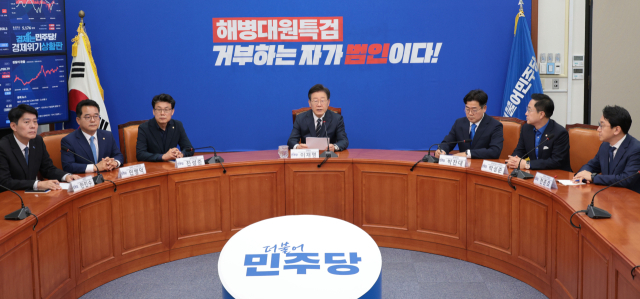
Lee Jae-myung, leader of the Democratic Party of Korea, speaks at a press conference on pension reform held at the National Assembly in Yeouido, Seoul, on the 25th. Yonhap News
▶Yun Suk-myung: Rather than the amounts, first of all, since this has become a matter of debate—why it has, I find a bit strange. Our country’s conservative media are hammering Yongsan, the presidential office. They keep churning out editorials: the difference is not even 1 or 2 percentage points, so why not accept it, will you take responsibility? Let me say this here. Those people are committing a historic sin, and in just a few years they will beat the ground in regret. Let me tell you why I can speak to the major media almost threateningly like this—as one individual’s conviction. It is because I took part in every National Pension financial projection from the 1st through the 5th, and there, too, I was in charge of the fiscal stabilization measures. This time too, I was in charge of fiscal stabilization measures on the advisory committee of the National Assembly’s Special Committee on Pension Reform. For 25 years I have worked only on fiscal stabilization. The people who join these discussions are people who come in and go out once in a while. I have the whole 25-year history at my fingertips. Not that having done it means I do it well, but at any rate I have the experience, because I have done everything. Yet in this 5th round in 2023, the core of the financial projection was clearly this: the projection result, announced in March of last year, 2023, was that even if the income replacement rate were kept at 40% as it is and contributions raised by 0.6 percentage points a year within 10 years, up to 15%, there would still be that much of a gap from achieving fiscal stabilization—that fiscal stabilization would still be far off. That was one year and two months ago. But over these two years, a year and a half—forgive me for using such an expression—after putting on a whole circus, confusing people and gaslighting them, they now say the political sphere has reached an agreement. That a 13% contribution rate is a great historic achievement. That after 26 years it rises from a single digit, 9%, to double digits, by 4 percentage points—so why, over a gap of 1 to 2 percentage points in the income replacement rate, 43%–44% or 45%, does the ruling party refuse to accept it and Yongsan just blindly oppose it? That is in every media outlet these days. Which direction is Yongsan?
▷Lee Dong-jae: Not all media, but a lot of them are coming out that way.
▶Yun Suk-myung: So let me explain. What makes an expert an expert? You have to speak the truth even if knives come at you and bullets fly. Let me tell you one more key point of the 5th financial projection: why are we trying to reform pensions?
▷Lee Dong-jae: Because there is no money.
▶Yun Suk-myung: Are we doing it to pass even more onto future generations, or to reduce it for them?
▷Lee Dong-jae: To reduce it, of course.
▶Yun Suk-myung: Then you both answered well. The core of the 5th financial projection is that if we reform pensions this year and, from next year on, want to avoid passing debt to the two of you and to future generations, then while keeping the income replacement rate at 40%, contributions must be raised to 19.8%. Up to 20%.
▷Kim Sae-bom: The country next door is at 18.3% now, after all.
▶Yun Suk-myung: Yes, 18.3%. Shall I take Sweden as an example? This also leaves something out: Sweden now pays 18.5% in contributions. Yes, of that, 2.5% goes into what is called the individual premium account, a kind of private funding, and is left out, and 16% goes to the public pension side as contributions. What do you think the income replacement rate they expect in 2070 will be? Our host—let us make this a quiz. It is more fun as a quiz.
▷Lee Dong-jae: I am a bit weak at arithmetic, but would it not be somewhere around 30%?
▶Yun Suk-myung: You are very good. It is 30%. Impressive. So my point is this: even if we keep the current 40% as it is, we must collect a 19.8% contribution rate—roughly 20%—11 percentage points more, more than twice what we collect now, to avoid passing debt on to later generations.
▷Lee Dong-jae: But what the National Assembly is discussing now is 13%.
▶Yun Suk-myung: They say: we are raising it by 4 percentage points, so what does the income replacement rate matter—just accept it. But the thing is, an income replacement rate of 44% means it goes up by 4 percentage points, right? Yes, and meanwhile, according to KDI estimates, our pension system is already 609 trillion won in debt, and in five years that is set to grow to 869 trillion. I am involved in pension research. According to our Pension Future Forum’s projections—it is called the unfunded liability—the shortfall relative to the amount already promised to be paid is 1,825 trillion won, a shortfall equal to 80.8% of GDP. Even supposing that the two of you here or future generations somehow pay taxes to cover it, if we overhaul the system this year and want to avoid piling further debt on top of it from next year, the contribution rate has to be at 22%, you see. What they are talking about now is 13%, right? So that means 9 percentage points more would have to be collected.
▷Lee Dong-jae: As much as 9%.
▶Yun Suk-myung: To the extent that those 9 percentage points are not collected, the burden on you two grows. So—just a moment. Converting this into the concept of unfunded liability is the great strength of our pension research. We will announce it tomorrow, but I will announce it here today first. It seems to have come out briefly elsewhere. I said the unfunded liability now is 1,825 trillion won, right? If this year the income replacement rate is raised to 44% and contributions to 13%—that figure is as of 2023. By 2050 there is a 27-year gap. In that time, how many times over do you think the unfunded liability will grow? This time let me ask our Reporter Lee Dong-jae.
▷Lee Dong-jae: I am a little weak with numbers—could you say that once more?
▶Yun Suk-myung: So the unfunded liability now is 1,825 trillion won. Now they are saying it is a very good plan, a reform plan, that if we do not reform, debt will grow by 110 billion won a day, so accept it quickly. But if we accept it, the unfunded liability, which now stands at 1,825 trillion won, 27 years from now—27 because the base year of the calculation is 2023—in 2050, how large will it be? That is the quiz I posed.
▷Lee Dong-jae: I think it will be several thousand trillion.
▶Yun Suk-myung: Is it hard to say how many times over?
▷Lee Dong-jae: Maybe about four times?
▶Yun Suk-myung: Why are you so brilliant?
▷Lee Dong-jae: I just guess high on everything.
▶Yun Suk-myung: It grows 3.5-fold. It swells to more than 6,000 trillion won.
▷Lee Dong-jae: That is staggering.
▶Yun Suk-myung: And they call this a reform plan, saying let us reform as soon as possible, let us hold a leaders’ summit, every day of delay adds to the debt.
▷Lee Dong-jae: But some people also say this: if parametric reform fails this time, structural reform will fail too. So there have been many claims along the lines that if it was not done in the 21st National Assembly, it will not be done in the 22nd either.
▶Yun Suk-myung: I do not know what to make of that way of thinking. The same goes for the experts who say it. Parametric reform—parametric reform is nothing else; as I said on another program earlier, since talking about contributions and such is difficult, people say: do not talk about parameters and structure; changing what you pay and what you receive is parametric reform. But raising what you receive further and nudging contributions up a little is not reform. Parameters means changing those numbers, but as for the word “reform” after it—I told you, did I not? How is it reform for the unfunded liability to grow 3.5-fold in 27 years? It is deterioration.
▷Lee Dong-jae: That is right.
▶Yun Suk-myung: The politicians and experts who say that must without fail be put before the judgment of history.
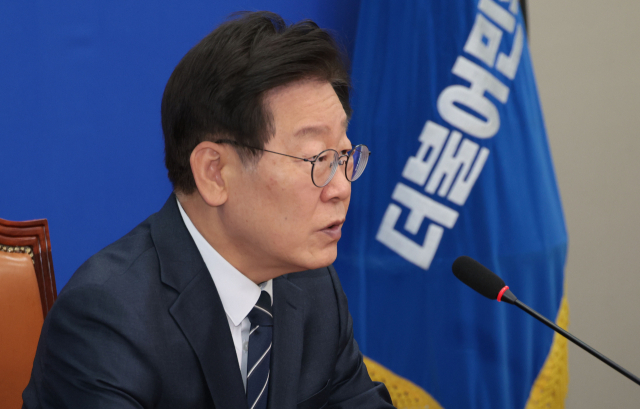
Lee Jae-myung, leader of the Democratic Party of Korea, speaks at a press conference on pension reform held at the National Assembly in Yeouido, Seoul, on the 25th. Yonhap News
▷Lee Dong-jae: Yes. Then there is something else I want to ask—you speak so forcefully that part of me finds it refreshing, but I still have questions, so let me ask them. Under the current system, by 2093—that is, about 70 years from now?—the cumulative deficit is 21,656 trillion won. On top of that, 13%—that is, raising it from the current 9% to 14% and setting what is received at 44%—they say that, compared with the current system, 3,738 trillion won would be cut. That still leaves about 18,000 trillion won—can it really go into the tens of thousands of trillions like this? And how did we end up with this structure? I just cannot accept that part.
▷Kim Sae-bom: The first time I ever heard a number in the ten-thousand-trillions was here, with pensions.
▶Yun Suk-myung: I used it a lot five years ago. Abroad too: “Have you ever heard of a number in the ten-thousand-trillions?” Yes—our host Lee Dong-jae has done a lot of homework.
▷Lee Dong-jae: I am very interested in pensions; I even wrote a column on them.
▶Yun Suk-myung: Let me tell you. Half of that is right and half of it is wrong. I do not mean that our host, our editorial writer Lee Dong-jae, is wrong, but that the people who gave out that information are distorting the data. It was worth coming here today. I have kept pressing the issue of the cumulative deficit. I was not the first to get it—we are now in the 21st [National Assembly], so back in 2018 it was Representative Kim Se-yeon of Busan, who then chaired the Health and Welfare Committee in the second half of the term. At that time I was at a meeting at the ADB in Jakarta when I got a call asking if I would appear with him on KBS’s late-night debate. I cut my schedule short by a day, came back to Seoul and went on the late-night debate. Before going on air, before taking his seat, when asked to say a word, what Representative Kim Se-yeon said was: let us not become bad adults. And he pressed the Ministry of Health and Welfare into calculating the cumulative deficit for the first time. He passed that data on to me, and I have been writing about it nonstop for five years since. So what do you think the cumulative deficit was five years ago? If you get this one too, you are amazing.
▷Lee Dong-jae: Then perhaps ask over here.
▷Kim Sae-bom: This one is too hard.
▷Lee Dong-jae: When it comes to numbers, I am a humanities person.
▶Yun Suk-myung: That is how it should be. I think viewers and listeners will pay closer attention this way, too.
▷Lee Dong-jae: Would they not have projected about half of today’s figure? Something like that?
▶Yun Suk-myung: Well, since we are short on time and I have a lot to say: it was 17,000 trillion won. So is this a pension? Yet what did the Moon Jae-in administration say at the time? It said let us pay more in pensions, did it not? With a cumulative deficit of 17,000 trillion won, it said let us pay more in pensions by raising contributions a little. So—I have not said this elsewhere—people say now is the golden opportunity, but the golden opportunity has already passed.
▷Lee Dong-jae: When was the golden opportunity?
▶Yun Suk-myung: However late, it should have been done at that point, under the Moon Jae-in administration. But then they said let us pay more in pensions. How pathetic is that? But the thing is, the reason I say this is that it was 17,000 trillion won, and up to now I was in charge only of fiscal stabilization—at the Ministry of Health and Welfare, on the Financial Estimation Committee, and on the first and second advisory committees of the National Assembly Special Committee. Back then I alone kept insisting nonstop: ‘Disclose the cumulative deficit! Disclose the cumulative deficit! Disclose the unfunded liability! Disclose the unfunded liability!’ They never disclosed it until now, and at the last minute they are leaking to the press only the figures they want, without anyone knowing how they were calculated. There is the aspect that the intent itself is not pure. In any case, if we take it at face value, the figure is somewhat smaller than what we calculated. When we calculated it to 2092, it was already about 22,500 trillion won. What has now been announced is about 1,000 trillion less—even though it used far more optimistic assumptions.
▷Lee Dong-jae: Then what happens if the fertility rate falls further?
▶Yun Suk-myung: A falling fertility rate—the pension system, you know. I mentioned this, but please remind me of the cumulative topic if I forget. Let me tell you how some of our politicians and some experts are misleading and deceiving the public. A soccer match. Do you like soccer? Yes, Son Heung-min is famous. A soccer match has a first half, a second half, and injury time. Now we talk about fiscal stabilization in terms of the fund depletion date. This time too, people are saying the depletion date is pushed back five years, six years. In soccer terms, that depletion date is the middle of the first half. What are we trying to reform pensions for? Is it not to give assurance that people now in their 20s and the generations yet to be born will receive their pensions stably until they die? That is why Japan introduced its “100-year secure pension” and Canada looks 150 years ahead. But we show only up to the middle of the first half and say, “See, our finances are stable.” What can show this is the cumulative deficit. If the fund is depleted in 2055, deficits start from then. We look 70 years ahead. I think we should look 100 years ahead. Looking 70 years ahead as this time, that is up to 2093. Deficits occur in ’55, they occur in ’60, and they will keep growing. The sum through ’93 is the cumulative deficit. Five years ago, in 2018, it was 17,000 trillion won. Now it is 21,656 trillion won. It grew by 4,600 trillion in five years. Does that not mean it is growing by roughly 2,000 trillion a year? A year—since these are figures the government announced.
▷Lee Dong-jae: Still, let me now take the opposing position again.
▶Yun Suk-myung: And let me add one more thing. You said earlier that taking fiscal stabilization measures now would cut the cumulative deficit by 3,000 to 4,000 trillion won. Thank you for inviting me today. What makes coming out today feel worthwhile is this. When it is described that way—when I presented it or wrote columns I used present values, but this is in current prices. Current prices are inflated and look bigger. So let us say that part is fine for now. What matters is that this time the citizen representatives decided something. This year our pensionable age is 63. Yes, it rises to 64 in 2028 and to 65 in 2033. Even now there is a lot of discontent about the so-called old-age income crevasse. Militant unions say they cannot survive and demand that the retirement age be extended from 63 to 65. Then young people cannot get jobs, so there is even more intergenerational conflict, is there not? Anyway, that aside, what the citizen representatives decided this time is that even without extending the retirement age—even keeping it at 60, as in Japan—if people are re-employed after retirement, not as regular employees but receiving about 70% of their pay, and the employer pays all the pre-retirement social insurance contributions, including National Pension contributions, that is a real win-win. For young people too. That is called the mandatory contribution age. We currently cap the mandatory contribution age at 59; extend it by five years and it becomes 64, right? Yes, the citizen representatives all agreed on it, I have said for 10 years that it should be done, and a good many experts all say it should have been done. Because in other countries the point of retirement is exactly the point of pension receipt. On this point, the state must feel a grave sense of responsibility. Why I am going on at length is that, since the age at which we receive pensions is rising to 65 anyway, [the gap] has become 10 years, and the mandatory contribution age must be matched up to 64, up to 65. But now they say accept it unconditionally, you know. It is true that the plan of a 40% income replacement rate and 13% contributions reduces the cumulative deficit by 3,000 to 4,000 trillion won in current prices, but if the mandatory contribution age is extended by five years, the cumulative deficit does not shrink that way—it actually grows. It grows beyond 21,650 trillion won.
▷Lee Dong-jae: It grows even more than that?
▶Yun Suk-myung: That is because we pay little and receive a lot, so the longer the contribution period, the larger the deficit. They leave all of this out, play tricks, and say the cumulative deficit shrinks this way. And one more important thing, as I said earlier: they say it falls by 3,000 trillion from 21,650 trillion. With the fertility rate heading into the 0.6 range, a generation of 200,000 births has to support generations of 700,000 or 1 million births—if it is cut by 3,000 trillion from 21,650 trillion to, say, 18,000 trillion won, can we say “we reformed pensions” and shout hurrah?
▷Lee Dong-jae: Absolutely not.
▶Yun Suk-myung: That is why I say you could not find a comedy like this anywhere.
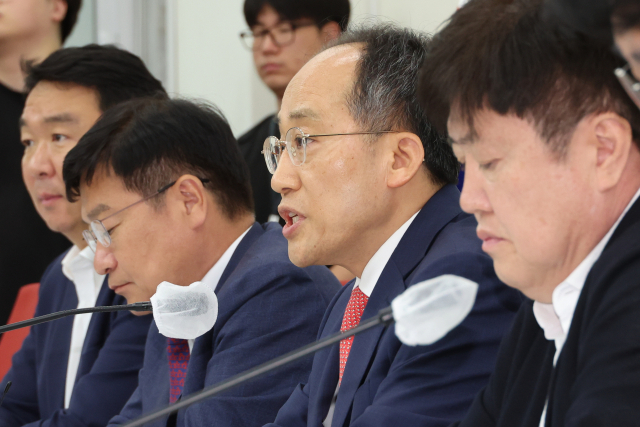
Choo Kyung-ho, floor leader of the People Power Party, speaks at a press conference on current issues including the pension reform plan, held at the National Assembly in Yeouido, Seoul, on the afternoon of the 26th. Yonhap News
▷Lee Dong-jae: But in the National Pension public deliberation committee, 56% of the citizen representatives—more than half—chose the option of a 13% contribution rate and raising the income replacement rate to 50%. Why did the survey produce this result?
▶Yun Suk-myung: I am afraid of being criticized for this, so please do not cut what I am about to say. Young people are furious. They are seething. I went into young people’s online communities. Looking there, this is what they say about that result: it is the result of putting 500 people in a room for a few days and gaslighting them. Why do they say so? Why do these citizens go to a public deliberation committee and learn? Why do they study? Is it not because, if we leave our system as it is, it is dangerous and future generations, young generations, will suffer too much—so they are made to study in order to speak on behalf of future generations who are not yet born and those under 18 who have no vote? Then would it not be normal for them to come to accept, at least a little, the painful things they thought hard to accept before studying? Is that not why there is public deliberation and learning? Yet somehow, before the learning, the share of respondents saying the system should be fixed so as to shift less pain onto future generations was higher, but after the learning, support for passing more of the burden onto future generations rose by 1%, from about 19%. So they say they were gaslighted. Key information was left out of what they were told. Because—we did public deliberation in the UK’s manner; it seems we said we were benchmarking it. The UK differs from us decisively in three respects. Here is some candid advice I offer so that our President Yoon Suk-yeol, who is crying out a great deal about pensions, pays a little more attention: after pension reform discussions began in the UK, Prime Minister Blair made sure to attend to pension reform work for five or six hours a week until the end. Next, what is more important is that before the public deliberation committee was launched, very objective experts produced an objective fact report on the reality facing British pensions. Citizens studied it and began deliberating, but here the citizen representatives were made to study materials made however it liked by the side arguing that the income replacement rate can be raised to 50%, while the materials made by the side arguing that 40% must be maintained were widely criticized, I hear, as having been made carelessly. They had them study—so they had them study without verifying whether the content was right or wrong. To tell you what they asked—let me tell you one more thing about the UK. In the UK, the survey questions were all organically linked. If we do not reform now, it will be painful later; if we do not reform now, you will receive a smaller pension later; if we do not reform now, you will have to pay enormous contributions later. They linked it up like that. But what we asked was: compared with now, you can receive 10 percentage points more, a 50% income replacement rate, by paying just 1 percentage point more in contributions than the other option. And they said that even then the fund depletion date differs by only one year. So, our two hosts, if you were being normal, would you take the option of a 50% income replacement rate with 13% contributions, or the option of a 40% income replacement rate with 12% contributions?
▷Lee Dong-jae: The one that pays more, of course?
▶Yun Suk-myung: Exactly. That is why people say they were gaslighted through distortion.
▷Lee Dong-jae: Many young people around me say things like this. They even argue: I would rather just give up what I have paid so far, so can I not just stop paying and stop receiving? They say they will give up what they have paid so far—how do you see this? Given this reaction from young people, is it right to keep the pension going to the end, all the same?
▶Yun Suk-myung: The insurance has to go on. Because when you are young, you see the whole world optimistically. But once you are in your 50s, the future starts to look rather pessimistic. Since you do not have much of your working life left, you start to feel in your bones how you will live the rest of your old age. But in your early 20s or early 30s, it is: no use, it is a bother, it annoys me, do not interfere, I will take care of my own life. This—why the state intervenes like this is called “paternalism” in English. Politicians would not like hearing this either. Benevolent paternalism, or in the past it was even called patriarchalism. The point is that you live life only once. Do you two hosts like a drink?
▷Lee Dong-jae: She does not seem to like it much, but I drink now and then.
▶Yun Suk-myung: If you drink too much, the next day your body suffers and your head aches, and you feel it. Even so you do not fix it, but you can do that hundreds or thousands of times over a lifetime. Preparing for old age, though, you can do only once in your life. If you do not do it when you are young, that is the end. So it is: I have lived it first, so I know—when you get old there is no chance. So the state simply makes you save by force, what is called compulsory savings.
▷Lee Dong-jae: Do not go YOLO—put the money into savings.
▶Yun Suk-myung: Saving does not happen after you have spent everything, so set it aside first and spend the rest. But when I was young, too, if someone interfered I would think, why interfere, I will manage just fine on my own. In that sense, why do other countries run compulsory public pension systems? The intent is good. It is just that it has not been run properly. Let me add just one more thing: now in Yeouido and on every broadcast they are saying accept it quickly. The two of you should feel anger at this. They say let us reform, but then, people like me who have paid little and received a lot so far—what pain are we sharing? I do not pay any more contributions. I only receive.
▷Lee Dong-jae: I envy you.
▶Yun Suk-myung: Yet young people are told to pay more contributions without even knowing whether they will receive more, so it gets to the point where they say: let us fold, I will just consider what I have paid so far a donation to somewhere. Then there is Germany. In 2004, through the Hartz reforms, Chancellor Schröder carried out a revolutionary pension reform, and the person who led it was Bert Rürup. Rürup. The proposition he put to the German people was this: why must we reform pensions? There is a lot of talk now about intergenerational equity. Some say it is fine for us to receive more pension. That our generation, the 586 generation, supported our parents and our children, built the infrastructure, built the airport on Yeongjong Island and the Gyeongbu Expressway, so you do not have to do all that—so do not feel bad that we receive more pension now. I am strongly opposed to people who say such things—I have gone off on a tangent; what was I talking about?
▷Lee Dong-jae: Our time is limited, so just a couple more questions.
▶Yun Suk-myung: So this is a continuation: the elderly poverty rate is approaching 40%. So the National Pension is functioning as a safety net for older people in the current situation, and there is an outlook that if structural reform reduces it, it will ultimately be hard to solve poverty.
▷Lee Dong-jae: Would solving elderly poverty not be rather difficult?
▶Yun Suk-myung: That too is gaslighting. Two things. First, elderly poverty—the core of our country’s elderly poverty. Look. People who own good buildings in Gangnam—excluding famous entertainers, excluding the “golden spoon” set—are mostly older people, are they not? The core of our country’s elderly poverty is the polarization of older people’s incomes. Among older people, the richest in our country make up a group of, for example, about 30%. And those in our entire population who truly struggle, pulling handcarts and collecting scrap paper just to survive, are about 25% of all older people. But the pension issue now is this: we are raising the income replacement rate, right? Yes. Say we raise it by 10 [points] in the name of strengthening the public side. For someone who enters the labor market and joins the National Pension to see the effect, 40 years must pass. The National Pension system and our elderly poverty problem are completely different problems. If you raise the income replacement rate, can people who could not join the National Pension because they have no income now receive more pension? This hands an enormous burden to later generations while giving more benefits to those with good jobs and high salaries. This too is gaslighting. There is no conflict at all between elderly poverty and pension reform.
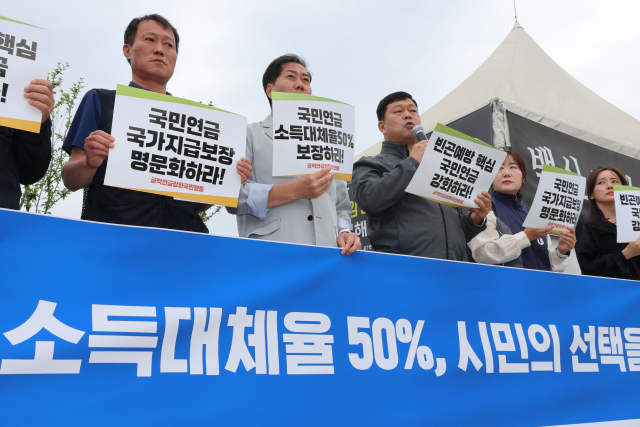
Officials of the Public Pension Strengthening People’s Action hold a press conference in front of the National Assembly in Yeouido, Seoul, on the afternoon of the 26th, urging implementation of a pension reform that strengthens old-age income security with a 50% income replacement rate, the option chosen by a majority of citizens in the citizen deliberation process of the National Assembly Special Committee on Pension Reform. Yonhap News
▷Lee Dong-jae: Then, recently, there has been talk in political circles of dividing pensions into stages by generation—a new pension and an old pension—injecting fiscal funds into the old pension and running the new pension separately for young people. Many such proposals are coming out. Do you see this as realistic?
▶Yun Suk-myung: First of all, that specific approach is similar to the Swedish approach. Sweden is a byword for welfare. Sweden already did that in 1998. Indeed. Even if we do it now, we would be doing it 25 or 26 years later. Yes, but to do that there is a precondition. In the pension system—earlier I said the balanced contribution rate is 19.8%, right? Whatever structural reform or parametric reform you do, to do it properly you have to balance the money coming in and going out. But because we collect far too little in contributions—to pay pensions at our level, contributions of about 18% to 20% must be collected. Since we collect about half of that—what the KDI side is arguing now is 609 trillion, is it not? Yes, they say pay that off with national debt, cut it off and move to a new type, but even moving to a new pension with 9% contributions, the pension amounts are not large. With double that, pensions could be paid at a reasonable level. So at some point we need to move that way quickly. Because 70% of those in their 50s are running a system that pays what you put in. That new pension means paying out as much as you put in. Without building up reserves, we now set it so that no matter how much you pay, we will unconditionally pay this much—so is that not why people say it cannot be fixed? So we must go that way. Now the problem is this: however much we want to go, the path we are on now is—since this is a Maeil broadcast—it is like heading to Jeonju on the Honam Expressway and suddenly saying let us go to Daegu on the Gyeongbu Expressway. Pension and welfare systems have path dependence, so they cannot suddenly jump somewhere else. So what I have kept proposing for 10 years is that, in terms of our path dependence, it would be good for us to go in two steps. Yes, so first, our contributions are 9%. Even KDI, even those who argue for that approach, say contributions must be raised to 15.5%. But even now, while raising the income replacement rate further, they say they can only raise contributions to 13%, right? Yes, it must be raised to 15.5%, so realistically it is not easy. Young people would say, would they not: what scam is this, telling us to pay double again? So what I propose is this: now people talk about parametric reform and structural reform, but to do structural reform properly, parametric reform must first be done properly. And to avoid deterioration, the income replacement rate must not go up by even 0.1 percentage point from 40%. Raising it by even 0.1 percentage point is unconditionally deterioration. That is because of the balanced contribution rate I mentioned earlier. So to divide into new and old pensions, I think we need to go through one intermediate step. Since they say they have reached a historic agreement, freeze the income replacement rate at 40%. Then please raise contributions only to 13%. Leave benefits as they are. If we can get to that point, moving on to structural reform, to the new pension, is not very difficult. We can move over very easily.
▷Lee Dong-jae: How do we reach social consensus, then? Honestly, even 10,000 won is dear to ordinary people.
▶Yun Suk-myung: When the Roh Moo-hyun administration reformed pensions in 2007, I had been working on the financial projection since 2003. The results were submitted to the National Assembly. Population and socioeconomic conditions were much better then than now, were they not? Even then, it showed that to pay a 40% income replacement rate, contributions of 12% would have to be collected. How much worse has it become since? Now far more contributions must be collected. But people now seem to think the 2007 Roh Moo-hyun administration’s pension reform just happened by itself. How was it done—how was it possible? The minister of health and welfare and the president at the time said this whenever they had a moment, to the press and the public: every day our pension reform is delayed, the pension debt grows by 80 billion won, handing a debt bomb to the grandchildren we treasure like gold. 80 billion a day. Even then: this is not something we should do. The president and the minister of health and welfare said this to the press every day. That is how. About what is happening in our country now, what is being said among experts is: why do you treasure your own children and grandchildren like gold while telling everyone else’s children to take on this debt bomb? So my point is this: in any country—and what I especially want to ask of President Yoon Suk-yeol is—rather than thinking about and striving for how to reform, [first make clear] what the reality of our National Pension, Government Employees, Private School Teachers, and Military Pensions is—the cumulative deficit, the unfunded liability I mentioned. Yes, they do not disclose it. There is nothing. Disclose it transparently, that is what I am saying.
▷Kim Sae-bom: Like the birth-rate status board—put up a pension status board, urgently.
▶Yun Suk-myung: Yes, yes. A status board. Many people now say we should raise the income tax on 100 million won further. It came up at the Press Center last time too. Since our country cannot make it unless the fertility rate goes up, there is no choice but to go [that way]. Is that not hope torture? Right. Do you think the fertility rate will go up? It is not going up. If it does not, then, as I said earlier, even raising contributions to 15% and keeping a 40% income replacement rate would not achieve fiscal stabilization, right? What do you think the fertility rate assumed there is? Our host?
▷Lee Dong-jae: Would it be about 1.0?
▶Yun Suk-myung: Wrong. They assumed it would rise to 1.21.
▷Lee Dong-jae: When it is about 0.6 now.
▶Yun Suk-myung: It is falling into the 0.6 range, is it not? Then what our President should do—the opposition leader keeps saying it too—is say: fine. Let us push this properly and look at it together with the public, to see which direction is right. For 20 years, 25 years, I have been crying out that pension reform is extremely urgent. But the last thing I want to say today, appearing on this YouTube program, is this: however urgent pension reform may be, if the direction of reform is wrong, it is worse than not doing it at all. What is being discussed in the Yeouido political sphere now is, among deterioration plans worse than doing nothing, a deterioration plan of the very worst kind. I think it would be good if Yongsan, and also floor leader Choo Kyung-ho, made this public with confidence.
▷Lee Dong-jae: Then today’s article headline is settled: better not to accept a reform that is worse than none. Open everything up.
▶Yun Suk-myung: Accept it and you become a historical accomplice.
▷Lee Dong-jae: Since accepting it makes you a historical accomplice, disclose the current state of everything and start in a way that clears the air.
▶Yun Suk-myung: I have written it in a column. What comes out in today’s, tomorrow’s edition says that the small group of forces leading this will surely be put before the judgment of history. Even if we do not do it, the angry MZ generation will surely judge them. That is what I wrote in my column.
▷Lee Dong-jae: I see. Finally—tomorrow you are holding a press conference, are you not?
▶Yun Suk-myung: Our Pension Future Forum has prepared it very ambitiously. From 10:00 a.m. tomorrow at the Franciscan Center in Jeong-dong, our aces will take the field with eight presentations, and we will have five discussants. We hope for a lot of interest.
▷Lee Dong-jae: I see. We would be grateful if our viewers also take a strong interest.
I think this pension issue is truly a serious problem.
▶Yun Suk-myung: Thank you for having me.
▷Lee Dong-jae: Thank you as well. That was News Cabinet with Yun Suk-myung, Research Fellow Emeritus at the Korea Institute for Health and Social Affairs. That is all for today’s News Cabinet. Please be sure to subscribe, like, and turn on notifications, and please take a strong interest in pensions too. News Cabinet will be back tomorrow at 6:30 p.m. Thank you.